
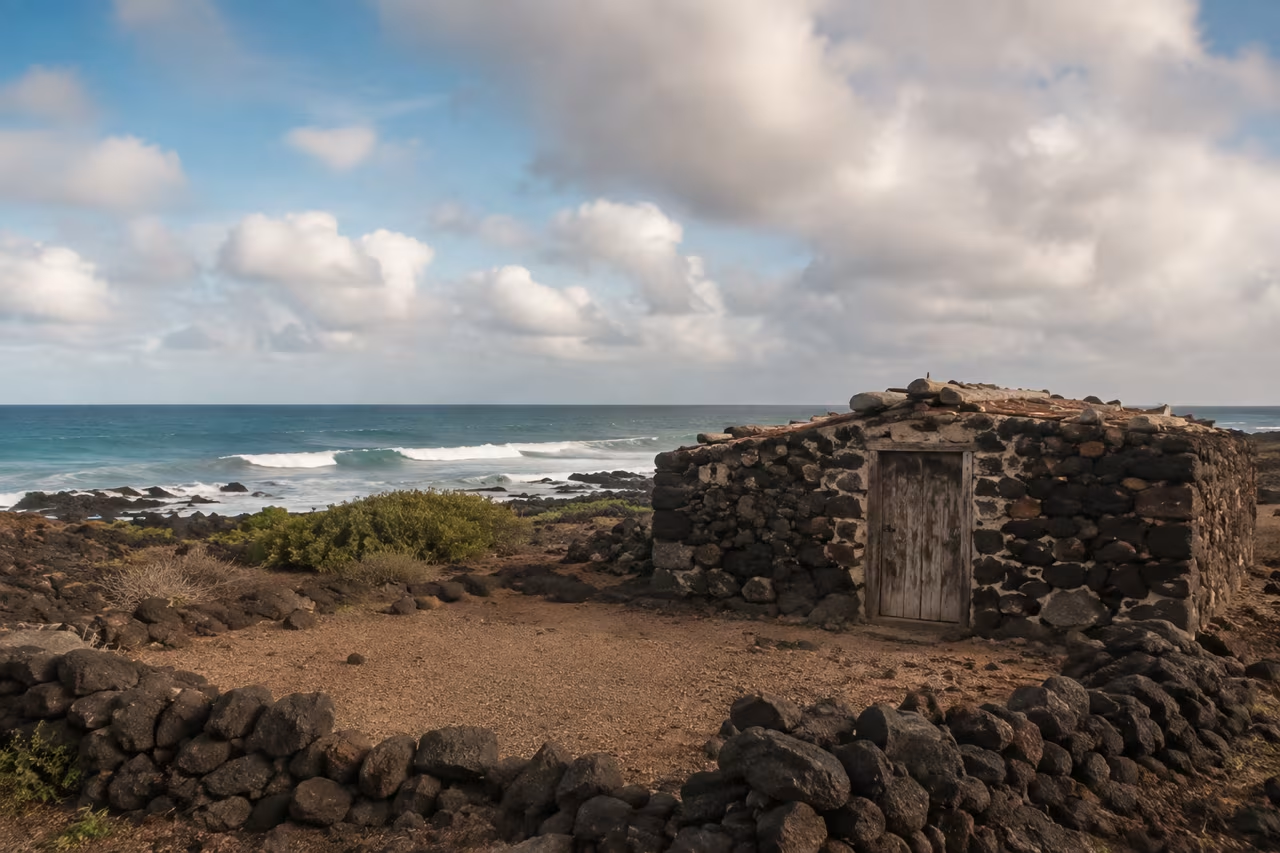

Lanzarote Coastal Row: Environmentalists Question Treatment of Historic Seifío Hut and Papagayo Arena
Environmentalists in Lanzarote are questioning what they describe as a double standard in the way coastal buildings are being treated, after the planned demolition of a traditional hut at Playa de Seifío was halted at the last minute.
A long-running debate over Lanzarote’s coastline, planning regulations and the Law of Coasts has come back into the spotlight this week, with attention focused on a small traditional coastal building in the municipality of Haría.
The structure, locally known as the “Choza de los Barcos”, at Playa de Seifío, had been due to be demolished by order of the Directorate General of the Coast. However, on Friday 28 August, a group of around 50 people gathered at the site as a demonstration against the planned demolition.
The demolition was subsequently put on hold after the owner submitted an administrative appeal against the order.
What is happening at Playa de Seifío?
The traditional hut is located at Playa de Seifío on the northern coast of Lanzarote, in Haría.
According to Ecologistas en Acción Lanzarote, the building is almost a century old and formed part of the island’s traditional coastal way of life. The environmental organisation argues that these types of structures were not simply buildings, but part of the relationship between Lanzarote’s rural communities and the sea.
They were historically used for activities including storing boats, sheltering from the elements, drying fish and other traditional coastal activities.
The organisation says the building should be considered as part of Lanzarote’s ethnographic heritage, rather than being treated simply as an unauthorised structure within the coastal protection zone.
Ecologistas en Acción has called for traditional coastal huts of this type to be catalogued as Bien Etnográfico, while suggesting that they could potentially have practical uses such as supporting fishing activities, providing shelter for walkers and helping preserve Lanzarote’s maritime heritage.
The demolition is not happening – for now
Although machinery had reportedly been brought to the area ready for the demolition, the operation was stopped after the owner appealed the administrative order.
A representative of the coastal authority told those gathered at the site that the hut would not be demolished during August while the appeal is being dealt with.
That means the immediate situation has changed significantly from the original expectation that the structure would be removed on Friday.
The dispute, however, is far from over.
Why are environmentalists talking about the Papagayo Arena?
The controversy has become particularly significant because Ecologistas en Acción is comparing the treatment of the Seifío hut with the long-running planning and legal problems surrounding the Papagayo Arena hotel in Playa Blanca.
The hotel, now known as Sandos Papagayo, has been the subject of legal proceedings for many years.
The history goes back to the late 1990s, when the hotel’s construction licences were granted by Yaiza. Those licences were subsequently challenged and annulled by the courts. A 2007 ruling by the Tribunal Superior de Justicia de Canarias (TSJC) annulled the relevant construction licences.
The legal problems have continued for years, with the courts examining issues including the hotel’s occupation of a public pedestrian route providing access towards the coast and other planning matters.
In 2022, a court in Las Palmas determined that the hotel’s planning breaches could not be legalised under the circumstances then before the court, putting the building at risk of demolition.
The hotel has around 700-plus tourist places
The size of the Papagayo Arena is one reason why the case has attracted so much attention.
Historical documentation puts the complex at around 746-747 tourist places, although the number cited can vary depending on the particular stage of the planning and authorisation process. A 2024 Cabildo document referred to 746 accommodation places.
The hotel therefore represents a very different scale from a traditional coastal hut.
That difference is central to the argument now being made by environmental campaigners.
Was the Papagayo Arena actually given permission to stay?
This is where the story needs some clarification.
In August 2024, the Cabildo de Lanzarote began the process for a provisional tourist authorisation for the hotel, following a ruling by the TSJC concerning the administration’s handling of the hotel’s tourism authorisation.
However, this was not the same thing as a blanket legalisation of the building.
The Cabildo stated that the provisional tourist authorisation was subject to the hotel obtaining the necessary urban planning licence from Yaiza and the required authorisation from Costas.
Yaiza subsequently clarified that the process could not simply move forward without those requirements being satisfied.
There is another important factor: in July 2024, the coastal protection boundary affecting the area around Playa Blanca was revised, with the protected coastal servitude being established at 100 metres rather than 20 metres in the relevant area. That added another complication to the hotel’s planning situation.
More recently, the situation has continued to be discussed at municipal level. During a Yaiza council meeting in April 2026, the mayor described ongoing works relating to new public access routes towards the sea around the Las Coloradas area and discussed the wider planning history of the Papagayo Arena.
So it would be misleading to say simply that “the hotel has been legalised” or that it has received an unconditional permission to remain.
The situation remains considerably more complicated.
Why environmentalists say there is a “double standard”
Ecologistas en Acción Lanzarote argues that the contrast is difficult to understand.
On one side is a traditional coastal hut which the organisation says has around 100 years of cultural and historical significance and which was associated with traditional fishing and rural activities.
On the other is a large tourist complex which has been involved in a lengthy series of legal and planning proceedings.
The environmental group argues that the authorities are applying the Ley de Costas and coastal protection rules particularly harshly to traditional structures while large tourism developments have been able to remain in operation while their legal situations are addressed.
That is the environmentalists’ argument, rather than an established legal finding that the authorities have actually applied the law inconsistently.
And that distinction is important.
The two cases involve very different planning histories, ownership arrangements, court proceedings and administrative procedures. Whether they represent a genuine “double standard” is therefore a matter of political and environmental debate rather than something that has been established by a court.
A wider debate about Lanzarote’s coastline
The dispute touches on a much bigger issue for the island.
Lanzarote’s coastline is protected by a complex mixture of environmental, planning and coastal legislation. The Law of Coasts regulates the public maritime-terrestrial domain and establishes restrictions designed to protect coastal areas and guarantee public access.
At the same time, Lanzarote has a remarkable collection of traditional coastal structures, fishing settlements and buildings connected with the island’s historic way of life.
That creates a difficult question:
How should Lanzarote protect its coastline while also preserving the cultural heritage created by the people who historically lived and worked along it?
That question is becoming increasingly relevant as coastal protection rules are applied to older buildings and traditional settlements.
For residents, the issue is about much more than tourism.
For visitors, meanwhile, these traditional structures are part of the character and history that make Lanzarote different from a conventional beach holiday destination.
What happens next at Seifío?
For now, the immediate threat of demolition has been paused.
The owner of the Seifío hut has lodged an administrative appeal, meaning the authorities must now consider that challenge before the demolition can proceed.
Environmental campaigners want the authorities to go further and consider whether the hut and similar structures can receive formal protection as part of Lanzarote’s ethnographic heritage.
The outcome could potentially have implications beyond this single building, particularly if other traditional coastal huts face similar issues under the Dominio Público Marítimo-Terrestre (DPMT) rules.
For now, however, the “Choza de los Barcos” remains standing.
