Diving in Lanzarote
Lanzarote is one of Europe's top diving destinations with year-round warm water, volcanic reefs, angel sharks and the Museo Atlantico underwater museum. Full guide to dive sites, PADI courses and centres.
Lanzarote has long been a favourite among divers, and it is easy to see why. Thanks to the Canary Current, our waters are rich with life, supporting a wonderful variety of marine creatures that you might not expect to find in a subtropical spot. The sea here is inviting year-round, with temperatures ranging from a refreshing 18 degrees in winter to a balmy 24 degrees by late summer. Visibility is often superb, and the volcanic seabed creates an underwater landscape that is truly unique to our island.
As a UNESCO Biosphere Reserve, Lanzarote’s coastline is carefully protected, which means our marine life continues to thrive. Whether you are just starting out or have years of diving experience, you will find something special waiting for you beneath the surface.


Sponsored
Why Lanzarote is a world-class dive destination
There are so many reasons why Lanzarote is such a special place for divers. The volcanic landscape has shaped the underwater world here, creating a playground of walls, arches, caves and lava tubes that you could spend a lifetime exploring. Because there are no rivers on the island, the water stays beautifully clear, with visibility often reaching 30 metres or more, especially along the south and east coasts. The sea is inviting all year round, with water temperatures that mean you can dive comfortably in a 5mm wetsuit in winter and a lighter one in summer. Tides are gentle, so conditions are usually easy to predict and plan for.
Thanks to the Canary Current, you never quite know what you might see – from colourful Atlantic reef fish to passing pelagics and unique local species, all on the same dive. One of the things we love most is that many of the best dive sites are right off the shore, so you can enjoy world-class diving without the need for expensive boat trips.
Playa Chica and the Puerto del Carmen reef
Playa Chica is a real favourite among divers here on Lanzarote, and with good reason. Tucked away in the heart of Puerto del Carmen’s old town, this sheltered little cove offers easy access to a volcanic reef that begins just a few steps from the shore. The shallow waters are ideal if you are new to diving or just want to try a Discover Scuba session, with sandy patches between the rocks where you might spot cuttlefish, octopus and lively schools of damselfish. As you venture a little deeper, the landscape becomes more dramatic, with overhangs, small swim-throughs and fields of black volcanic boulders.
If you are lucky, you may see angel sharks resting quietly on the sand at around 15 to 20 metres. Further down, barracuda, rays and the occasional large stingray glide through the deeper water. Night dives at Playa Chica are something special. Once the sun sets, the reef is transformed as moray eels leave their hiding places, octopus begin to hunt, and shrimp and crabs scuttle across the rocks. Local dive centres organise regular night dives each week, so there are plenty of opportunities to experience this magical underwater world after dark.
Museo Atlantico Diving Attraction in Playa Blanca
The Museo Atlantico is one of those Lanzarote experiences that stays with you long after you leave the water. As Europe's only underwater sculpture museum, it sits quietly off the coast near Playa Blanca, in the south of the island I have called home for many years. Created by British artist Jason deCaires Taylor and opened in 2016, the museum rests about 12 metres below the surface on a sandy seabed, making it accessible even if you are new to diving or joining a Discover Scuba session with an instructor.
There are over 300 life-sized figures arranged in thoughtful installations. Some, like The Raft of Lampedusa, reflect on the migration stories that touch Europe, while others capture everyday moments; people taking selfies, sitting at desks, or simply walking together in a circle. The sculptures are made from special pH-neutral cement that encourages marine life, and after several years beneath the waves, they have become home to algae, barnacles, small corals and curious fish weaving between the figures. The result is both haunting and beautiful, and there is a real sense of peace as you drift among them.
To visit, you will need to book through a local dive centre, as the site is protected and not open to independent divers. Certified divers can expect to pay around 50 to 60 euros for a single dive, while beginners can join a Discover Scuba experience for about 80 to 100 euros. If you prefer to stay on the surface, snorkelling trips are also available, though I always think the magic is strongest when you see the sculptures up close.
Mala, the north coast and advanced sites
The stretch of coastline around Mala, tucked between Arrieta and Orzola on Lanzarote’s north coast, is home to some of the island’s most breathtaking underwater landscapes. Here, you’ll find dramatic volcanic arches, deep caverns and sheer walls that seem to disappear into the blue. One of my favourite spots is The Cathedral, a remarkable chamber with a vaulted ceiling where sunlight pours in from above, casting a magical glow that truly lives up to its name. Not far away, Richie's Place, named for a much-loved local dive guide, offers a maze of swim-throughs and tunnels for those with a sense of adventure.
These northern sites are best explored by boat and are generally suited to divers with a bit more experience, as the depths and occasional currents can be challenging. Over on the northwest coast, La Santa is known for its rocky seabed and the abundance of marine life that gathers in the sheltered nooks—angel sharks and rays are regular visitors here. If you prefer a quieter spot, Charco del Palo on the east coast is easily reached from shore and its rocky reef is often alive with parrotfish, trumpet fish and, if you’re lucky, a passing turtle. Even in the heart of Puerto del Carmen, the old harbour wall has become a haven for marine life, with colourful nudibranchs, seahorses, moray eels and shoals of bream making their home among the rocks.
Marine life in Lanzarote
For many divers, the real highlight of exploring Lanzarote’s underwater world is the chance to see an angel shark. These remarkable, flat-bodied sharks are now sadly rare in most of their former home waters, but here in Lanzarote and across the Canary Islands, they still find sanctuary. It’s always a thrill to spot one resting quietly on the sandy seabed, especially around Playa Chica or near Playa Blanca, where sightings are fairly common throughout the year.
Our local dive centres are passionate about protecting these gentle creatures, and every diver is carefully briefed on how to observe them respectfully. Of course, angel sharks are just the beginning. The marine life here is wonderfully diverse. You might find yourself surrounded by a swirling school of barracuda, or peering into a rocky crevice to spot a moray eel, sometimes a small brown one in the shallows, sometimes a larger black moray deeper down. Cuttlefish are a constant delight, changing colour and texture as they glide by. Stingrays and butterfly rays drift gracefully over the sand, while octopus, always a favourite, can often be seen during the day, though they are even more active after dark. Trumpet fish hang motionless among the rocks, blending in with the seaweed, and the reefs are alive with colourful parrotfish, wrasse, damselfish, bream and grouper. In recent years, green turtles have become a more regular sight around Playa Blanca, perhaps thanks to the warmer waters.
And if you are very lucky, you might even catch a glimpse of a hammerhead shark out in the deeper southern waters, though these encounters are rare and always a special treat.
PADI courses and learning to dive in Lanzarote
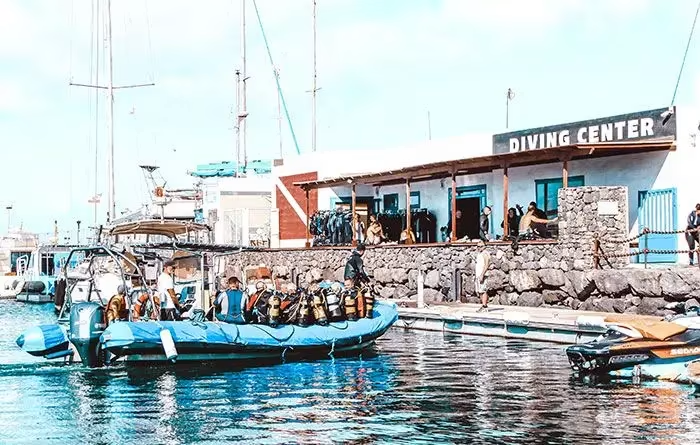
Lanzarote is a wonderful place to take your first breaths underwater. Thanks to the island’s calm, clear waters, learning to dive here is a relaxed and enjoyable experience, with instructors able to focus on helping you build confidence at your own pace. You’ll find at least a couple of friendly, PADI-affiliated dive centres in every resort, and many also offer SSI and BSAC courses.
If you’re curious to give it a go, the Discover Scuba Diving experience is a great introduction. It’s a half-day session that starts with some gentle training in the pool or shallow water, followed by a supervised open water dive to a maximum of 12 metres. Prices usually range from 50 to 80 euros. For those who want to take things further, the PADI Open Water Diver course takes three to four days and includes theory, pool skills and four open water dives, with prices typically between 300 and 400 euros.
The Advanced Open Water course adds another two days and five dives, including navigation, deep diving and a choice of specialities. Qualified divers can enjoy fun dives from around 35 to 50 euros per dive, with discounts if you book a package. Most centres also offer Nitrox for a small extra charge. If you’re thinking about a career in diving, several of the larger centres run full Divemaster and Instructor Development courses, so you can take your passion to the next level right here on the island.
Night diving in Lanzarote
Night diving here in Lanzarote is a magical experience that reveals a side of the reef most people never see. As darkness falls, the volcanic rocks seem to come alive in the glow of your torch, and creatures that hide away during the day begin to emerge.
Playa Chica is a favourite spot for night dives, thanks to its easy access and the way the reef starts close to shore in shallow water. With a torch in hand, you can drift along at around 8 to 15 metres, watching moray eels hunting, octopus gliding across the rocks, and parrotfish tucked up for the night in their delicate cocoons. The real treat comes when you switch off your torch for a moment and wave your hand through the water, sometimes sparking a display of bioluminescence. Most local dive centres offer night dives, usually starting at dusk and finishing in full darkness, with prices generally between 40 and 55 euros.
Snorkelling in Lanzarote for non-divers
If diving is not quite your thing, there is still plenty to enjoy beneath Lanzarote’s surface. Playa Chica is a favourite spot of ours for snorkelling, with colourful fish often visible even in the shallows.
Families tend to enjoy the rocky edges of Playa de Jablillo in Costa Teguise, where little ones can spot small fish and crabs in the rock pools. Down in the Papagayo coves, just south of Playa Blanca, the water is beautifully clear over both sand and rocks, making it a lovely place to explore with a mask and snorkel.
You will find snorkelling gear for hire at most beach resorts, usually for a very reasonable daily rate, or you can pick up your own set at local supermarkets and beach shops. For something a little different, guided snorkelling trips to the Museo Atlantico are also available, allowing you to discover the underwater sculptures without needing to dive.
Accessibility and adaptive diving
Lanzarote is a wonderful place for adaptive diving, and over the years the island has developed a welcoming programme for people with physical disabilities. Several local dive centres are well equipped and have trained instructors ready to help wheelchair users and those with reduced mobility discover the magic beneath our waters. The Handisport Lanzarote initiative, along with centres that have HSA-trained staff, offer specialist equipment such as hoists, adapted entry points and personal support in the water.
Playa Chica is a favourite spot for adaptive diving, thanks to its easy, flat access from the car park and a reef that begins in shallow water, making it much simpler to get started. One of the joys of diving here is that the feeling of weightlessness means many physical disabilities matter far less once you are underwater. If you or someone you know would like to give diving a try, I recommend getting in touch with the dive centres ah
ead of time to talk through any requirements. In my experience, most are more than happy to help if you give them a little notice.