Castillo de San Gabriel in Arrecife
Complete guide to Castillo de San Gabriel in Arrecife, Lanzarote. History of the fortress, Puente de las Bolas bridge, museum, visiting times, photography tips and nearby attractions.
Castillo de San Gabriel sits on its own little islet just off the Arrecife waterfront, and it is one of those sights that always catches the eye, no matter how many times you pass by. The old stone bridge, Puente de las Bolas, links it to the mainland, with its two cannonball finials marking the way. This sturdy fortress has been keeping watch over Arrecife for almost five centuries, and it remains a favourite spot for both locals and visitors alike.
For me, this is one of those places that never loses its charm, no matter how often I visit. There is a special feeling as you cross the bridge with the Atlantic swirling below, the breeze in your hair, and the golden walls of the castle standing out against the blue sky. Whether you are drawn by history, architecture, or just fancy a peaceful walk along the Arrecife seafront, Castillo de San Gabriel is a spot I always recommend. Many visitors miss it, but it is well worth seeking out.
A Brief History of the Fortress
The story of this site begins back in the 1570s, when King Felipe II of Spain realised that Arrecife’s natural harbour made it a tempting target for pirates. In those days, the Canary Islands were often at the mercy of raiders, and the first fort here was a modest wooden structure. It did not last long. In 1586, Algerian corsairs led by Morato Arráez swept in, set the fort alight, and ransacked the town, taking captives and leaving no doubt that stronger defences were needed.
After that dramatic raid, the fort was rebuilt in stone by Leonardo Torriani, an Italian engineer who left his mark on many of the Canary Islands. He designed the sturdy, square fortress with its thick basalt walls and watchtowers that still stand today, completed around 1590. The Puente de las Bolas drawbridge was added as a clever way to cut the castle off from the mainland if trouble arrived.
The bridge gets its name from the two stone balls, or bolas, perched on pillars at the mainland end. These have become a favourite photo spot for visitors to Arrecife. Over the years, the castle has served as a garrison, a weapons store, and a lookout post. Once the days of pirate raids faded in the 18th century, the old fortress slowly slipped into quieter times.
Castillo de San Gabriel Architecture
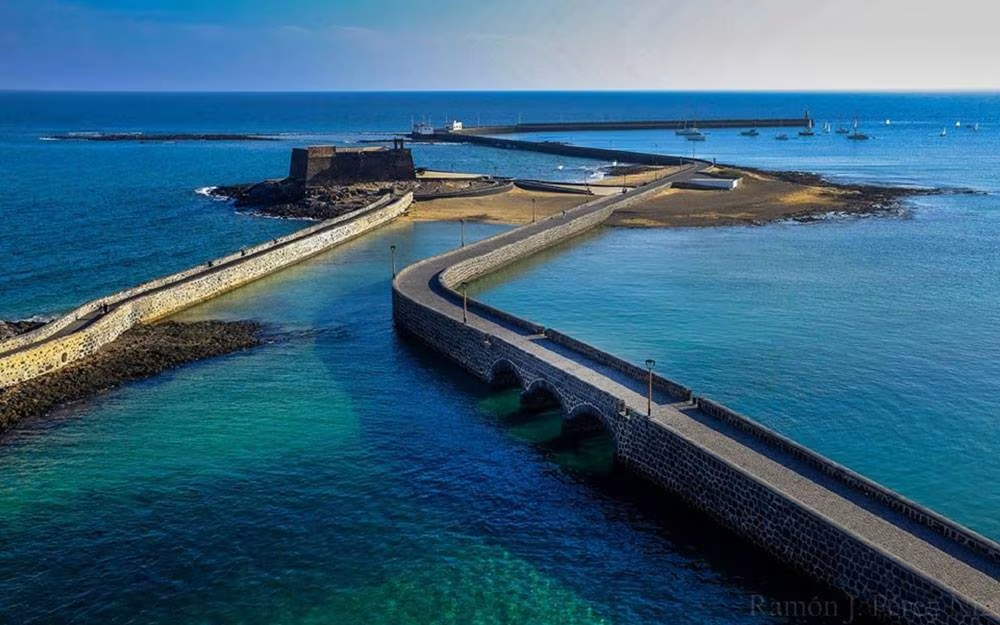
Castillo de San Gabriel is one of those places that feels woven into the very fabric of Lanzarote. Built in the 16th century, its sturdy basalt walls have stood for centuries, their golden-grey tones catching the afternoon sun in a way that always stops us in our tracks. The fortress is compact and practical, with rounded turrets at each corner and thick walls that once kept watch over the harbour. You will notice the arrow slits and small windows dotted along the walls, and the main entrance still faces the old drawbridge, just as it has for generations.
Step inside and you will find the fortress is smaller than you might expect, but perfectly in keeping with its purpose. The thick stone walls keep things cool, even when the Lanzarote sun is at its hottest, and the vaulted rooms have a simple, honest charm. The restoration work has been done with real care, so the building still feels authentic and true to its history. Climb up to the roof terrace and you are rewarded with some of the best views in Arrecife. From up here, you can take in the whole waterfront, the Charco de San Ginés lagoon, the busy port, and on a clear day, even spot Fuerteventura and Lobos shimmering on the horizon. It is a spot we always recommend to visitors.
Inside The Castillo de San Gabriel Museum
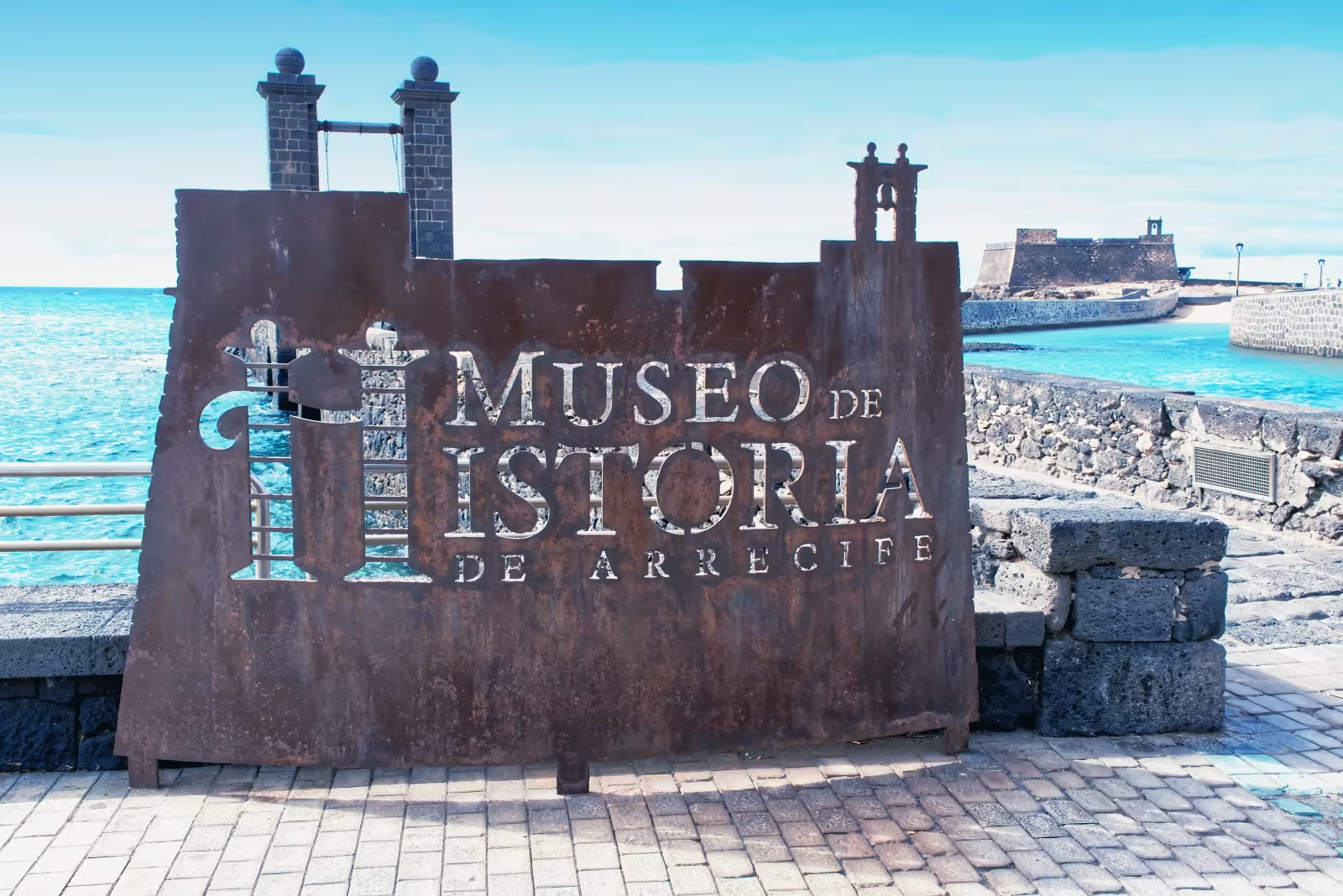
These days, the Castillo de San Gabriel is home to the Museo de Historia de Arrecife, a small but fascinating museum that tells the story of both the town and the island. Inside, you will find archaeological pieces from the days when the Majos were the island’s first inhabitants, as well as artefacts from the Spanish colonial era, maritime treasures, old maps and documents that recall the pirate raids which left their mark on Lanzarote’s past. There are also exhibits about the fishing and salt industries, which kept Arrecife thriving for generations.
It is only fair to say that the museum is quite modest, and the displays are not especially modern or interactive. This is a local history museum, not a grand cultural centre, and some of the information is only in Spanish. But the real magic is in the setting. Wandering through the old stone rooms, where soldiers once kept watch for pirates and stored their gunpowder, you get a real sense of Lanzarote’s past that you simply would not find in a modern gallery.
The entry fee is just a few euros, and in our view, it is worth it for the chance to explore the castle’s interior and enjoy the views from the roof terrace alone. Do be aware that opening hours can be a little unpredictable, especially at weekends or during siesta time, so it is always a good idea to check locally or ask at the tourist office before you set out. Most of the time, the museum is open on weekday mornings and some afternoons from Tuesday to Saturday.
The Puente de las Bolas
The Puente de las Bolas is, in our opinion, even more photogenic than the castle it leads to, and it has become one of those classic Arrecife sights that locals and visitors alike love to capture. This narrow stone bridge links the islet to the mainland, with low walls on either side and the Atlantic often swirling beneath your feet. At the entrance, two sturdy stone pillars topped with round cannon balls give the bridge its name. It was once a drawbridge, raised to keep invaders at bay, but these days it serves as a peaceful walkway for anyone wanting to enjoy the view.
Crossing the Puente de las Bolas is always a treat for the senses. The bridge is open to the elements, so on windy days you might find yourself holding onto the walls as the Atlantic breeze sweeps across. The sound of the waves below adds a touch of drama, and if the sea is rough, you may even feel a little salt spray on your face. When the weather is calm, the water beneath the bridge glows a beautiful turquoise, and if you look closely, you might spot fish or even a small ray gliding through the shallows. We find the bridge especially magical at sunset, when the stones glow golden and the castle stands out against the evening sky. It is one of our favourite spots for a photo, and no matter how many times we visit, we always find something new to enjoy.
Castillo de San Gabriel Photography Tips
The Castillo de San Gabriel and the Puente de las Bolas are places we return to again and again, camera in hand, simply because they are so photogenic. There is something special about the late afternoon here, when the sun sits behind you on the promenade and the stones glow with a gentle golden warmth. Sunset brings its own magic, painting the sky orange and turning the castle and bridge into striking silhouettes against the sea. We have spent many peaceful hours here, just soaking up the changing light.
If you enjoy photography, you will find endless inspiration here. We love wandering along the bridge, sometimes crouching down to capture the way the stone walls lead your eye towards the castle. Climbing up to the castle roof, you are rewarded with sweeping views over the harbour, the town and the ocean beyond. Inside, the museum rooms are quietly beautiful, with sunlight streaming through narrow windows and casting soft pools of light on the old stone floors. Early mornings are especially peaceful, with hardly anyone around and the softest light of the day. And for those who like to see things from above, the view from a drone can be truly breathtaking, showing the islet, bridge and harbour all together.
Exploring the Arrecife Waterfront Nearby
The castle marks the start of one of my favourite waterfront walks in Arrecife, taking you through some of the town’s most charming spots. If you head south from the bridge along Avenida Generalísimo Franco, you’ll soon come across Playa del Reducto, a small beach much loved by locals for its calm, shallow waters. From there, the promenade leads you to the Charco de San Ginés, a tidal lagoon fringed by whitewashed fishermen’s cottages and dotted with small boats gently bobbing on the water. Many people say it feels like a miniature Venice, and I have to agree, especially in the early morning or evening when the still water mirrors the buildings and the whole scene feels wonderfully peaceful.
From the Charco, I like to wander back through the old town’s narrow streets, where you’ll find inviting tapas bars, little shops, and the main pedestrian street, Calle León y Castillo. The whole walk from the castle, around the Charco and back is about two kilometres and usually takes 30 to 40 minutes at a relaxed pace. Of course, it’s easy to linger longer if you pause for a coffee or some tapas along the way, which I always suggest.
If you fancy a longer stroll, you can head north from the castle along the seafront towards the commercial port and the modern Marina Lanzarote. Here, the waterfront restaurants and bars provide a lively, contemporary contrast to the old fortress. Over the years, the Arrecife waterfront has seen some wonderful improvements, and it’s now a truly pleasant place to while away a morning or afternoon.
Practical Information for Visitors to Castillo de San Gabriel
Castillo de San Gabriel sits right on the Arrecife seafront, and it is an easy stroll from anywhere in the town centre. If you are coming by car, you will usually find street parking along the Avenida near the bridge or in the nearby streets, though it can fill up on weekday mornings. The castle itself is a familiar landmark, clearly visible from the main road along the seafront, and the old stone bridge is a feature you simply cannot miss. Entry to the museum is very reasonable, at around 3 euros for adults, with discounts for children and seniors. You are welcome to wander across the bridge and enjoy the views or take photos of the castle exterior at any time, free of charge.
I would suggest allowing about 30 to 45 minutes to explore the museum and take in the views from the roof terrace, and perhaps a little longer if you enjoy taking photos from the bridge. The castle is quite exposed to the elements, so it is wise to bring sunscreen and a hat in the summer months, or a jacket if the wind is up. There are no facilities inside, but you will find plenty of welcoming cafes and restaurants just along the waterfront and around the Charco de San Ginés. Arrecife is the main hub for the island’s bus network, so it is easy to reach by public transport from all the main resorts. If you are planning a trip to Arrecife for shopping or to visit the Charco, the castle is a lovely addition to your day and fits in perfectly with a relaxed morning or afternoon exploring the capital.