Lanzarote Calima
What is a calima in Lanzarote? Learn why Saharan dust clouds reach the Canary Islands, how calima affects daily life, health tips, and what to expect during a calima event.
If you spend enough time here on Lanzarote, sooner or later you will wake up to a sky that just feels out of place. Instead of our familiar, brilliant blue, the horizon is cloaked in a hazy orange or yellow light. The air feels heavy, visibility fades, and a fine layer of dust settles on every surface outdoors. This is what we call calima.
Calima happens when hot, dry winds sweep across from the Sahara Desert, bringing with them dust and sand that travel all the way to the Canary Islands. With the Sahara only about 100 kilometres away at its closest, it does not take much for the dust to reach us. Sometimes calima arrives overnight and disappears within a day or two, but now and then it lingers for most of the week.
The word calima translates to 'haze' in Spanish, which sums it up perfectly. When it is strong, the air turns thick and milky, and you can even taste the dust as you breathe. On the worst days, the mountains all but disappear from view, even if you are standing right on the coast.
Why does Calima happen in Lanzarote?
Most of the time, Lanzarote enjoys a wonderfully comfortable climate, thanks to the trade winds that sweep in from the northeast. These gentle breezes bring fresh, cool air from the Atlantic, which is why the island rarely feels as hot as you might imagine for a place so close to Africa. On the rare occasions when the trade winds drop or change direction, we lose that natural shield.
In their place comes a wave of hot, dusty air from North Africa, carried across by high pressure over the Sahara. Fine dust rises high into the sky and travels west on the breeze. Because Lanzarote and Fuerteventura sit closest to the African coast, we are usually the first to feel the effects, and often the most strongly.
Calima events are most common in summer and late winter.
During the summer, calima can bring intense heat, with temperatures sometimes climbing above 40°C. In winter, these events are usually less fierce, but the air can still fill with dust and visibility drops right down. We do see calima in spring and autumn as well, though it tends to be less common.
What does a Lanzarote Calima feel like?
A calima is something you really feel when you live here. The temperature rises quickly and the air becomes dry, almost parched, with hardly any humidity left. If you spend much time outdoors, you might notice your eyes stinging a little and your throat feeling scratchy. It is one of those Lanzarote moments that most of us would rather do without.
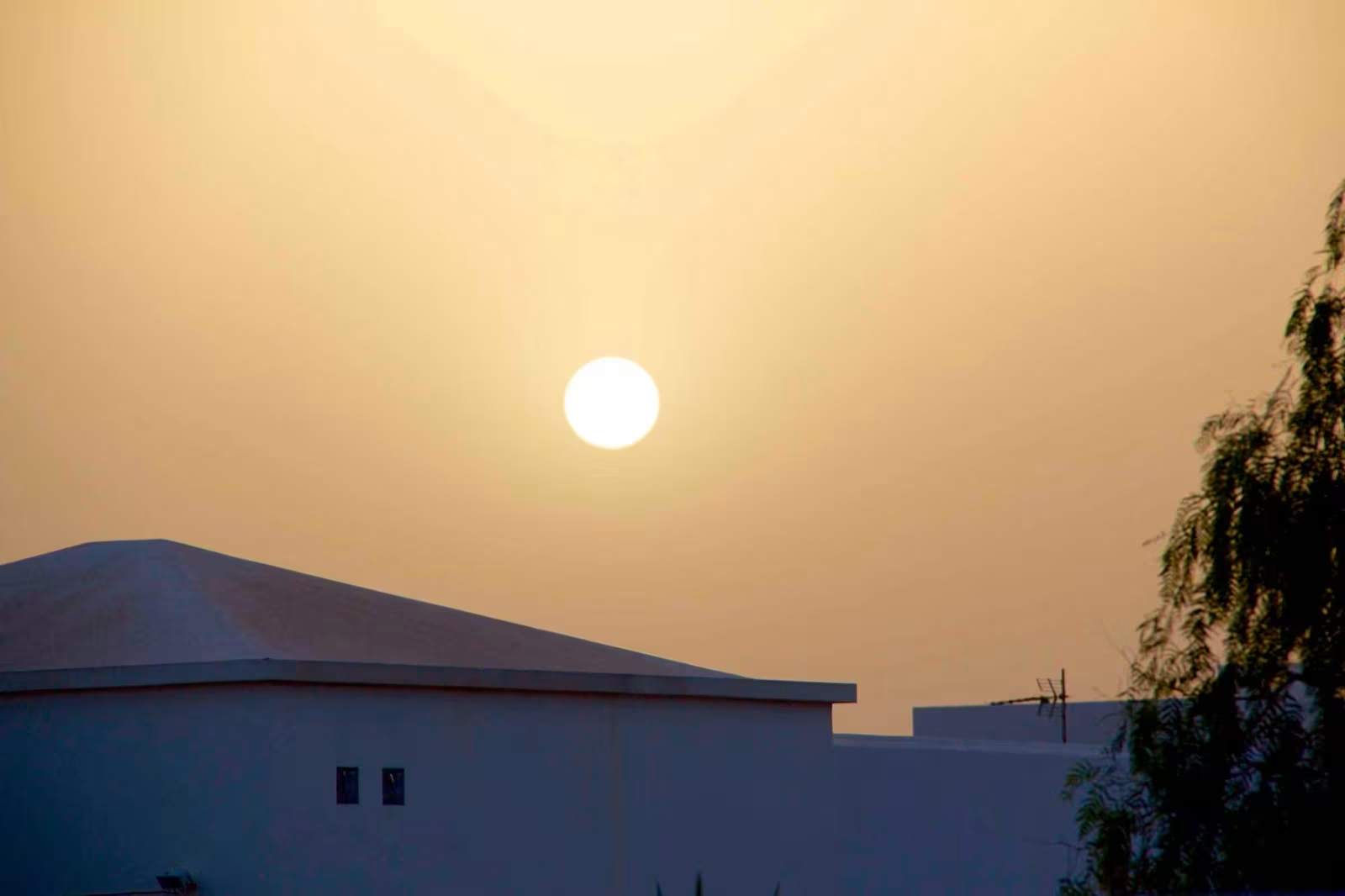
The sky changes in a way that is hard to forget. Sometimes it is just pale and washed out, but when the calima is strong, everything turns a deep orange or brown. The sun fades to a dull disc you can almost look at without squinting. If you take a photo during a heavy calima, it will look as if you have used an old sepia filter.
After a calima, you notice the fine dust on everything; cars, terraces, swimming pools, even the washing you forgot to bring in. The dust finds its way into every corner. Once the wind dies down, there is a real sense of community as everyone comes out to hose down patios and give their cars a good scrub.
Health advice during a Lanzarote Calima
For those of us who call Lanzarote home, a calima is usually just an inconvenience rather than something to worry about. That said, if you have asthma or any breathing issues, these dusty days can be much tougher. The fine Saharan dust in the air can really bother your lungs, and it is quite common for the local hospital to see a few more people with breathing difficulties when the calima hangs around.
When the calima rolls in, most of us find it best to stay indoors, especially when the dust is at its worst. It helps to keep windows and doors closed, and if you have air conditioning, this is the perfect excuse to use it. The air can get very dry, so it is a good idea to drink a bit more water than usual. If you do need to pop outside, slipping on a simple face mask can make things a little more comfortable.
If you wear contact lenses, you will probably notice they are not much fun during a calima. The dry, dusty air can make them uncomfortable, so it is worth reaching for your glasses if you have a pair handy. And even though the sky might look hazy, do not forget your sun protection. The UV is still strong here, just filtered through the dust instead of clouds.
If the Calima leaves you feeling unwell, do remember that our local health centres and pharmacies are always there to help. The staff are friendly and used to helping both residents and visitors, so you will be in good hands.
Can a Lanzarote Calima affect flights and travel?
For visitors, the main concern during a calima is how it can affect flights at Cesar Manrique-Lanzarote Airport. When the dust in the air reduces visibility, flights may be delayed or diverted, and on rare occasions, the airport may close for a short time. Thankfully, this does not happen with every calima, but when it does, it can certainly make travel plans a little more complicated.
Many of us remember the February 2020 calima, which was one of the strongest in recent memory. For nearly two days, airports across the Canary Islands were closed, and thousands of visitors found themselves unexpectedly extending their stay. Sand even drifted across some of the roads, and the story made headlines around the world. If you happened to be here then, it is likely an experience you will always remember.
If you are due to fly to or from Lanzarote and a calima is in the forecast, it is a good idea to check with your airline and the airport website for the latest updates. There is little to do but wait for conditions to improve, so a bit of patience goes a long way. Having travel insurance that covers weather delays can also offer some peace of mind.
Ferry services between the islands are sometimes affected as well, although they usually continue unless the weather is particularly severe. On the island itself, visibility on the roads can drop quite a bit during a strong calima, so it is wise to take extra care if you are driving, especially along the more open stretches between towns.
Living through a Calima in Lanzarote
Living here, you soon come to recognise calima as just another part of island life. It becomes second nature to glance at the forecast, close the shutters, bring in the washing and cover the pool if you are lucky enough to have one. Most of us keep a little extra water on hand and simply settle in for a quieter day indoors until it passes.
Most of us who call Lanzarote home take calima in our stride. Shops and cafés usually stay open unless things get really wild, but you will notice the beaches are almost deserted—no one fancies sitting out in a dust storm. Covered terraces become the best seats in town, while open-air spots are left to the wind. Life slows down for a while, and we all wait patiently for the trade winds to sweep the air clean again.
What often surprises visitors is just how quickly calima can disappear. Sometimes you wake to a hazy, heavy morning, only to find the sky sparkling clear by evening once the wind changes. Afterwards, the air feels especially fresh and bright. Some of the most beautiful sunsets I have seen here come just after a calima, when a hint of dust still lingers high above, turning the sky every shade of gold and pink.