
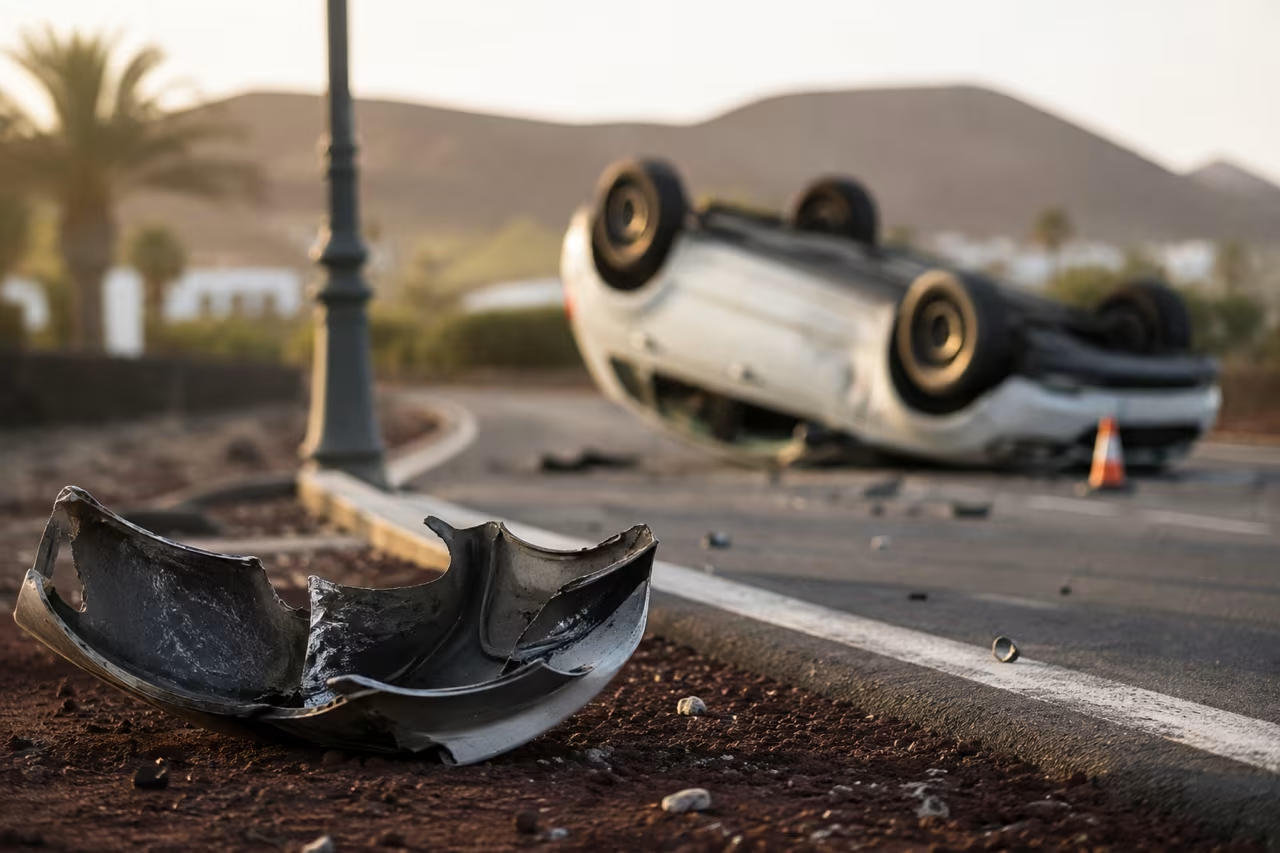

Are There Really More Road Accidents in Lanzarote? We Look at the Numbers
If you feel like we are hearing about a road traffic accidents in Lanzarote, you are certainly not alone.
Over recent months, residents and visitors have increasingly been commenting on the number of crashes being reported across the island. With local accidents now being shared almost immediately across social media and local news pages, a question is being asked more and more often:
Are there actually more road accidents in Lanzarote — and are tourists or residents responsible for most of them?
We have looked at the available figures, the island’s growing population, tourism numbers and vehicle numbers to see what the evidence really tells us.
The numbers: are accidents actually increasing?
There is evidence that road traffic incidents have increased recently, although it is important to understand exactly what the figures measure.
The Lanzarote Consortium for Security and Emergencies recorded 156 traffic accidents requiring firefighter intervention in 2022.
That figure fell to 127 in 2023, before dropping again to 96 in 2024.
2022 156 accidents
2023 127 accidents
2024 96 accidents
2025 approx 100 accidents
2026 – first six months 56 accidents
The figures for 2022–2024 show a clear decline, with accidents requiring firefighter intervention falling from 156 to 96.
However, the situation changed during 2025.
At the end of 2025, the Lanzarote emergency services reported that traffic-related incidents had increased by around 14% compared with 2024. The firefighters had attended around a hundred traffic accidents during the year, with incidents involving people trapped in vehicles and requiring rescue or other direct intervention.
And the numbers have continued into 2026.
During the first six months of 2026, the Lanzarote Emergency Consortium recorded 52 interventions involving traffic accidents.
It is important to stress that these are firefighter interventions, rather than every minor collision reported to the police or insurance companies. A small bump where nobody requires assistance from the emergency services will not necessarily appear in these figures.
Lanzarote has more people on its roads than ever
One of the biggest factors is simply the number of people moving around the island.
Lanzarote’s resident population has been growing steadily. The island had approximately 166,800 residents in 2025, while tourism also reached record levels, with more than 3.45 million visitors during the year.
But looking only at the number of people who officially live here doesn’t tell the whole story.
On any given day, thousands of tourists are staying on the island and travelling between their accommodation, beaches, restaurants, attractions, airports and other destinations.
That means Lanzarote’s roads are serving considerably more people than the resident population figure suggests.
One recent estimate put the island’s average human presence at around 245,000 people, when residents and tourists staying on the island are considered together.
More people means more journeys.
More journeys inevitably mean more opportunities for something to go wrong.
And there are a lot more vehicles
The number of vehicles on Lanzarote’s roads is another major part of the picture.
At the end of 2025, the island had approximately 149,445 registered vehicles, an increase of roughly 4,500 vehicles in a single year.
Lanzarote has long had an extremely high level of motorisation.
Back in 2023, the island already had 138,687 registered vehicles, equivalent to around 888 vehicles per 1,000 inhabitants.
That means the roads aren’t simply dealing with increasing numbers of residents.
They are dealing with:
- More privately owned cars
- More rental vehicles
- More tourists
- More residents
- More commercial vehicles
- More daily journeys
All of this puts additional pressure on the island’s road network.
What are the emergency services saying?
When Lanzarote’s emergency services discussed the increase in traffic incidents during 2025, the Consortium’s manager, Enrique Espinosa, pointed towards several factors.
These included:
Speeding and inappropriate speed
Distraction while driving, particularly mobile-phone use
Failure to follow traffic regulations
Increasing traffic levels
Population growth
High levels of tourism
Driving on wet roads
Some roads are more problematic than others
Lanzarote’s road network also presents its own challenges.
Emergency officials have identified concerns on a number of interior roads, including areas around Tinajo, Tinguatón, Nazaret and Arrieta.
Some of these roads have limited or no shoulders, while inappropriate speeds can make even a momentary loss of concentration much more serious.
For someone who has lived on Lanzarote for years, these roads may be familiar.
For somebody who has just picked up a rental car at Lanzarote Airport, they can be completely unfamiliar.
Tourists do have some additional challenges
Although we cannot say tourists cause most accidents, it would also be wrong to pretend that driving on holiday presents no additional risks.
Visitors may be:
- Driving on unfamiliar roads
- Using a rental car they have never driven before
- Looking at navigation instructions
- Unfamiliar with local roundabouts and junctions
- Unfamiliar with Spanish road signs
- Adjusting to Lanzarote’s narrow rural roads
- Driving in an unfamiliar vehicle
- Travelling on roads they have never previously encountered
For some visitors, there is also the challenge of adapting to driving on the right-hand side of the road.
But these factors don’t automatically make tourists worse drivers.
They simply mean that tourists can face a different set of challenges from someone who has lived and driven on Lanzarote for many years.
Residents can also be part of the problem
It is equally important not to overlook local drivers.
Residents drive considerably more frequently than the average holidaymaker and are familiar with the roads — but familiarity can sometimes lead to complacency.
Speed, mobile-phone use, alcohol, impatience and ignoring traffic rules aren’t problems exclusive to tourists.
The emergency services’ comments about speeding, distraction and failure to follow traffic regulations apply to anyone behind the wheel.
Why does it FEEL like there are accidents everywhere?
There is another major factor that shouldn’t be overlooked:
We are hearing about them much more.
This is particularly noticeable if you follow Lanzarote Facebook groups and local news pages.
A few years ago, a relatively minor accident might have been seen by the people who happened to be nearby, reported briefly by emergency services and perhaps mentioned in a local newspaper.
Today, an accident can be reported online within minutes.
A photograph appears.
Then it is shared into Facebook groups.
People comment.
Other pages report it.
And suddenly thousands of people know that a crash has happened.
This creates an important visibility effect.
It doesn’t necessarily mean that the number of accidents has increased by the same amount as the number of accident reports appearing in your Facebook feed.
Social media can make the increase feel even bigger
There is also a psychological effect.
Once people start noticing traffic accidents, they become much more aware of the next one.
Someone might see three accident reports in one week and think:
“There are accidents everywhere at the moment.”
Then another crash appears two days later and it reinforces the feeling.
This doesn’t mean the person’s observation is wrong.
In Lanzarote’s case, there has been a recent increase in traffic-related emergency interventions.
But social media means residents and visitors now have unprecedented visibility of those incidents.
And that is something that didn’t exist to the same extent a few years ago.
A final reminder for everyone driving in Lanzarote
Whether you’re a resident who has driven these roads for 20 years or a visitor who picked up a rental car this morning, the safest approach is the same:
Slow down. Put the phone away. Don’t drink and drive. Pay attention to the road. And remember that being familiar with Lanzarote doesn’t make you immune to an accident.
