

CALIMA IN LANZAROTE: WHY THE SKIES TURNED HAZY AND WHAT VISITORS NEED TO KNOW
Lanzarote's latest calima is easing — and there is no need for holidaymakers to panic
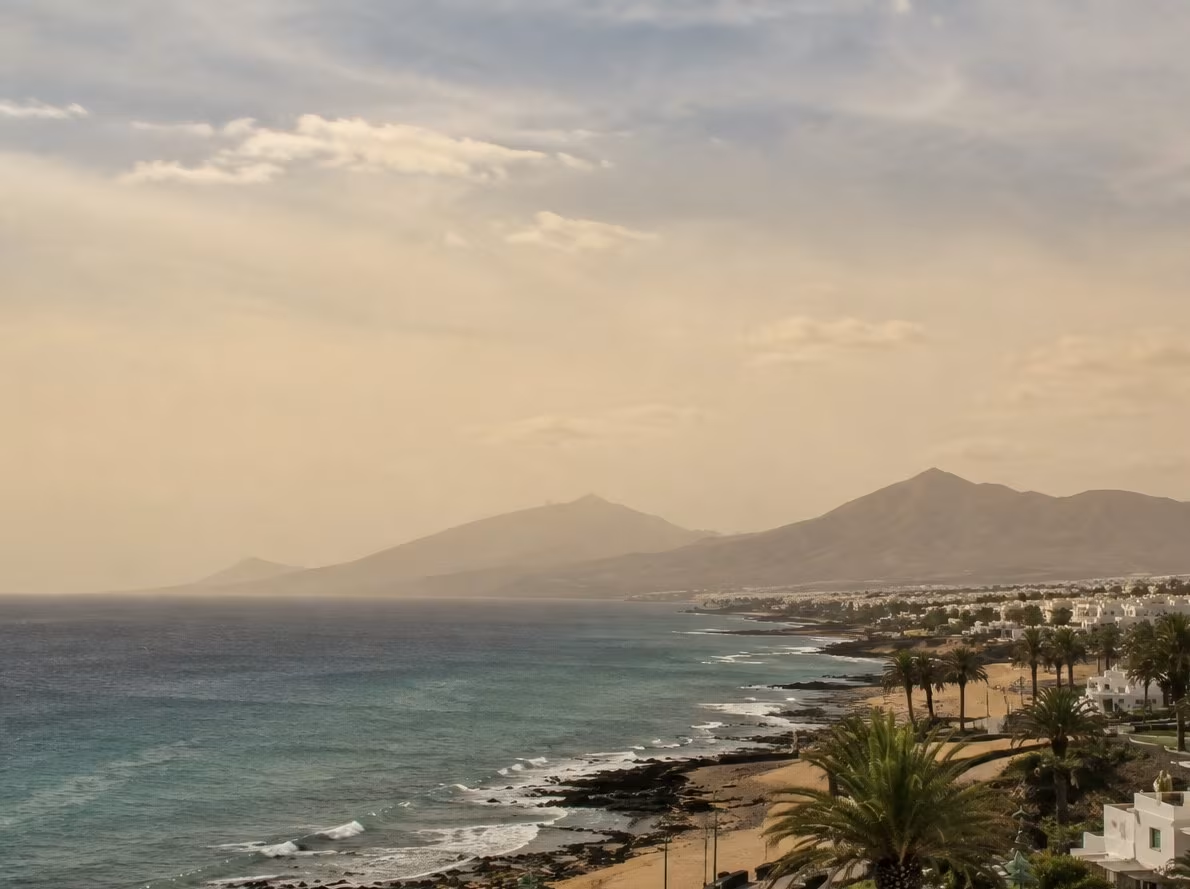
If you have been looking across Lanzarote over the past few days and noticed a hazy, yellow-orange sky, reduced visibility or a layer of dust settling on cars and outdoor surfaces, you have been seeing one of the Canary Islands' most familiar weather phenomena: calima.
The latest episode of calima affected several of the Canary Islands during September 2026, with Lanzarote and Fuerteventura among the islands where suspended dust was particularly noticeable. The Canary Islands Government officially ended its calima pre-alert at 10am on Thursday 17 September after meteorological conditions responsible for the alert had eased.
So, what exactly is calima, where does the dust come from, and what does it mean if you are currently on holiday in Lanzarote?
WHAT IS CALIMA?
Calima is the local name commonly used in the Canary Islands for episodes of airborne dust, usually involving mineral particles transported from North Africa. Lanzarote's position close to the African coast means the island can be affected more readily than some of the western Canary Islands.
The dust is carried by particular wind patterns and can remain suspended in the atmosphere, giving the sky a milky, beige, yellow or orange appearance. When concentrations are higher, visibility can fall noticeably and a fine layer of dust may settle on cars, balconies, terraces and outdoor furniture.
This is not an unusual feature of the Lanzarote climate. Calima can occur at different times of the year and can last from relatively short episodes to several days, depending on the weather pattern.
WHY DOES LANZAROTE GET SO MUCH DUST?
Lanzarote and the other eastern Canary Islands are geographically close to North Africa. When winds transport air from the African continent towards the Atlantic, Saharan and other North African dust particles can travel with it.
Satellite observations and atmospheric monitoring systems are routinely used to follow these dust plumes. Copernicus explains that desert dust transport is a natural atmospheric process and that major plumes can travel thousands of kilometres.
That is why a weather system developing over North Africa can eventually become visible over Lanzarote, Fuerteventura and the other Canary Islands.
THE SEPTEMBER 2026 CALIMA EPISODE
This month's episode developed alongside a period of unusually warm weather across the Canary Islands.
On 3 September, the Canary Islands Government declared a pre-alert for calima covering Gran Canaria, Fuerteventura, Lanzarote and La Graciosa because of African-origin suspended dust. The Government noted that particularly elevated particle concentrations had been recorded in Fuerteventura, Lanzarote and La Graciosa.
Further episodes of suspended dust followed during the month. By mid-September, calima was again affecting the eastern islands while temperatures were also high.
AEMET forecasts during the episode showed calima affecting Lanzarote and Fuerteventura, while official reports highlighted the combination of heat and suspended dust.
By Thursday 17 September, the Canary Islands Government confirmed that the conditions that had justified the calima pre-alert had ended and formally lifted the pre-alert at 10am.
That does not mean every trace of dust disappears instantly. Atmospheric dust can take some time to clear completely, particularly when local wind conditions are light. But the end of the pre-alert is a useful indication that the episode responsible for the official alert had passed.
DOES CALIMA MEAN YOUR LANZAROTE HOLIDAY IS RUINED?
Absolutely not.
For most visitors, a normal calima episode is more of an inconvenience than a reason to change holiday plans. The biggest difference is usually the appearance of the sky and the reduction in long-distance visibility.
Those spectacular views of the ocean, neighbouring islands and volcanic landscape can look softer or more muted while dust is suspended in the air. Photographs can also look very different, with the familiar deep blue Canary Islands sky replaced by warmer golden or hazy tones, but don´t put away in the sunscreen you can still tan during a calima.
As the dust clears, visibility normally improves and the characteristic blue skies return.
WHAT SHOULD TOURISTS DO DURING CALIMA?
For most healthy people, sensible precautions are enough.
If the air looks particularly dusty, you may want to reduce strenuous outdoor exercise and take breaks indoors. Keeping windows closed during the worst periods can reduce the amount of dust entering accommodation.
It is also worth drinking plenty of water, particularly when calima arrives alongside high temperatures.
People who are more sensitive to airborne particles — including some people with respiratory or heart conditions, older people and young children — may need to take extra care. Canary Islands health authorities have previously advised vulnerable groups to limit prolonged exposure outdoors during episodes of high dust concentrations.
If you experience significant breathing difficulties or other concerning symptoms, seek appropriate medical advice.
WHY DOES THE SKY TURN ORANGE?
The orange and reddish colours associated with calima are caused by sunlight interacting with dust particles in the atmosphere.
When there is a large amount of dust suspended above the islands, the normal blue appearance of the sky can be filtered and scattered differently. The result can be a dramatic golden, orange or reddish glow, especially around sunrise and sunset.
It is one of the reasons calima can produce some extraordinary photographs of Lanzarote's volcanic landscape.
CALIMA AND LANZAROTE WEATHER
One thing visitors sometimes notice is that calima can arrive at the same time as very warm temperatures.
That is because the weather pattern transporting air from North Africa can also bring a warmer, drier air mass. However, calima itself is the suspended dust — it is not simply another name for hot weather.
A hot day does not automatically mean there is calima, and calima can occur without extreme temperatures.
The two conditions can, however, occur together.
WHAT ABOUT AIR QUALITY IN LANZAROTE?
Air quality can deteriorate when concentrations of suspended dust become high. This is why official authorities monitor these episodes and may issue advisories or alerts when necessary.
For tourists, the easiest way to judge the situation is to check the latest AEMET forecast and official Canary Islands emergency information rather than relying solely on how the sky looks.
Conditions can vary considerably between different parts of Lanzarote, and an episode that looks dramatic from a distance may not mean that every location on the island is experiencing the same concentration of dust.
THE GOOD NEWS FOR VISITORS
The latest official information is reassuring for anyone currently in Lanzarote.
The Canary Islands Government ended its calima pre-alert on Thursday 17 September after the meteorological conditions that had prompted it came to an end.
Calima is a natural and recurring part of the climate of Lanzarote and the eastern Canary Islands. It can make the sky look unusual, reduce visibility and leave a coating of dust behind, but most episodes pass and the clear island skies return.
So if you are waking up in Lanzarote to a slightly strange-looking sky, don't assume something dramatic is happening. Quite often, it is simply the Canary Islands doing what the Canary Islands do — welcoming a little dust from across the Atlantic.
