

Four Migrant Boats Intercepted Near Lanzarote in 24 Hours
Four boats carrying a total of 189 migrants were rescued in waters around Lanzarote and La Graciosa over a period of less than 24 hours, in a series of operations involving Spain's maritime rescue service and local emergency teams.
The arrivals took place between Tuesday 22 September and the early hours of Wednesday 23 September 2026, with the people rescued subsequently brought to Arrecife for medical checks, identification and processing.
WHAT HAPPENED?
The first boat was located on Tuesday morning close to La Graciosa. Salvamento Marítimo's Guardamar Urania rescued 38 people from a wooden boat approximately 5.5 kilometres east of the island.
Later that day, two inflatable boats were intercepted near the north of Lanzarote. One was carrying 46 people and was assisted near Punta Mujeres. The other was carrying 43 people.
The fourth boat was located during the early hours of Wednesday. It was carrying 62 people and was spotted by a merchant vessel around 89 kilometres, or 48 nautical miles, north-northeast of Órzola. The Guardamar Urania then carried out the rescue and brought the group to Arrecife, arriving shortly after 7am.
Across the four operations, the confirmed total reported by EFE and RTVC was 189 people.
WHO WAS ON BOARD?
The people rescued came from different backgrounds. The first three boats were reported to have mainly or entirely Moroccan/Maghreb occupants, while the fourth group was reported to be of sub-Saharan origin.
The overall total included 20 minors, according to emergency-service information reported by EFE. Women were also among those rescued.
Because early counts can change as people are registered on shore, figures reported during the operations varied slightly between initial estimates and final totals. The 189 figure is the consolidated total reported by EFE and RTVC.
MEDICAL ASSISTANCE
Medical teams were involved when the boats reached Arrecife. Several people required medical attention during the operations.
In one of the inflatable boats, two occupants were reported to have health problems, while a person from another boat was airlifted by the Helimer rescue helicopter to Lanzarote hospital with symptoms of hypothermia.
The remaining arrivals were attended by the emergency and humanitarian services in the port area.
WHERE WERE THEY TAKEN?
The people rescued were brought to Puerto Naos in Arrecife, where the relevant emergency, police, medical and humanitarian services were involved in the reception process.
This is part of the established procedure following maritime rescues: people are medically assessed and then undergo identification and immigration procedures.
WHAT DOES THIS MEAN FOR TOURISTS AND RESIDENTS?
For people living in Lanzarote or visiting the island, the operations are taking place through the island's established emergency and port services, principally around Arrecife and the northern waters of Lanzarote and La Graciosa.
The news is significant for the island because of the number of people involved and the concentration of four rescues in such a short period, but the locations mentioned in the reports are primarily maritime rescue and port-processing areas rather than tourist attractions.
The situation is also a reminder of the role played by Salvamento Marítimo, emergency services, police, healthcare workers and humanitarian organisations when boats reach the Canary Islands.
WHY ARE THERE MORE ARRIVALS AT CERTAIN TIMES OF YEAR?
Sea conditions are one factor in when attempted crossings take place. Local reporting has noted that calmer conditions in September and October can coincide with increased maritime arrivals to the Canary Islands.
However, each journey is different and conditions at sea can change quickly. The Atlantic crossing remains dangerous, particularly for people travelling in small or poorly equipped boats.
LANZAROTE'S LOCATION ON THE CANARY ROUTE
Lanzarote and neighbouring La Graciosa sit close to the northern approaches to the Canary Islands, making their surrounding waters an area where maritime authorities regularly conduct search-and-rescue operations.
The latest incidents involved vessels detected at very different distances from the island: one was found just a few kilometres from La Graciosa, while the final boat was located almost 90 kilometres from Órzola.
THE WIDER PICTURE
These four rescues form one short period of arrivals rather than a complete picture of migration to the Canary Islands. National figures, routes and arrival numbers can change throughout the year, so comparisons with previous months or years should be made using official Ministry of the Interior data rather than individual incidents. 2026 migrant arrival numbers has seen a decrease of 55% in comparison to 2025.
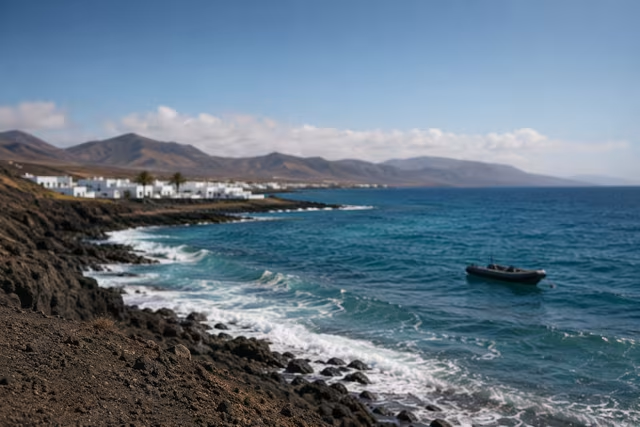
An AI Generated Image has been used to illustrate this Article.
