

WHAT HAPPENS TO PEOPLE RESCUED FROM BOATS AFTER THEY REACH LANZAROTE?
For people living in or visiting Lanzarote, reports of a migrant boat being rescued off the island often lead to a simple question: what actually happens to the people once they reach the island?
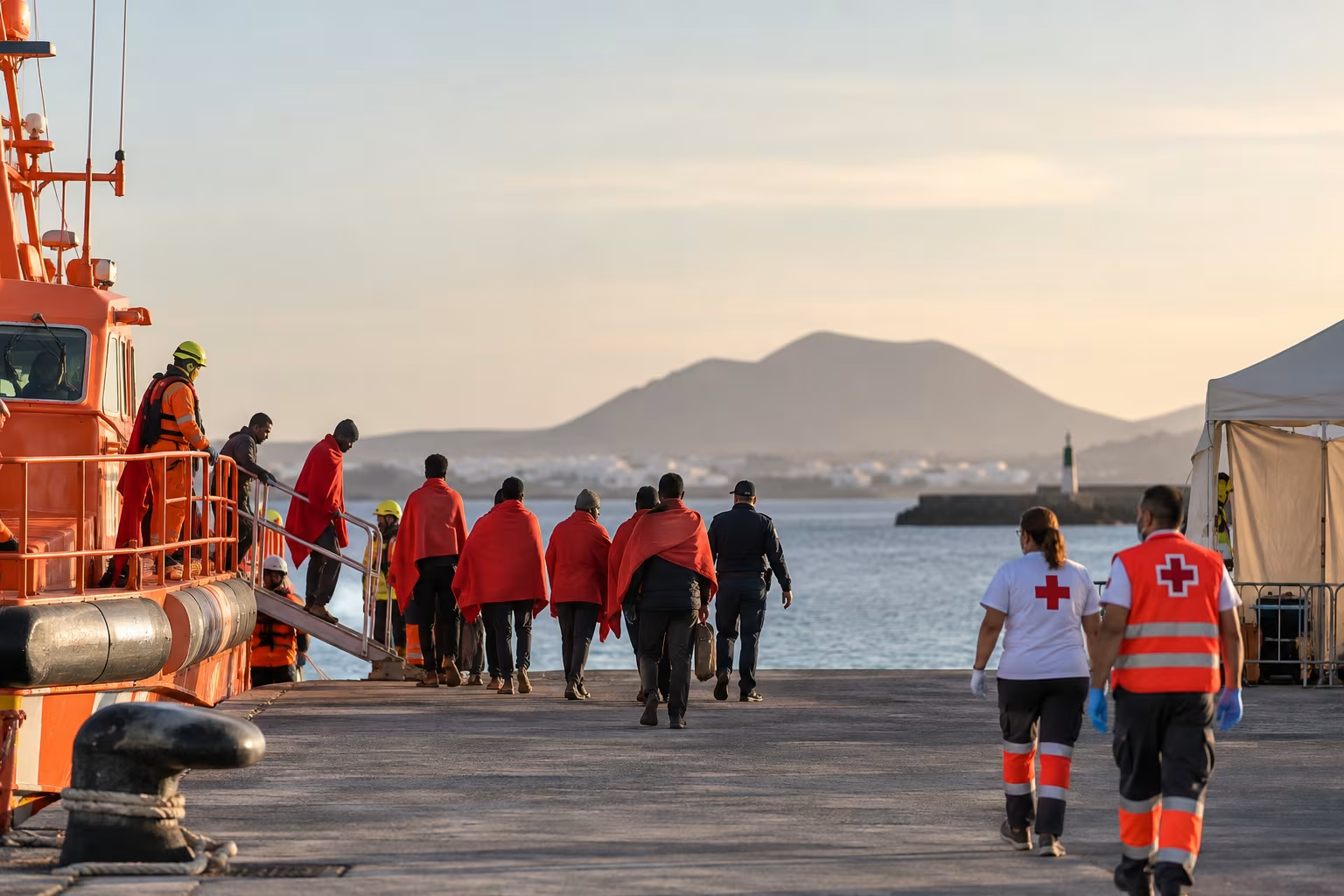
The process is more structured than many people realise. People rescued at sea are not simply brought ashore and left to make their own arrangements. Their arrival can involve emergency medical teams, Cruz Roja, Policía Nacional and Spain’s wider immigration and humanitarian reception system.
FIRST STOP: MEDICAL AND HUMANITARIAN ASSISTANCE
When a boat is intercepted or rescued, those on board are brought to a designated port where the relevant emergency services are prepared to receive them.
After what may have been a long and dangerous sea journey, immediate medical and humanitarian assistance is a priority. People can arrive suffering from dehydration, exhaustion, injuries or other medical problems. Those requiring further treatment can be taken to hospital.
Cruz Roja provides first-response humanitarian assistance at arrivals in the Canary Islands, including basic supplies such as clothing, blankets, food and hygiene kits, together with social and healthcare support.
IDENTIFICATION AND POLICE PROCEDURES
Once people have been brought ashore, Policía Nacional carries out identification and immigration procedures. This can involve establishing identity and nationality, taking fingerprints and photographs, and recording relevant personal circumstances.
The process is important because the legal situation of each individual can be different. Age, nationality, family circumstances, vulnerability and whether someone requests international protection can all affect what happens next.
WHAT HAPPENS AFTER THE INITIAL RECEPTION?
Following the initial procedures, people may enter Spain’s humanitarian reception system or another immigration or asylum procedure, depending on their circumstances.
Spain’s humanitarian assistance programme is designed to provide support to vulnerable people arriving at the country’s borders. The programme can include accommodation and food, basic clothing and hygiene supplies, basic healthcare, social and legal information, psychological support, help maintaining family contact and transfers between reception facilities.
Importantly, receiving humanitarian assistance does not mean that someone has automatically been granted asylum or permanent residency in Spain. Emergency assistance and legal immigration status are two separate matters.
DO THEY STAY IN LANZAROTE?
Not normally.
Lanzarote can be the point at which people first come into contact with the Spanish authorities, but it does not necessarily become their long-term destination.
People who enter the state reception system can subsequently be transferred to other accommodation within the Canary Islands or to mainland Spain. Spain’s Ministry of Inclusion reported that its state reception system transferred around 20,500 people from the Canary Islands to mainland Spain during 2025, illustrating the role that transfers can play in managing reception capacity.
WHAT HAPPENS IF SOMEONE REQUESTS ASYLUM?
A person who wishes to seek international protection can enter Spain’s asylum system, where their individual circumstances are considered.
An asylum request is not automatically accepted. The relevant authorities assess whether the person meets the legal requirements for international protection.
While their case is being processed, eligible applicants may receive support through the reception system, depending on their circumstances and stage of the procedure.
WHAT IF THEY DO NOT HAVE A RIGHT TO REMAIN IN SPAIN?
Where a person does not have a legal basis to remain in Spain, immigration proceedings can result in a return decision.
However, a return decision does not necessarily mean that somebody is immediately put on a plane and sent back. Authorities may need to establish identity and nationality, obtain travel documentation and ensure that the legal requirements for return are met. There can also be practical difficulties where a country does not accept returns or where an individual’s circumstances make immediate removal impossible.
This is one reason why the period between arriving by boat and reaching a final legal outcome can vary considerably from one person to another.
UNACCOMPANIED CHILDREN ARE TREATED DIFFERENTLY
Unaccompanied minors are dealt with differently from adults arriving irregularly.
Where a child arrives without a parent or legal guardian, the relevant child-protection authorities become involved. Their age and circumstances are assessed and they can be placed within the regional child-protection system rather than being handled solely through the adult immigration process.
WHY CAN PEOPLE BE MOVED OFF LANZAROTE?
The Canary Islands have experienced sustained pressure on reception facilities because of arrivals along the Atlantic migration route.
Moving people between reception facilities can therefore be part of the wider national response. It also means that the people seen arriving in Lanzarote are not necessarily the same people who remain on the island weeks or months later.
A PROCESS INVOLVING SEVERAL DIFFERENT AUTHORITIES
There is no single organisation responsible for everything that happens after a boat reaches Lanzarote.
Salvamento Marítimo is involved in maritime rescue operations. Once people reach land, emergency services and organisations such as Cruz Roja provide immediate humanitarian and healthcare assistance. Policía Nacional deals with identification and immigration procedures, while the relevant reception, asylum and child-protection authorities become involved according to each person’s circumstances.
THE PROCESS IN SIMPLE TERMS
For someone rescued from a migrant boat approaching Lanzarote, the broad process is:
Rescue at sea → arrival at port → medical and humanitarian assistance → identification and registration → immigration or asylum procedures → reception and/or transfer → eventual decision on legal status.
The final outcome can be very different from one individual to another.
For residents and visitors, understanding this process helps explain why the arrival of a boat in Lanzarote is only the beginning of a much longer procedure. The people arriving may be dealt with through different parts of Spain’s emergency, immigration, asylum, child-protection and humanitarian-support systems depending on their individual circumstances.
This article is intended as a general explanation of the process. Individual cases can differ depending on nationality, age, medical circumstances, asylum claims and other legal factors.
An AI Generated Image has been used in this Article.
