
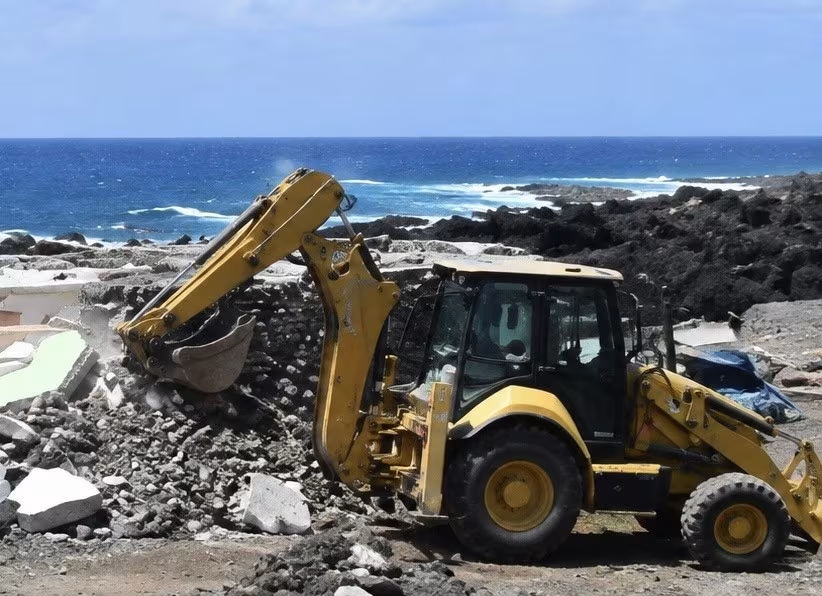

Historic Family Beach Hut Demolished on Lanzarote Coast After Almost 20 Years of Legal Proceedings
A small family holiday home on the northern coast of Lanzarote has been demolished by the Spanish coastal authorities after almost two decades of administrative and legal proceedings.
A much-loved piece of local history has disappeared from the coastline of Haría after machinery moved in to demolish a small family property at Caleta de las Escamas, on the north coast of Lanzarote.
The modest seaside building measured around 31 square metres and had reportedly stood at the location since before the 1950s. For the family connected to the property, it was far more than a building. It was a place associated with summer holidays, fishing, swimming and generations of family memories.
The demolition took place on Monday, 24 August 2026, according to information reported by La Voz de Lanzarote.
A tiny building with a very long history
The property was one of a small number of traditional structures built along this remote section of the northern Lanzarote coastline, in the volcanic landscape around the Malpaís de La Corona.
According to the family, the building had been used as a simple summer retreat for decades. Rather than being a conventional permanent residence, it was a place where relatives spent time during the warmer months, going fishing and swimming and gathering together.
The family has described the demolition as the loss of a small but significant part of their personal history.
For visitors familiar with Lanzarote, this type of simple coastal building can also form part of the visual character of the island. Away from the major resorts, the northern coastline contains a mixture of volcanic terrain, traditional fishing locations and small historic structures that reflect how previous generations used the coast.
Why was it demolished?
The property had become subject to Spain’s Ley de Costas, or Coastal Law, because it fell within land classified as part of the public maritime-terrestrial domain.
The relevant coastal boundary in this part of Haría stretches between Playa del Caletón and Punta del Burro. The Spanish Government formally approved the coastal demarcation for this section in 2006.
The Director Insular of the Spanish State Administration in Lanzarote, Pedro Viera, told La Voz de Lanzarote that a possession-recovery procedure was opened in June 2008 in relation to the property.
In other words, the case was not something that appeared suddenly in 2026. The process had been running for approximately 18 years before the demolition eventually took place.
What does “recovery of possession” mean?
Under Spain’s Coastal Law, land forming part of the public maritime-terrestrial domain cannot simply become private property because somebody has occupied it for a long period.
The law states that public maritime-terrestrial land is inalienable, imprescriptible and unseizable. It also gives the State the power to recover possession of such land officially and at any time.
The regulations governing the Coastal Law specifically provide for a procedure to recover possession of land included within an approved coastal demarcation.
That helps explain why the fact that the family had used the property for generations did not, by itself, prevent the authorities from eventually ordering its removal.
A building dating back to before the 1950s
One of the details that has attracted particular attention is the age of the property.
According to the family account reported by La Voz de Lanzarote, the small building was constructed before the 1950s.
That makes the story especially interesting from a Lanzarote heritage perspective. The property was not a recently constructed holiday villa or modern development. It was a very modest coastal building that had survived for many decades in an area where traditional relationships with the sea remain an important part of local history.
However, age alone does not necessarily give a structure a permanent right to remain on public coastal land.
The Coastal Law specifically states that private occupation does not override the status of public maritime-terrestrial land simply because it has continued for many years.
The demolition was not without controversy
The final stage of the case has created an additional point of controversy.
According to the family, the decision allowing Costas to proceed with the demolition had become final through both the administrative and judicial processes. La Voz de Lanzarote reported that the court notified Costas on 1 July 2026 that it could proceed.
The family nevertheless says that, on 24 August, the same day the demolition was due to take place, a court ordered the execution to be suspended.
Despite this, the demolition went ahead and the building was reduced to rubble.
This part of the story is particularly important because it concerns an alleged court suspension and should therefore be distinguished from the established fact that the building was demolished.
The family’s account and the legal position surrounding that final order could become the subject of further clarification.
A protected and environmentally sensitive landscape
Caleta de las Escamas lies within the wider northern landscape associated with La Corona, an area of major environmental and geological importance.
The Monumento Natural de La Corona covers around 1,797 hectares in the municipality of Haría. Its landscape includes the volcanic cone of La Corona and the extensive lava fields, or malpaís, that run towards the coast.
The area is also part of the wider La Corona Special Area of Conservation (ZEC) within the European Natura 2000 network. The official management plan identifies the protected area as covering more than 2,600 hectares in northern Lanzarote.
This means that the debate is not simply about a family property on a beach. The coastline around Haría is subject to a combination of coastal, environmental and landscape protections.
What does this mean for Lanzarote’s traditional coastal buildings?
The demolition is likely to prompt renewed discussion about what should happen to old structures that have become part of the island’s visual and cultural identity.
Lanzarote has many examples of buildings and spaces that developed from the practical needs of earlier generations — fishing, agriculture, salt production and simple summer use of the coastline.
Some residents see these places as an important part of Lanzarote’s heritage and collective memory.
At the same time, the authorities responsible for Spain’s coastline have a legal obligation to protect public coastal land and ensure that private buildings do not permanently occupy areas belonging to the maritime-terrestrial public domain.
That creates a difficult question for an island such as Lanzarote:
Where should the line be drawn between protecting the coastline and preserving the small pieces of history that developed along it?
A reminder that Lanzarote’s coastline is protected
For tourists, the story also provides an interesting insight into why parts of the Lanzarote coastline look so undeveloped compared with other popular European holiday destinations.
Large areas of northern Lanzarote remain dominated by volcanic landscape, protected habitats and open coastline rather than extensive development.
The Coastal Law is designed, among other things, to guarantee public use of the shore and protect the maritime-terrestrial domain. It states that ordinary use of the coast should generally remain free, public and compatible with its natural character.
For residents, however, the issue is more complicated.
A building can be legally considered an occupation of public land while simultaneously representing decades of memories for the people who used it.
That is what makes the demolition at Caleta de las Escamas in Haría such an emotive story.
What remains now?
The small building has gone, leaving behind rubble where a family once spent summers together.
It is a reminder of how quickly parts of Lanzarote’s physical landscape can disappear — and how complicated it can be to balance coastal protection, environmental conservation, property rights and local heritage.
