
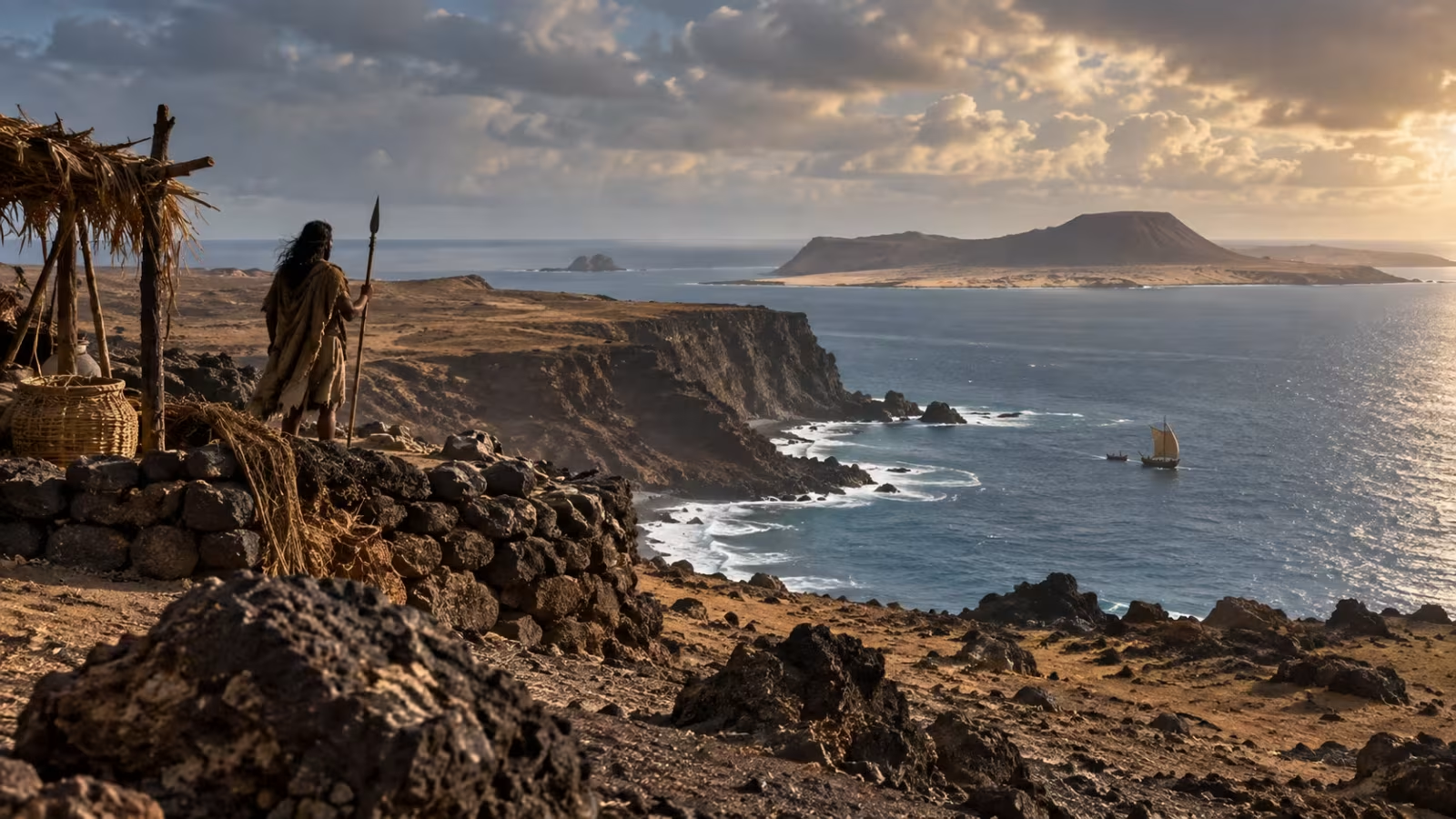

Lanzarote and La Graciosa Take Centre Stage in New Film Premiering in Toronto
A new feature film inspired by the early history of the Canary Islands has put Lanzarote and La Graciosa in the international spotlight after its world premiere at the 2026 Toronto International Film Festival.
Las islas afortunadas, known internationally as The Fortunate Isles, was premiered in Toronto on 15 September 2026 in the festival’s Discovery section. The 80-minute Spanish-Greek production is directed by Canarian filmmakers Helena Girón and Samuel Delgado and uses the landscapes and history of the eastern Canary Islands as the setting for a story about survival, water, power and resistance.
For visitors and residents in Lanzarote, the film offers an unusual reason to look beyond the beaches, resorts and volcanic landscapes and explore some of the island’s much older history.
A story rooted in La Graciosa
The film is set in the Canary Islands during the 15th century, with much of the story centred on La Graciosa.
At the heart of the film is Fátima, a woman who serves a marquis who controls the island’s only source of fresh drinking water. When the well dries up and tensions rise within the community, she sets out to find a way for the population to survive.
Although the story is a historical drama rather than a documentary, its setting draws on the period when European conquest was transforming the Canary Islands. The filmmakers use water scarcity and the harsh island environment to explore how power can develop around control of essential resources.
That makes the film particularly interesting from a Lanzarote perspective. Water has always been a central part of life on these dry volcanic islands, and the contrast between the modern visitor experience and the difficulties faced by earlier communities is striking.
Lanzarote's connection to the story
The film’s connection with Lanzarote goes further than simply using the island as a backdrop.
The directors have explained that the idea for the film began at Samuel Delgado’s family home in Lanzarote, positioned high on a cliff with views towards La Graciosa. From there, the relationship between the two islands helped inspire their thoughts about conquest, scarcity and the development of systems of power.
The film was also shot in the Canary Islands, with locations in Lanzarote, La Graciosa and Tenerife. Official Spanish film records list filming locations including the Risco de Famara area of Lanzarote and La Graciosa.
For anyone who has stood on the Mirador del Río or explored the north of Lanzarote, the geography makes the connection easy to appreciate. La Graciosa sits just across El Río, and the two islands are visually linked by the dramatic cliffs and volcanic landscape of northern Lanzarote.
A glimpse into the conquest of Lanzarote
The historical period used by the film is also significant.
In 1402, the Norman expedition associated with Jean de Béthencourt and Gadifer de La Salle arrived in the eastern Canary Islands. Historical sources record that the expedition reached La Graciosa before moving on to Lanzarote. The conquest of Lanzarote formed part of the wider European conquest of the Canary Islands during the 15th century.
The history was complex, involving agreements, conflict, changing alliances, shortages of supplies and the forced incorporation of the islands into new political and social structures. The arrival of Europeans had profound consequences for the Indigenous population of Lanzarote and for the development of the islands that followed.
The new film does not attempt to reproduce every historical event. Instead, it uses a fictional story and its characters to explore themes associated with that period, including scarcity, domination, survival and solidarity.
From Lanzarote to an international film festival
Las islas afortunadas is the second feature film made jointly by Helena Girón and Samuel Delgado. Their earlier film, Eles transportan a morte, was released in 2021 and had a festival career that included Venice and San Sebastián.
Their new film was selected for the Discovery programme at the Toronto International Film Festival 2026. The programme focuses on emerging filmmakers and new voices in international cinema.
The Toronto premiere is an important moment for Canarian cinema because the production is closely tied to the Canary Islands, both creatively and through its filming locations and production companies.
The film is a co-production between Spain and Greece and was made in Spanish, French and Arabic. Its cast includes Luisa Ahl-Laabiad, Lou Castel, Grégoire Colin and several Canarian performers.
Why this matters to Lanzarote
For Lanzarote, international attention of this kind can help introduce a completely different side of the island to people who know it mainly as a holiday destination.
Millions of visitors arrive in Lanzarote each year for its beaches, sunshine, volcanic scenery, restaurants and outdoor activities. Yet the island also has a fascinating cultural history stretching back long before modern tourism.
The story of Lanzarote and La Graciosa includes Indigenous communities, European exploration and conquest, agriculture, fishing, water management and the struggle to live in an exceptionally dry environment.
A film such as The Fortunate Isles gives audiences around the world another way of discovering that history.
It may also encourage visitors to explore places such as northern Lanzarote, Haría, Famara, the Mirador del Río and the route towards Órzola and La Graciosa with a little more curiosity about what came before the modern island they see today.
A film inspired by the islands' past
Las islas afortunadas is a work of historical fiction. It is not a documentary or a complete retelling of the conquest of Lanzarote.
What it does provide is a cinematic interpretation of a period of Canary Islands history that is rarely seen on the international screen.
For residents, history enthusiasts and tourists looking for something beyond the usual Lanzarote attractions, that makes the film particularly intriguing.
From the volcanic cliffs of Lanzarote to the small island of La Graciosa, a landscape that has witnessed centuries of change is now being presented to an international cinema audience in a very different way.
And for an island that is so often associated with sunshine and holidays, it is a timely reminder that Lanzarote has a much deeper story to tell.
An AI Generated Image has been used in this Article
