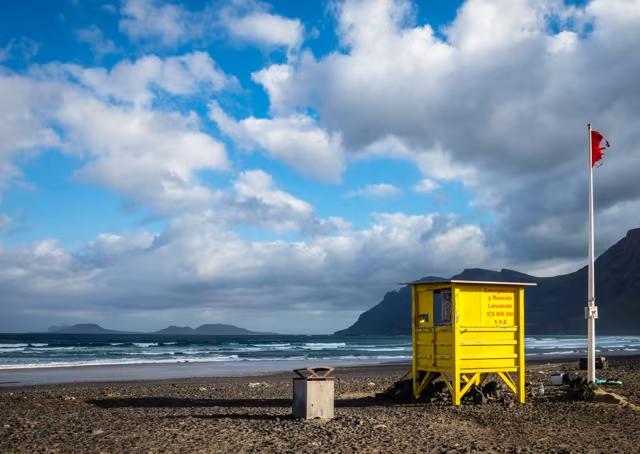

Lanzarote Beach Safety Gets Extra Funding After 19 Canary Islands Deaths This Summer
The Canary Islands is putting more money into coastal and beach safety after a difficult summer in which 19 people died in aquatic incidents across the islands.
For Lanzarote, the figures are particularly relevant. Five people lost their lives in aquatic accidents during the 2026 summer period, giving the island the second-highest total in the archipelago behind Tenerife.
The new funding is designed to help councils strengthen safety around beaches and other bathing areas, while a wider set of regional rules for aquatic safety is also being developed.
What is happening with beach safety funding in the Canary Islands?
The Canary Islands Government has approved an additional €983,612.73 for coastal safety costs in municipalities with fewer than 20,000 residents.
That money is being added to €250,000 already included in the 2026 budget. Together, the two amounts take the year's allocation for this particular council support to just over €1.23 million.
The funding is intended to help smaller municipalities meet the cost of safety measures in coastal and bathing areas. The initiative continues support provided in 2025, when €1.4 million was allocated for the same type of expenditure.
The regional government is also working with municipalities and other organisations on a new framework intended to create more consistent safety standards at bathing areas across the Canary Islands.
Why has beach safety become such an important issue?
The latest figures from the association Canarias, 1,500 Km de Costa show that 19 people died in aquatic environments during the summer period running from 19 June to 9 September 2026.
The island breakdown was:
• Tenerife – 6 deaths
• Lanzarote – 5 deaths
• Fuerteventura – 4 deaths
• Gran Canaria – 3 deaths
• La Palma – 1 death
Across the same period, 78 people were involved in aquatic accidents. Besides the 19 fatalities, three people were assisted in critical condition and 17 suffered serious injuries. There were also 15 moderate injuries, 11 minor injuries and 13 people rescued without injury.
The figures cover more than traditional beach swimming. Aquatic incidents can happen in different coastal and water environments, which is why visitors and residents should pay attention to local warnings wherever they are close to the sea.
Lanzarote's figures
Lanzarote recorded five deaths during the summer period.
There is another figure that stands out for families visiting the island: seven of the 17 minors involved in aquatic accidents across the Canary Islands were in Lanzarote.
Across the whole archipelago, 17 people under the age of 18 were involved in aquatic accidents during the summer. Five minors died, seven suffered serious injuries, three suffered moderate injuries and two were rescued without injury.
For parents visiting Lanzarote, this is a useful reminder that children need close supervision around swimming pools, beaches, natural swimming areas and the sea. A holiday beach can look calm while conditions in the water can still change quickly.
Sea conditions matter
One of the clearest points in the latest figures is the connection between some incidents and periods of officially recognised dangerous coastal conditions.
Four of the 19 people who died during the summer were involved in incidents in coastal areas while a Government of the Canary Islands pre-alert for adverse coastal conditions was active. Thirteen of the 78 people affected by aquatic accidents were also involved in incidents during these pre-alert periods.
That does not mean every accident occurs during bad weather. It does show why checking official warnings before heading into the sea is an important part of beach safety in Lanzarote.
The Canary Islands Government advises bathers to pay attention to beach flags. A red flag means bathing is prohibited, yellow indicates caution and green indicates that conditions are suitable for bathing.
It also advises swimmers to remain parallel to the shoreline rather than swimming directly away from land, and warns that inflatables and floating devices can be carried away by currents.
Where possible, choosing a beach with lifeguard cover provides an additional layer of safety.
A reminder for tourists visiting Lanzarote
For most visitors, enjoying the beaches of Lanzarote is one of the highlights of a holiday. The island has long stretches of golden sand, sheltered bays, natural volcanic coastline and some excellent family-friendly beaches.
The new figures are not a reason to avoid the sea. They are a reminder to understand the conditions before getting in.
Visitors who are unfamiliar with the Atlantic should be particularly careful around rocky coastlines, natural pools and exposed areas where waves can behave very differently from a sheltered swimming beach.
It is also worth remembering that the sea can be more powerful than it appears from the shore. A calm-looking stretch of water does not necessarily mean that currents or waves are harmless.
Extra support for water-safety education
Alongside the €1.2 million allocation for councils, the Canary Islands Government has approved €29,980 for the Asociación de Socorristas de las Islas Canarias.
The money will support projects aimed at improving public awareness and training in aquatic safety. These include initiatives aimed at children and programmes designed to help members of the public and professionals respond more effectively during water emergencies.
The regional government also says safety information issued during coastal warnings has been translated into several languages, with the tourism sector being encouraged to help communicate those messages to visitors.
What should you do before swimming in Lanzarote?
A few simple habits can make a big difference:
• Check the beach flag before entering the water.
• Follow instructions from lifeguards and local authorities.
• Check official weather and coastal warnings, particularly if you plan to visit exposed coastline.
• Keep children within close reach around water.
• Avoid entering the sea during a red-flag warning.
• Be cautious around rocks, natural pools and areas without lifeguard supervision.
• Do not assume an inflatable will keep you safe if currents are strong.
• If you are not a confident swimmer, choose a supervised and sheltered bathing area.
• If conditions suddenly worsen, get out of the water and move away from the shoreline.
The bigger picture for Lanzarote
The additional funding comes at a time when the Canary Islands has recorded more than 50 aquatic deaths during 2026 so far, according to the same association.
For Lanzarote, where the coastline is a major part of everyday life and tourism, the issue affects both residents and visitors. Better resources, clearer warnings and stronger water-safety education can all play a role in reducing risk.
The message for anyone enjoying Lanzarote's beaches is simple: enjoy the sea, but respect it. Checking conditions, understanding the flags and keeping children closely supervised are small steps that can make a holiday or a day at the beach considerably safer.