
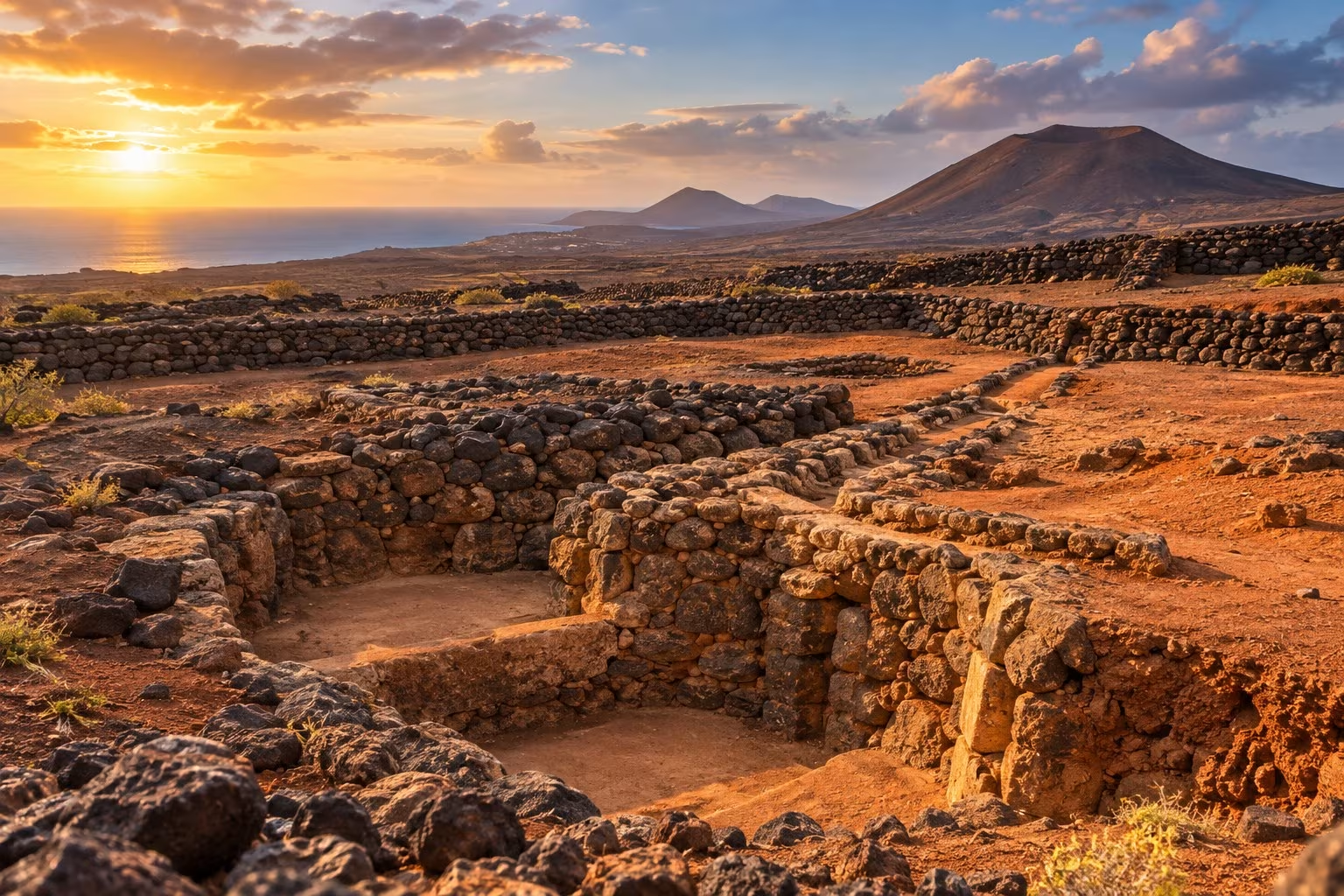

Lanzarote’s Ancient Water System: A Remarkable Discovery at El Bebedero
A newly uncovered water-management system at the El Bebedero archaeological site near Tiagua, in the municipality of Teguise, is giving researchers a fascinating insight into how Lanzarote’s indigenous communities adapted to life on one of the Canary Islands’ driest landscapes.
The discovery was made during the 2026 archaeological campaign and builds on an important find from the previous year. Researchers say the remains represent an unusually sophisticated indigenous system for collecting, filtering, directing and storing rainwater — and one of the most significant discoveries yet made at this important Lanzarote archaeological site.
Where is El Bebedero?
El Bebedero is an archaeological site in the Teguise municipality, close to Tiagua. Excavations began there in 1985 and have continued intermittently over the decades, making it one of the key sites for understanding the earliest communities of Lanzarote and the wider protohistory of the Canary Islands.
The name El Bebedero is particularly interesting. In Lanzarote and Fuerteventura, the word “bebedero” has traditionally been used for land adapted to receive and collect rainwater runoff, sometimes allowing the collected water to filter into the ground and supporting cultivation. The meaning is therefore closely linked to Lanzarote’s long history of making the most of scarce rainfall.
The first major clue came in 2025
During the 2025 excavation campaign, archaeologists uncovered a circular structure measuring around 1.5 metres across. It was interpreted as a possible cistern, reservoir or water-storage tank and is currently considered a candidate for the oldest cistern discovered on Lanzarote.
The structure was found in the southern part of the settlement, within archaeological layers dating from around the first century BC onwards. Its location and construction provided the first indication that the indigenous inhabitants may have had a dedicated facility for storing water rather than relying solely on natural pools or simpler collection areas.
The 2026 excavation revealed the bigger picture
The latest campaign has been particularly important because archaeologists were able to uncover a much larger part of the water-collection system around the cistern.
A broad paved area was identified as a surface designed to collect rainfall and direct it towards the storage structure. The system also includes channels and settling or decanting areas. These would have helped control the movement of water and reduce the amount of sediment entering the cistern.
Researchers describe the combination as the first indigenous hydraulic infrastructure of this type and complexity documented in the protohistory of the Canary Islands. Its use has been dated broadly between the first century BC and the fourth century AD.
In practical terms, this means the people living at El Bebedero were not simply finding water when it appeared. They were engineering ways to capture one of the island’s most valuable natural resources and make it available for later use.
Why water mattered so much in ancient Lanzarote
For modern visitors, Lanzarote’s volcanic scenery can make the island appear almost completely dry, but the challenge of water has shaped life here for centuries. Rainfall is limited and irregular, so traditional communities developed a range of ways to capture and store what little water arrived during wet periods.
Historic Lanzarote later became famous for its aljibes, maretas and other rainwater-collection systems. The archaeological evidence at El Bebedero pushes that story much further back, showing that sophisticated water management was already being used by indigenous communities roughly two thousand years ago.
The discovery is especially significant because storing rainwater was not simply a matter of convenience. Reliable water could support people, livestock and agricultural activity, helping communities survive in an environment where rainfall could not be taken for granted.
Evidence of contact with the Roman world
El Bebedero is also important for another reason: the site contains evidence of contact between Lanzarote’s indigenous population and people travelling from the Mediterranean world during antiquity.
Excavations have recovered fragments of Roman amphorae dating from approximately the second century BC through to the fourth century AD, alongside indigenous pottery, stone tools, animal remains, metal objects and glass items.
Researchers have suggested that these contacts may have involved exchanges. Locally available products could potentially have included water, preserved meat or animal hides, while imported amphorae carried products such as wine and oil. These interpretations remain part of the archaeological research rather than a fully documented trading record, but the collection of finds indicates sustained interaction over several centuries.
A window into Lanzarote’s earliest communities
The El Bebedero excavations are helping archaeologists reconstruct far more than the history of one settlement. The site provides evidence about food, animals, agriculture, pottery, technology, environmental change and contacts with visitors from outside the island.
The 2026 campaign also reached the deepest archaeological layer investigated so far in this part of the site. Researchers recovered further animal bones, including sheep and goat remains, together with fragments of handmade pottery. Samples have been selected for further analysis to help establish the earliest date for human activity at El Bebedero.
Modern technology is now helping to record the ancient site. The excavation team has used 3D laser scanning, digital photogrammetry and drones to document the structures and monitor the progress of the archaeological work in detail.
What does this mean for visitors to Lanzarote?
El Bebedero is not simply another archaeological footnote. It adds another fascinating chapter to the story of Lanzarote and helps explain how people managed to live successfully on the island long before modern water infrastructure existed.
For anyone interested in Lanzarote history, Teguise, archaeology or the island’s traditional relationship with water, the discovery is a reminder that some of the most interesting stories are hidden beneath the volcanic landscape.
It also puts Lanzarote’s later tradition of rainwater harvesting into perspective. The island’s famous aljibes and other historic water systems were part of a much longer story of adapting to a dry climate — a story that now appears to reach back to the indigenous communities who lived at El Bebedero around two thousand years ago.
The research continues
The excavations at El Bebedero began in 1985 and the site continues to produce new evidence. The latest discoveries do not close the story; they raise further questions about exactly how the water system operated, how much water it could collect, how it was maintained and how it fitted into everyday life within the settlement.
For Lanzarote, that makes El Bebedero particularly valuable. It is helping researchers piece together the island’s earliest history while showing just how inventive its first communities could be when faced with one of the island’s biggest challenges: finding and preserving water.
For Illustration Purposes an AI Generated Image has been used in this Article.
