
Lanzarote’s Internet Is Getting a Major Upgrade: New Submarine Fibre-Optic Ring Reaches Playa Honda
Lanzarote is taking another major step towards becoming a better-connected island, with a new submarine fibre-optic network now reaching Playa Honda.
For an island where reliable internet is increasingly important for residents, businesses, remote workers and the millions of people who visit Lanzarote every year, the project could prove to be one of those developments that happens largely out of sight but makes a significant difference behind the scenes.
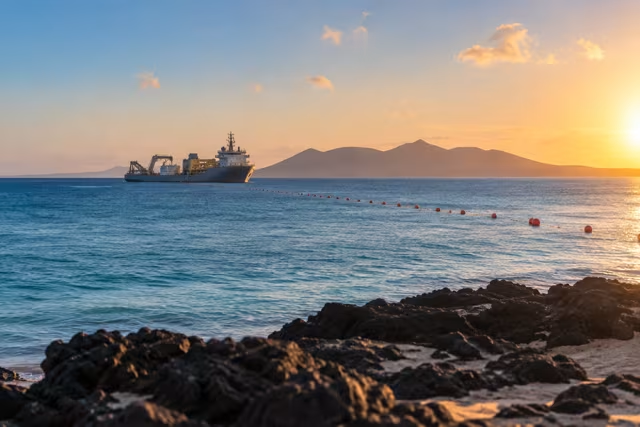
The latest milestone involves the Base4 submarine fibre-optic cable, which has now been deployed off the coast of Playa Honda as part of a much larger project connecting Lanzarote, Fuerteventura and Gran Canaria.
A new digital connection beneath the sea
The project, known as RING and being developed within the wider Atlántica initiative, is designed to create a new high-capacity submarine communications network between the eastern Canary Islands.
The complete system will use two separate submarine cable routes.
One route will connect:
Ojos de Garza – Gran Canaria → Puerto del Rosario – Fuerteventura → Playa Honda – Lanzarote
The second, western route will run:
Barranco de Tenoya – Gran Canaria → Corralejo – Fuerteventura → Playa Blanca – Lanzarote.
That second route is particularly important because the idea isn’t simply to add more cable. It creates alternative routes for data, making the network considerably more resilient if there is a problem with one connection.
So what does that mean for people living in Lanzarote?
In simple terms, the project is about creating a much stronger digital backbone for the island.
The new system is expected to provide greater capacity, improved resilience and more reliable communications between the eastern Canary Islands and the wider telecommunications network.
That could ultimately benefit everything from businesses and public services to tourism, online services and households relying increasingly on the internet.
It is particularly relevant for an island such as Lanzarote, where communications depend heavily on connections between the islands and the mainland.
553 kilometres of submarine cable
The scale of the project is impressive.
The planned system involves approximately 553 kilometres of submarine fibre-optic cable, linking the three islands.
The project has a total budget of around €34 million, with approximately €23 million in European funding through the Connecting Europe Facility’s CEF Digital programme.
According to the European Commission, the new system has been designed to replace or complement older submarine cable infrastructure and provide additional redundancy.
The system is planned with eight fibre pairs and a potential total capacity of around 308 Tbps, while the cables have been designed for a working life of approximately 25 years.
In other words, this isn’t simply an upgrade designed for today’s internet usage. It is infrastructure intended to cope with the enormous growth in digital demand expected over the coming decades.
Why Playa Honda is important
For Lanzarote, Playa Honda is one of the key points in the new network.
The recent operation involved the cable ship Teliri, supported by specialist technical teams and auxiliary vessels, deploying the Base4 cable off the Playa Honda coastline.
The cable will connect with terrestrial infrastructure at the landing point, allowing the submarine network to become part of the wider telecommunications system.
The Playa Honda connection is therefore much more than a piece of cable arriving on the Lanzarote coast. It is an important part of creating the new high-capacity network linking the eastern Canary Islands.
And there’s another route coming to Lanzarote
The work isn’t finished.
The next stage involves the western cable, which is planned to connect Gran Canaria, Fuerteventura and Lanzarote through Barranco de Tenoya, Corralejo and Playa Blanca.
This second route is crucial to the overall concept because it provides geographical diversification.
If one submarine connection experiences an interruption, having another route available can help keep communications running rather than leaving an island dependent on a single pathway.
The official project timetable puts completion of the RING project in September 2026, although the wider infrastructure still has to be integrated and brought into service. Canalink’s project documentation indicates that service operation is expected towards the end of 2026.
Will this make your home internet faster?
This is probably the question many Lanzarote residents will be asking.
Not necessarily immediately.
The project is primarily a submarine backbone infrastructure upgrade, rather than a scheme to replace the fibre connection running directly into every home.
Your actual broadband speed will still depend on your internet provider, your local network, your contract and the technology serving your property.
However, strengthening the underlying network gives telecommunications operators a much better platform on which to provide services as demand continues to grow.
So while you might not suddenly see your broadband package change overnight, more capacity and greater network resilience are good news for Lanzarote’s long-term internet infrastructure.
Good news for tourists and holiday businesses too
Reliable internet isn’t just important to people who live here.
For visitors, a dependable connection is now an expected part of a holiday.
Tourists use mobile and Wi-Fi networks to:
- Check maps and directions
- Book restaurants and excursions
- Make online payments
- Stream entertainment
- Contact family and friends
- Work remotely while visiting Lanzarote
- Check flights and travel information
Meanwhile, hotels, villas, apartments, restaurants, excursion companies and other Lanzarote tourism businesses increasingly rely on digital systems to manage bookings, payments, customer communication and day-to-day operations.
A stronger telecommunications backbone therefore has implications far beyond simply watching Netflix a little more reliably.
An important investment for Lanzarote’s future
The project also comes at a time when the Canary Islands are becoming increasingly dependent on digital services.
Remote working, cloud computing, online shopping, digital businesses, electronic administration, online education and technology-based services all require dependable connectivity.
Canalink says the new network is intended to support sectors including tourism, e-commerce, education, healthcare and digital services, while improving the resilience of communications between the eastern islands.
For Lanzarote, that could become increasingly important as the island continues to attract not only holidaymakers but also international businesses, entrepreneurs, remote workers and people choosing to live here permanently.
The invisible infrastructure beneath Lanzarote
Most people will never see the new fibre-optic network once the installation work is complete.
There won’t be a giant new building or an obvious landmark announcing that Lanzarote’s internet infrastructure has changed.
Instead, thousands of kilometres of technology beneath the Atlantic will quietly carry enormous quantities of data between the islands and beyond.
And that may be the most interesting part of the whole project.
The next time you’re sitting in Lanzarote making a video call, booking a holiday excursion or streaming something online, spare a thought for the infrastructure beneath the sea helping make it possible.
What happens next?
With the Playa Honda section now deployed, attention turns to the remaining work needed to complete the second route and integrate the new infrastructure.
Once operational, the Lanzarote–Fuerteventura–Gran Canaria fibre-optic ring should provide the eastern Canary Islands with a modern, higher-capacity and more resilient communications network designed to cope with increasing digital demand.
For residents and visitors alike, it is an important piece of Lanzarote’s digital future — even if most of it remains hidden beneath the Atlantic.