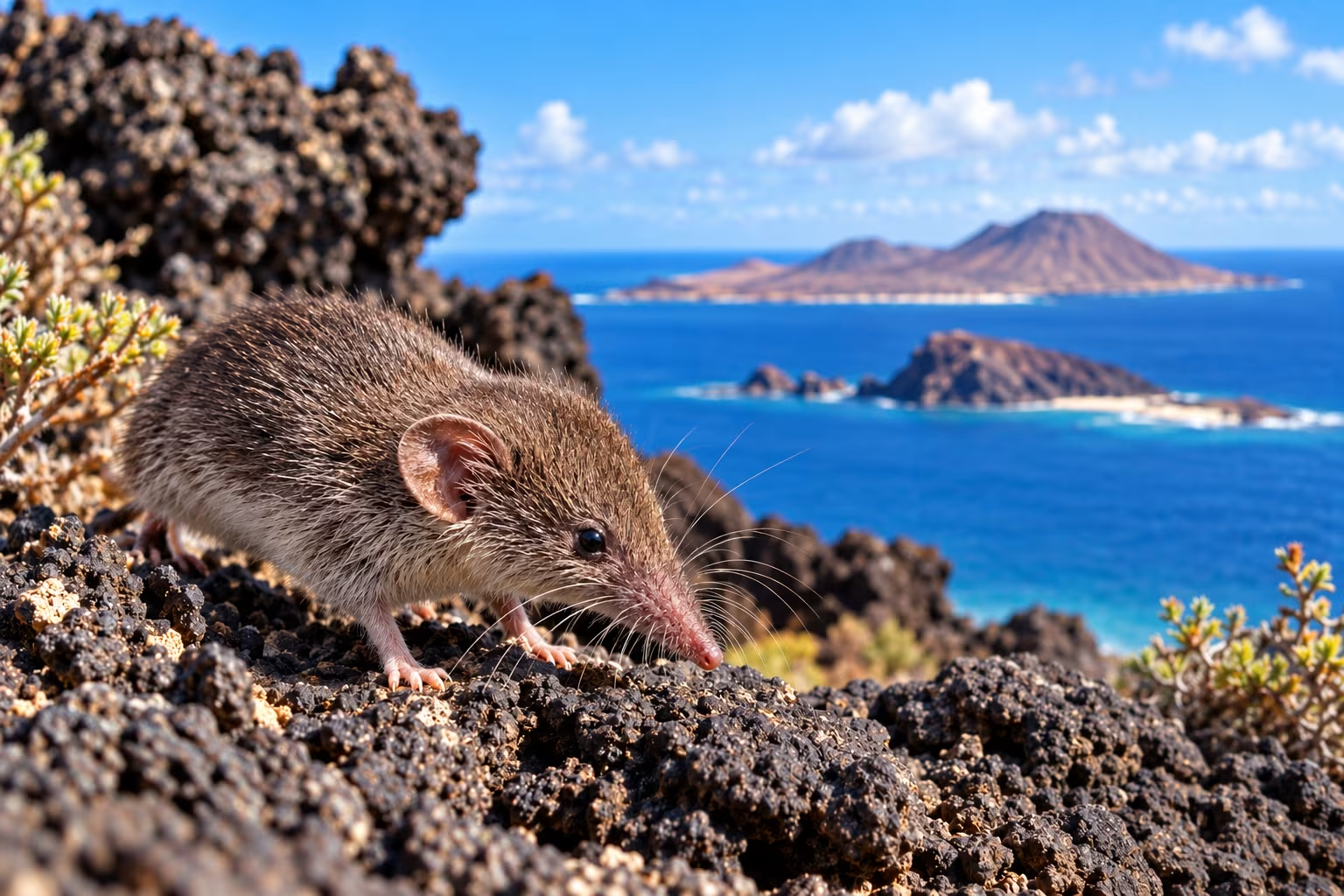

THE CANARY SHREW: WHAT TWO YEARS OF RESEARCH COULD TELL US ABOUT LANZAROTE'S ELUSIVE NATIVE MAMMAL
A tiny mammal hiding in Lanzarote's volcanic landscape
One particularly fascinating example is the Canary shrew (Crocidura canariensis), a small mammal found only in the eastern Canary Islands.
Now, after two years of research in Lanzarote and the nearby islet of Montaña Clara, scientists are taking a closer look at this little-known species and what its future could look like.
The latest research will be presented by zoologist Claudia Schuster at an upcoming Hablemos de la Biosfera event in Lanzarote on 22 September 2026.
One of the Canary Islands' most unusual mammals
The Canary shrew is particularly interesting because it is endemic to the Canary Islands — meaning it occurs naturally nowhere else in the world.
Its known distribution includes Lanzarote, Fuerteventura and several nearby islets, including Montaña Clara and Lobos. Official biodiversity records classify the species as Vulnerable in both Lanzarote and Fuerteventura.
It is also listed under Annex IV of the European Habitats Directive, meaning it receives strict protection.
For such a small animal, that makes the Canary shrew an important part of Lanzarote's natural heritage.
Where does the Canary shrew live?
Perhaps surprisingly, this isn't an animal associated with lush forests or green countryside.
The Canary shrew has been recorded in some of Lanzarote's more rugged environments, including lava fields, rocky areas and semi-desert landscapes.
Previous research by Claudia Schuster found the species particularly associated with relatively barren terrain. In one earlier study, shrews were recorded in lava fields and on a mountain ridge, while none were captured in richer habitats during that particular survey.
That makes Lanzarote's volcanic landscape more than just something beautiful to look at. The malpaís, lava formations and rocky terrain provide important habitat for native wildlife that has adapted to the island's harsh conditions.
Why is Montaña Clara so important?
One of the particularly interesting locations in the latest research is Montaña Clara, part of the Chinijo Archipelago to the north of Lanzarote.
Existing monitoring data suggests that Montaña Clara could be particularly significant for the Canary shrew. The absence of introduced mammals there may provide an important refuge for the species.
This is one reason why studying wildlife on the smaller islands and islets around Lanzarote can tell scientists something that isn't always obvious from looking at the main island alone.
Why does the Canary shrew need protecting?
Like many island species, the Canary shrew has a restricted geographical range.
That makes changes to its habitat potentially much more significant than they would be for a widespread mainland animal.
Research and official conservation information have identified concerns including habitat loss and fragmentation and the arrival of introduced species. More broadly, the Canary Islands' biodiversity faces pressures from invasive species, habitat changes and climate-related impacts.
The species is officially classified as Vulnerable, both nationally and within the Canary Islands.
Two years of research in Lanzarote
The new project, supported by the Environment Department of the Cabildo of Lanzarote and La Graciosa, was carried out through GREFA-Canarias, the organisation dedicated to the rehabilitation and conservation of native fauna and its habitat.
Over the two-year project, researchers have been investigating the Canary shrew in Lanzarote and Montaña Clara, with the forthcoming presentation expected to explain how the research was carried out and what scientists have learned.
Rather than simply asking where are the shrews?, research of this kind can help build a much clearer picture of a species — including its distribution, habitat requirements and the factors that could affect its long-term survival.
And that information matters when conservation decisions are being made.
You may never see one — and that's part of the story
If you're visiting Lanzarote, don't expect to spot a Canary shrew while walking along Puerto del Carmen's seafront or relaxing on one of the island's beaches.These are small, elusive animals, and their presence is far less obvious than Lanzarote's more familiar wildlife.
But that's what makes the species so fascinating.
Millions of visitors come to Lanzarote each year to experience its dramatic volcanic scenery, yet beneath the rocks and around the island's quieter natural areas there is a whole ecosystem that can easily go unnoticed.
The Canary shrew is a reminder that Lanzarote's wildlife isn't just about dolphins, whales, seabirds and lizards. Some of the island's most important inhabitants are tiny, secretive and rarely seen.
Find out more about Lanzarote's hidden wildlife
The results of the latest two-year study will be presented by zoologist Claudia Schuster during the Hablemos de la Biosfera programme.
Date: 22 September 2026
Time: 7:30pm
Location: Aula Magna, UNED, Lanzarote
Admission: Free, subject to capacity
Online: The presentation will also be available online.
For anyone interested in Lanzarote wildlife, Canary Islands nature, biodiversity, conservation or the island's unique volcanic environment, it could provide a fascinating insight into a species that most of us rarely get the chance to see.
A little animal with a big conservation story
Lanzarote's landscapes can sometimes look almost barren, but they are anything but lifeless.
From plants that survive with very little water to reptiles, birds and tiny mammals adapted to volcanic terrain, the island supports an extraordinary collection of species.
The Canary shrew is one of the lesser-known members of that community — and the latest research could help scientists understand how to ensure that this uniquely Canarian mammal remains part of Lanzarote's natural landscape for generations to come.