
THE STORY BEHIND LANZAROTE'S FAMOUS DEVIL
If you have ever visited Timanfaya, there is a good chance you have seen him.
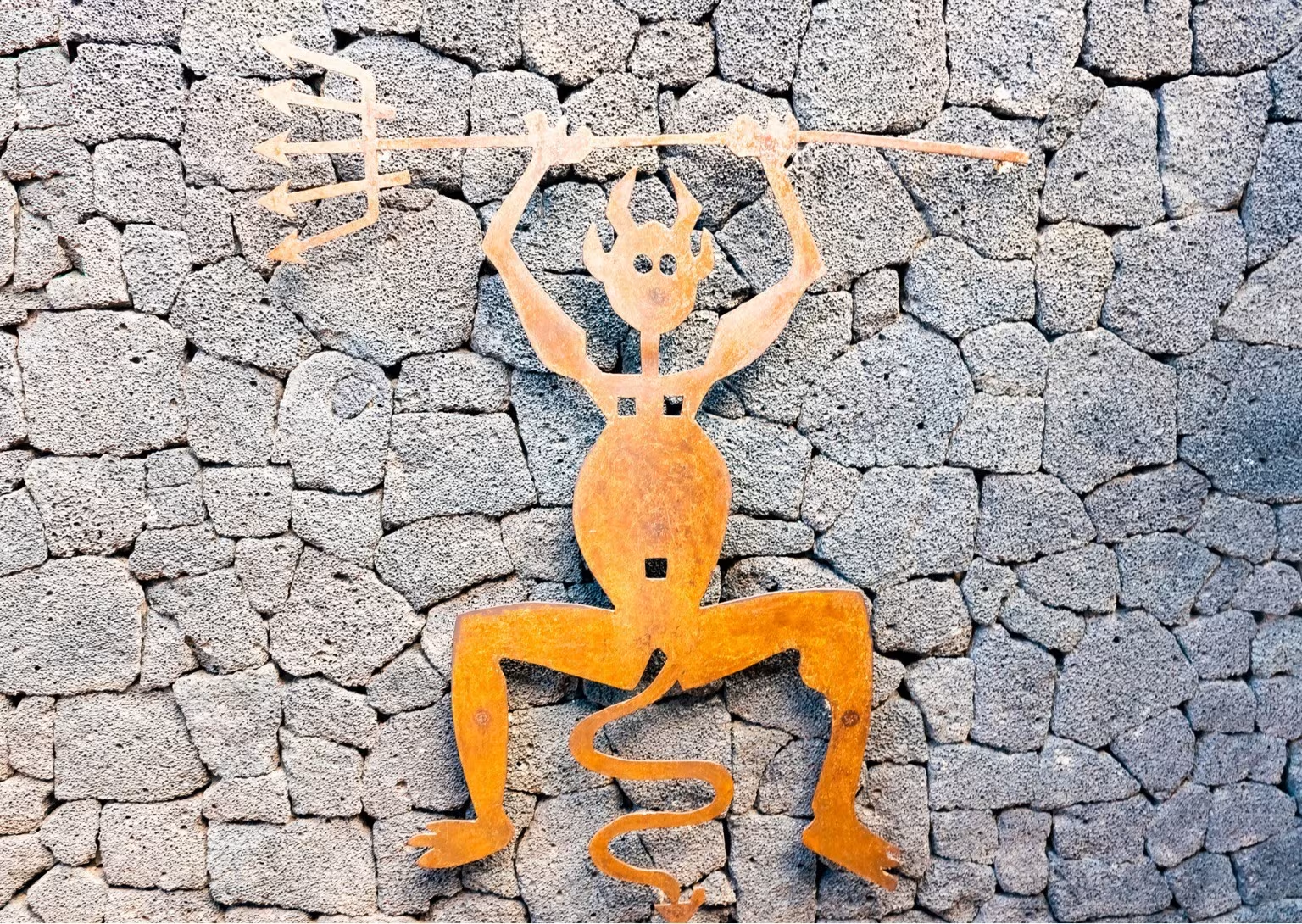
He stands out against the volcanic landscape with his horns, trident and unmistakable fiery appearance. You will find versions of the figure around the Montañas del Fuego area, and for many visitors he has become almost as recognisable as the volcanoes themselves.
But here is something many people don't realise: Lanzarote's famous devil isn't an ancient symbol handed down through centuries.
He was created by César Manrique.
THE DEVIL WAS BORN AS A WORK OF ART
The image known as El Diablo was designed by César Manrique in 1968. The Fundación César Manrique catalogues the original work as an ink drawing on paper, measuring 47.5 by 36 centimetres.
The design is simple but incredibly effective: a dark, almost cartoon-like devil with horns and a trident, created with a slightly ironic and playful character rather than as a frightening monster.
It was an image that fitted its surroundings perfectly.
Timanfaya is a landscape of fire, lava, craters and volcanic rock. The devil immediately suggests those same ideas, making the character a natural visual symbol for the Montañas del Fuego.
FROM DRAWING TO LANZAROTE ICON
The story becomes even more interesting when you look at what Manrique was doing in Timanfaya.
Around 1970, Manrique and his collaborators worked on the development of the visitor experience at Timanfaya, including Restaurante El Diablo and the Route of the Volcanoes.
His approach was very different from simply building tourist attractions. He wanted visitors to experience the landscape while keeping the volcanic environment at the centre of everything.
The Route of the Volcanoes was designed to allow people to see the dramatic landscape while limiting the physical impact of tourism. At Restaurante El Diablo, the building itself was designed to sit within the volcanic surroundings, with huge windows opening onto the lava fields.
And alongside this work came the devil.
According to the Fundación César Manrique, the schematic dark devil became the emblem of Timanfaya and eventually one of the symbols of Lanzarote itself.
WHY A DEVIL?
It is easy to see why the image works.
Timanfaya can feel otherworldly. The landscape was created by enormous volcanic eruptions, and the black, red and ochre colours of the lava fields can look almost unreal.
The devil therefore plays on the idea of fire and the power beneath the island.
But Manrique's devil isn't particularly sinister. There is something almost humorous about him. That fits Manrique's artistic style and helps explain why the figure became something visitors could enjoy and photograph rather than something genuinely frightening.
TODAY, HE IS PART OF THE LANZAROTE EXPERIENCE
For tourists, the devil has become one of those instantly recognisable images associated with a Lanzarote holiday.
You can visit Timanfaya, travel through the volcanic landscape, see the geothermal demonstrations and visit the area around Restaurante El Diablo — and the devil is never far from the visual identity of the place.
What makes it particularly fascinating is that the symbol is relatively modern.
It isn't an ancient Guanche figure and it wasn't created hundreds of years ago. It was the work of a 20th-century Lanzarote artist who understood how powerful a simple image could become when it was connected to the landscape.
AND THAT IS VERY MANRIQUE
Perhaps the most interesting thing about El Diablo is that it demonstrates what César Manrique did so well.
He didn't simply decorate Lanzarote.
He created ways of interpreting the island.
His work at Timanfaya, Jameos del Agua, Mirador del Río and other locations was based around the relationship between art and nature.
The devil is a perfect example.
A simple drawing became part of a much bigger experience: volcanic landscape, architecture, tourism, art and Lanzarote's identity all brought together.
SO NEXT TIME YOU SEE HIM...
Take a closer look.
That little devil isn't just a tourist logo.
He is part of the story of how modern Lanzarote was shaped.
He simply belongs here.