

455 Years On: The Forgotten History Beneath Lanzarote’s Southern Coast
If you have ever stood on the southern coast of Lanzarote and looked out towards the Atlantic, it is easy to think of the island purely as a holiday destination. Beaches, volcanoes, restaurants and spectacular sunsets dominate the modern picture. But beneath the landscape is a much older story — one involving conquest, settlement, trade, religion, conflict and repeated attacks from the sea.
This week brings an unusual anniversary. On 21 September 1571, the corsair Dogalí, also known as “El Turquillo”, arrived at Lanzarote with a force reported at around 400 men aboard seven galleys. Historical records place the landing at Arrecife, followed by an advance towards Teguise, then the island’s principal political centre. The raid continued until 7 October and resulted in the capture of more than 100 people, according to historical research held by the University of Las Palmas de Gran Canaria.
Exactly 455 years later, on 21 September 2026, the focus has shifted dramatically. Instead of armed ships arriving from across the Atlantic, archaeologists are returning to the south of Lanzarote. A new campaign at San Marcial de Rubicón is continuing work on one of the most important archaeological sites for understanding the early European history of the Canary Islands.
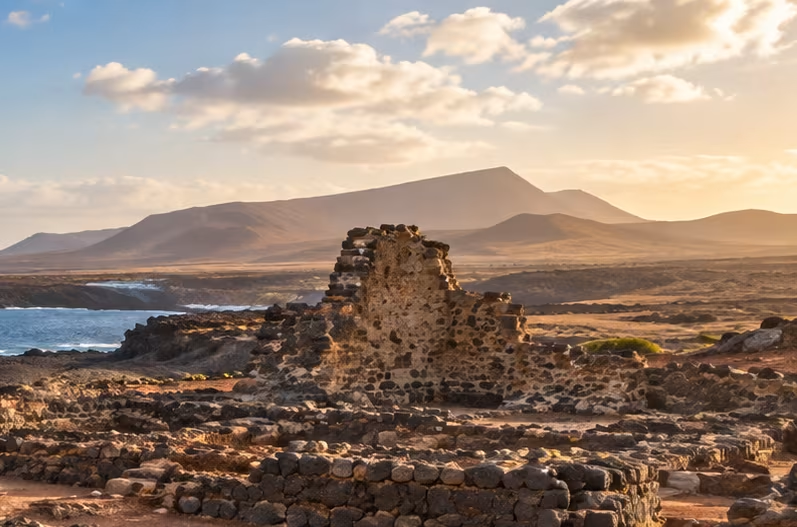
For visitors and residents, San Marcial de Rubicón is particularly interesting because it connects several different chapters of Lanzarote’s past. The site, in the municipality of Yaiza, is associated with the expedition led by Jean de Bethencourt and Gadifer de La Salle, which reached Lanzarote in 1402. Archaeological research identifies Rubicón as the first permanent European settlement established during the conquest process in the Canary Islands.
The location was not chosen at random. The archaeological area contains evidence of a settlement built around access to the coast, water and a sheltered landing place. Government documentation describing the protected archaeological zone identifies features including wells, a tower, the church or cathedral area, a cemetery, working areas and an indigenous zone. Research into the San Marcial well has also found evidence that its construction was a planned piece of hydraulic engineering rather than a simple improvised water source.
Over the years, excavations at Rubicón have revealed a picture that is much more complicated than a single story of European arrival. Archaeologists have found structures, pottery, hearths, occupation layers, coins and human remains. Geophysical surveys have helped researchers locate buried features before excavating them, while archaeological work has also extended into the coastal waters in the wider area.
The human remains are particularly valuable to researchers because bones can provide information that written chronicles cannot. Excavation campaigns between 2023 and 2025 documented 17 individuals in total. Researchers can examine these remains for evidence about age, diet, disease, living conditions, ancestry and population movement. Recent scientific work has added bioanthropological and genetic evidence to the documentary and archaeological record.
The story of Rubicón also helps explain why later events, such as the Dogalí raid of 1571, mattered so much. Lanzarote’s position in the Atlantic made it strategically important but also exposed it to attacks. The island had already suffered a major raid in 1569, when Calafat of Salé arrived with a much larger force. The repeated attacks contributed to growing concern about the island’s defences and the protection of Arrecife and other vulnerable points.
The aftermath of the 1571 attack is part of Lanzarote’s military history too. Historical sources record efforts to strengthen the island’s defences after Dogalí’s raid, including work associated with the Castillo de Santa Bárbara in Teguise. Today, the castle is one of the places where visitors can explore the island’s long relationship with Atlantic raids and defence.
What makes San Marcial de Rubicón especially fascinating is that the archaeology is still developing. The latest five-week campaign is the seventh excavation season, supported by the Government of the Canary Islands, Yaiza Town Hall, the University of Las Palmas de Gran Canaria and the University of La Laguna. The institutions have also extended their cooperation for a further two years, allowing research to continue.
There is a longer-term ambition as well: the development of an archaeological park at the site. If that happens, Rubicón could eventually become a place where visitors can see and understand the remains in their landscape rather than simply reading about them in a museum or history book.
The island’s history did not begin with modern tourism, and it is not limited to volcanoes and César Manrique. From the indigenous communities who lived here before the conquest, to the arrival of European forces in the early 15th century, to the corsair raids of the 16th century, Lanzarote has always been shaped by its position between Africa, Europe and the Atlantic.
So the next time you are exploring Yaiza, visiting the south of the island or travelling towards the Papagayo area, remember that the landscape has another layer. Around San Marcial de Rubicón, archaeologists are gradually piecing together evidence of a settlement that helped change the history of the Canary Islands — while the anniversary of a 16th-century raid reminds us just how vulnerable that same coastline once was.
An AI Generated Image has been used for this Article
