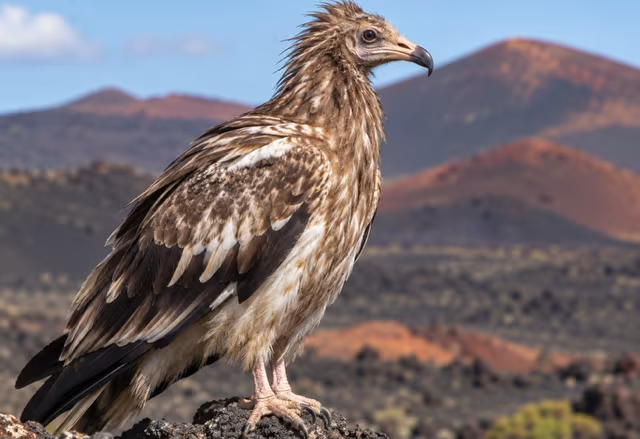

A Young Guirre Takes Flight from Timanfaya in Another Boost for Lanzarote’s Wildlife
A young Canary Islands Egyptian vulture born in Timanfaya National Park has successfully left its nest and begun the next stage of its life on Fuerteventura.
The chick, born earlier this year to a breeding pair in the national park, left its nest in July 2026 after being raised by its parents for several months. Its next destination is Fuerteventura, where it will spend the coming years developing the skills it needs to survive as an adult.
For Lanzarote, it is more than simply a story about one young bird taking flight. The successful breeding of the guirre represents another small but significant step in the recovery of one of the Canary Islands’ most important birds.
A rare sight in Lanzarote
The guirre, known in English as the Canary Islands Egyptian vulture, is a subspecies of Egyptian vulture scientifically known as Neophron percnopterus majorensis. It is endemic to the Canary Islands and is the only strictly scavenging bird of prey found in the archipelago.
For anyone who regularly looks up at the skies around Lanzarote, seeing one soaring overhead can be a particularly special experience.
The species has had a difficult history in the islands. Its population suffered a dramatic decline during the 20th century, with poisoning and human pressure among the factors contributing to its decline. Conservation programmes have since helped numbers recover, particularly on Fuerteventura.
The Canary Islands Government says there are now more than 500 guirres across Lanzarote, Fuerteventura and the Chinijo Archipelago, although Lanzarote’s recovery has been considerably slower than that seen on Fuerteventura.
Timanfaya breeding success
The breeding pair at Timanfaya National Park is particularly significant.
Guirres returned to breeding in Timanfaya in 2022, after an absence of more than two decades. The same pair subsequently bred again in 2024 and returned to reproduce during 2026.
The 2026 breeding attempt began at the start of the year, with the birds using the same general breeding territory they had selected previously.
The nest itself had been used in earlier years, and the parents successfully raised their latest chick.
According to information from Timanfaya National Park, the young bird left the nest in July. Before its first flight, park specialists were able to see it exercising its wings as it prepared for the moment when it would finally leave its birthplace.
Why the move to Fuerteventura matters
Leaving the nest doesn’t mean the young guirre is suddenly an independent adult.
Instead, the journey to Fuerteventura is an important part of its development.
There, it can mix with guirres of different ages, learn from other birds and explore the island while developing its ability to find food and survive independently.
Why protecting nesting guirres is so important
Successfully raising a chick isn’t guaranteed.
The Canary Islands Government estimates that the productivity of breeding guirre pairs is only around 40%, meaning that approximately four out of every ten monitored breeding pairs successfully raise a chick. Human disturbance around nesting areas is considered one of the important factors affecting breeding success.
That’s why monitoring has been deliberately carried out without getting too close.
Throughout the nesting period, a specialist field technician and a Timanfaya ranger visited the nest approximately every two weeks, keeping a safe distance so the birds weren’t disturbed.
It is a useful reminder for anyone exploring Timanfaya National Park and other wild areas of Lanzarote that sometimes the best way to appreciate wildlife is simply to give it space.
A conservation success worth celebrating
The story of the Timanfaya chick is particularly encouraging because the guirre in Lanzarote has come a long way from being on the brink of disappearing from the island.
Conservation work across the Canary Islands has included population monitoring, protection of nesting areas, supplementary feeding, measures to reduce electrocution risks on power infrastructure and action against illegal poisoning.
The recovery is still described as being in its early stages in Lanzarote, but successful breeding provides an important reason for optimism.
And while most visitors to Lanzarote come for the volcanoes, beaches, sunshine and spectacular landscapes, the island’s wildlife is another part of what makes it special.
That black-and-white silhouette circling high above the volcanic landscape is a reminder that Lanzarote is home to wildlife found nowhere else in quite the same way.
For residents, it’s another reason to be proud of the natural environment on the island.
For visitors, spotting a guirre soaring over Lanzarote’s volcanic landscape is a little bonus that doesn’t appear in every holiday brochure.
And somewhere over in Fuerteventura, a young bird born in Timanfaya is now beginning the next chapter of its life.