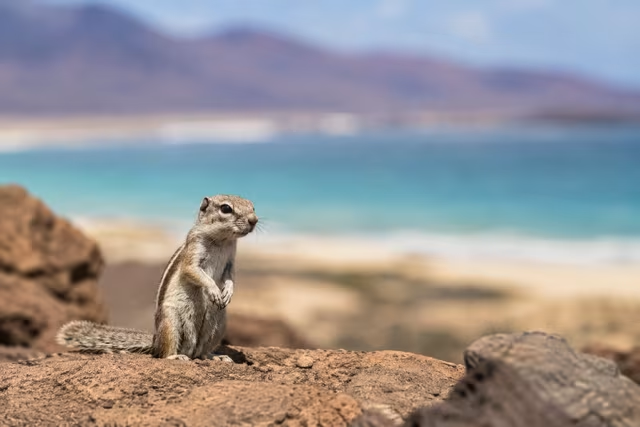

Ardilla moruna captured in Lanzarote after arriving hidden in a rental car from Fuerteventura
A surprise passenger has raised concerns about invasive species in Lanzarote after a Barbary ground squirrel was discovered in Playa Honda this week.
A rather unusual arrival in Lanzarote has put the spotlight on the island’s efforts to prevent invasive species in Lanzarote.
A Barbary ground squirrel, known in Spanish as the ardilla moruna and scientifically as Atlantoxerus getulus, was captured in Playa Honda, San Bartolomé, after apparently travelling from Fuerteventura concealed within the bodywork of a rental car.
The animal was discovered on 1 September 2026, after a local resident alerted the Policía Local. The subsequent operation involved San Bartolomé Local Police, environmental officers from the Cabildo de Lanzarote and the Government of the Canary Islands’ RedEXOS intervention team. The squirrel was captured before it could escape into the surrounding environment.
From Fuerteventura to Lanzarote – an unexpected journey
The incident is particularly significant because Fuerteventura is home to a large established population of Barbary ground squirrels, while authorities are keen to prevent the species from becoming established elsewhere in the Canary Islands.
According to the information released following the capture, the squirrel appears to have travelled accidentally with two tourists who had brought their rental vehicle across from Fuerteventura.
It is a good example of how easily an invasive species can move between the Canary Islands without anyone deliberately transporting it.
The animal was reportedly found before it had the opportunity to leave the vehicle and enter the natural environment around Playa Honda. The quick response therefore prevented what could have become a considerably more difficult situation.
Why are Barbary ground squirrels a concern?
To visitors, a small squirrel running around Lanzarote might initially seem harmless – and certainly an unusual sight on an island better known for camels, goats, lizards and its volcanic landscapes.
The problem is that the Barbary ground squirrel is not native to the Canary Islands.
The species originates from parts of north-west Africa and was introduced to Fuerteventura in 1965, following the arrival of a pair that had been brought to the island as pets and subsequently released. From that relatively small beginning, the species went on to spread extensively across Fuerteventura.
The Canary Islands biodiversity database identifies the animal as an introduced invasive species and documents potential impacts on native vegetation, wildlife and agriculture.
The squirrel feeds on plant material and can also prey on nests of small birds and consume terrestrial invertebrates. Researchers have therefore identified potential consequences for Canary Islands biodiversity and native wildlife if populations become established in new areas.
Is there now a population of squirrels in Lanzarote?
The capture of one animal does not mean that Lanzarote has an established population of Barbary ground squirrels.
The official Canary Islands biodiversity information has previously noted uncertainty over whether incipient populations could exist on Lanzarote.
For that reason, the latest incident is better viewed as an important early detection and prevention case rather than evidence that squirrels are now established across the island.
That distinction matters.
When an invasive species is detected early, authorities have a much better chance of removing individual animals before they reproduce and establish themselves.
Could tourists accidentally bring invasive species to Lanzarote?
Yes – and this incident demonstrates how easily it can happen without anyone intending to do so.
The squirrel apparently travelled inside a vehicle rather than being deliberately brought to Lanzarote.
For an island environment such as Lanzarote, where native ecosystems have developed in relative isolation, preventing the movement of non-native species is particularly important.
The incident also highlights something worth remembering for both Lanzarote residents and visitors: checking vehicles, luggage, equipment and other belongings when travelling between islands can help prevent unwanted passengers from making the journey too.
What should you do if you see a squirrel in Lanzarote?
The Cabildo is asking residents and visitors to remain vigilant.
If you believe you have spotted a Barbary ground squirrel in Lanzarote, don’t try to catch it yourself.
Authorities specifically recommend that members of the public do not capture, handle or release the animal themselves.
Instead, report the sighting as quickly as possible.
Reports can be made through:
- 112
- The Policía Local in the relevant municipality
- Cabildo de Lanzarote Environmental Officers: 928 598 548
- RedEXOS: 646 601 457
RedEXOS is the Canary Islands network responsible for the early detection and intervention of exotic invasive species.
If possible, take a photograph from a safe distance and note the exact location, time and direction in which the animal was travelling. Don’t put yourself at risk attempting to get closer.
A reminder about protecting Lanzarote’s unique environment
Lanzarote’s volcanic landscape may look tough and resilient, but the island’s ecosystems are particularly valuable and vulnerable to the introduction of species that don’t naturally belong here.
The latest squirrel incident ended well because the animal was detected and captured before it could reach the natural environment.
For Lanzarote residents and tourists, it’s a useful reminder that protecting the island’s environment isn’t only about looking after beaches, volcanoes and protected landscapes. It also means helping prevent invasive species from becoming established in Lanzarote.
One small animal arriving unnoticed could potentially create a much bigger environmental problem if it manages to establish a breeding population.
In this case, a sharp-eyed resident, followed by a rapid response from the authorities, meant that an unexpected passenger didn’t get the chance to make Lanzarote its new home.