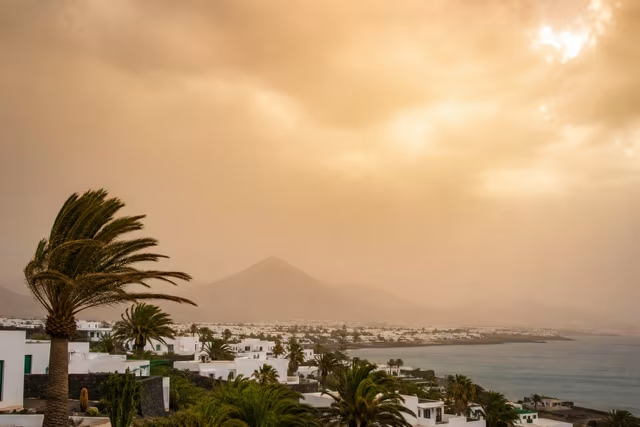

Canary Islands Now Affected by Saharan Dust Around 146 Days a Year, New Study Finds
The Canary Islands are experiencing the effects of Saharan dust on around 40% of days each year – equivalent to approximately 146 days – according to new research highlighting an increase in desert dust reaching Europe.
For people living in Lanzarote and visitors who regularly holiday in the Canary Islands, the hazy skies and reduced visibility associated with calima are a familiar sight. However, new scientific research suggests that airborne desert dust is becoming an increasingly significant environmental issue.
A major study published in the scientific journal Nature has found that the amount of desert dust in Europe’s atmosphere has increased by an estimated 10% to 25% over the past decade, with southern Europe experiencing considerably higher concentrations than central and northern parts of the continent.
The research, led by the Paul Scherrer Institute (PSI) in Switzerland and involving scientists from across Europe, including Spain’s IDAEA-CSIC, analysed data from more than 100 monitoring stations and used machine-learning techniques to assess levels of airborne desert dust.
Canary Islands Among the Areas Most Frequently Affected
The Canary Islands’ proximity to the African continent means the archipelago is particularly exposed to airborne dust originating in the Sahara and other desert regions of North Africa.
According to information released in connection with the study, African dust episodes affect the Canary Islands on approximately 40% of days during the year. If spread across a full 365-day year, that works out at roughly 146 days when some level of African dust may be present.
This does not mean that Lanzarote experiences severe calima conditions for five months of every year. The intensity of Saharan dust can vary enormously, from relatively low concentrations that may barely be noticed by residents and tourists to much stronger episodes that turn the sky hazy, reduce visibility and significantly affect air quality.
Why Is Saharan Dust Increasing?
Scientists believe several factors may be contributing to the increase in Saharan dust reaching the Canary Islands and Europe.
Changes in atmospheric circulation can alter the routes taken by air masses travelling from North Africa, while increasingly dry conditions in some areas can create more opportunities for desert material to become airborne.
Researchers behind the study say current scientific understanding suggests that human-produced greenhouse gas emissions and the associated effects of global warming are facilitating the increase, as drier conditions and desert expansion can contribute to greater dust emissions.
Normally, prevailing winds can carry African dust westwards across the Atlantic. However, particular weather patterns can transport large quantities of dust towards the Canary Islands, the Iberian Peninsula and other areas of Europe.
What Does Calima Mean for Lanzarote?
Calima in Lanzarote occurs when fine particles of dust and sand suspended in the atmosphere travel across from North Africa.
During a noticeable calima episode, people in Lanzarote may experience:
- Hazy or milky-looking skies
- Reduced visibility across the island
- Higher levels of airborne particles
- Dust settling on cars, windows and outdoor furniture
- Reduced air quality
- Increased discomfort for people sensitive to airborne particles
For tourists, a calima does not necessarily mean that a holiday in Lanzarote will be disrupted. Many episodes are relatively mild, and conditions can vary considerably from one event to another.
More intense episodes, however, can have a noticeable effect on visibility and air quality and may coincide with unusually warm conditions depending on the weather pattern responsible.
Scientists Highlight Potential Health Impact
One of the main concerns surrounding increased Saharan dust in the Canary Islands is its potential impact on air quality.
Desert dust contributes to atmospheric particulate matter, including PM10 particles, and scientific research has associated exposure to high levels of airborne dust with adverse health effects.
The Nature study notes that desert dust outbreaks can degrade air quality and are associated with health risks including the exacerbation of asthma and increased mortality.
Researchers calculated an average desert-dust concentration of around 5.3 micrograms per cubic metre of air in southern Europe, compared with approximately 2.1 micrograms in central and northern Europe.
Across the period studied, desert dust pollution increased by approximately half a microgram per cubic metre – representing an estimated rise of between 10% and 25%.
Could Increasing Calima Affect Solar Energy?
The implications are not limited to health.
Scientists also point to the potential impact of increasing desert dust on solar energy production. Dust in the atmosphere can reduce the amount of sunlight reaching solar installations, while particles settling directly onto solar panels can further reduce their efficiency.
This could be particularly relevant for sunny regions such as Lanzarote and the Canary Islands, where renewable energy and solar power have significant potential.
What Should Lanzarote Residents and Tourists Know?
For those living in or visiting Lanzarote, calima remains a normal feature of the Canary Islands’ climate, and the presence of some African dust does not automatically mean severe conditions.
The latest research does, however, provide new insight into just how frequently the archipelago is exposed to desert dust and suggests that the overall amount reaching Europe has been increasing.
With the Canary Islands affected by African dust on an estimated 40% of days, scientists will continue to examine how changing climate and atmospheric patterns could influence the frequency and intensity of future events.
For residents and holidaymakers, the best advice during periods of significant calima is to keep an eye on official Lanzarote weather forecasts, Canary Islands weather warnings and local air-quality information – particularly for anyone who may be more vulnerable to poor air quality.