
César Manrique: Remembering the Man Who Helped Shape Lanzarote
Today, 25 September 2026, marks 34 years since the death of César Manrique, one of the most influential figures in the story of modern Lanzarote.
For visitors arriving on the island today, it can be easy to see the whitewashed buildings, volcanic landscapes, sculpted viewpoints and carefully protected natural spaces simply as part of Lanzarote's character. But much of the visual identity that makes Lanzarote so distinctive is closely connected to Manrique's ideas about art, architecture and the natural environment.
Who was César Manrique?
César Manrique was born in Arrecife on 24 April 1919. He trained at the San Fernando Academy of Fine Arts in Madrid and developed an international career as a painter and artist.
His artistic journey also took him to New York in the 1960s, where he encountered movements including Abstract Expressionism, Pop Art and kinetic art. The experience broadened his artistic outlook, but Lanzarote's volcanic landscape remained central to his creative vision.
Manrique returned permanently to Lanzarote in 1966. From then on, his work became increasingly connected with the island itself.
Rather than treating architecture and nature as separate, he developed an approach often described through the idea of 'art-nature' – creating spaces where buildings, sculpture, gardens and volcanic scenery could work together.
The result is something visitors can still experience across Lanzarote today.
How César Manrique changed Lanzarote
Manrique worked with the Cabildo de Lanzarote and a wider team of architects, artists, engineers, craftsmen and other professionals on a series of projects that helped present the island's natural environment in a different way.
The island's Art, Culture and Tourism Centres grew from this vision.
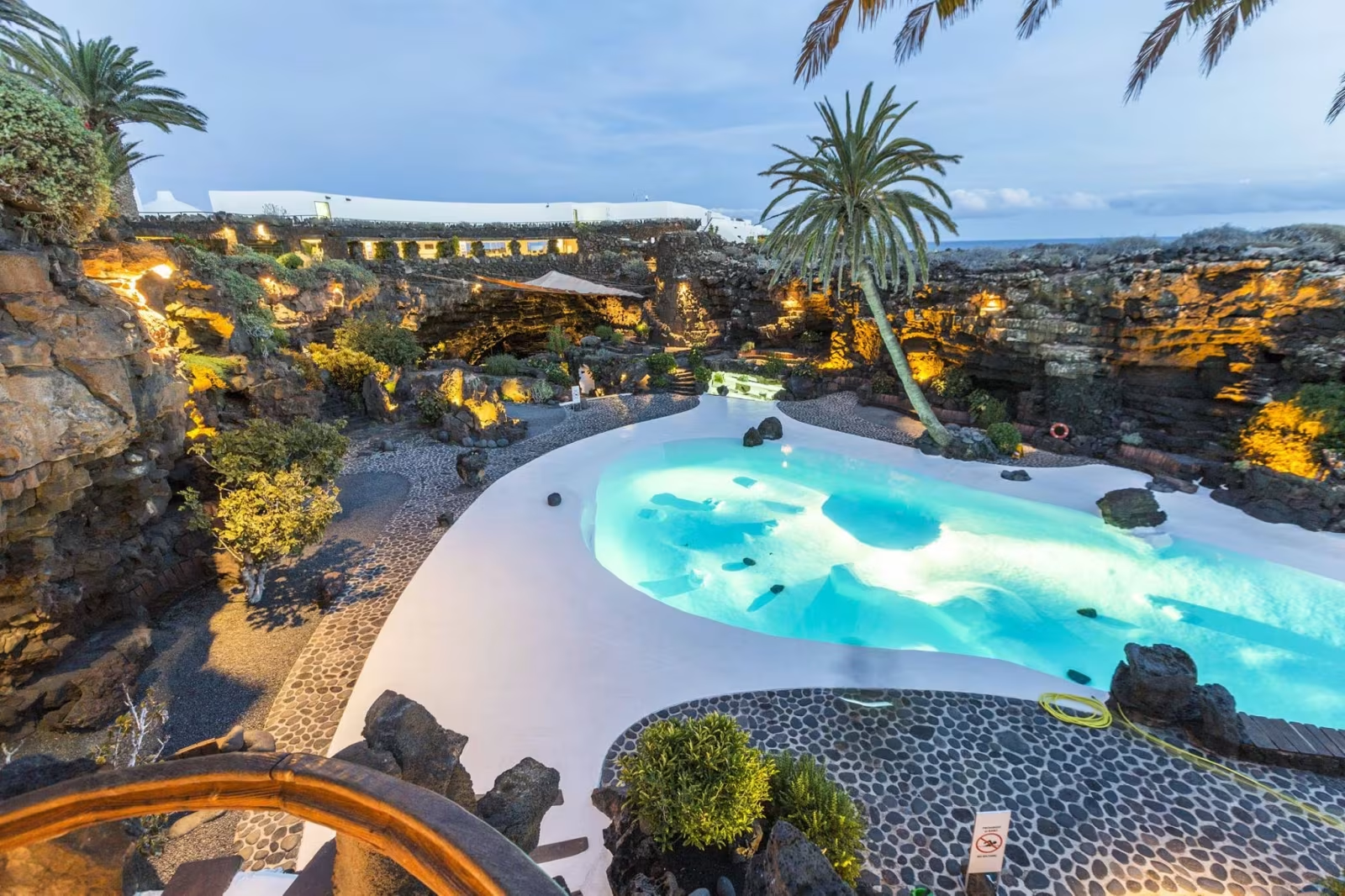
Among the best-known places associated with this approach are Jameos del Agua, the Cueva de los Verdes, Mirador del Río, the Cactus Garden, the El Diablo restaurant at Timanfaya, the Monumento al Campesino and the International Museum of Contemporary Art at Castillo de San José.
These attractions are now among the places many people put on their Lanzarote holiday itinerary, but their importance goes beyond tourism. They demonstrate a particular way of working with the landscape rather than simply building over it.
For tourists exploring Lanzarote, this is one of the reasons the island can feel so different from other destinations in the Canary Islands.
The volcanic landscape is not hidden behind layers of conventional development. Instead, it is often brought into the centre of the experience.
A home built into the lava
One of the clearest examples of Manrique's ideas can be found at the César Manrique Foundation in Tahíche.
Manrique began developing the property in 1968 after returning from New York. The house was built on a lava flow created by the major eruptions of Lanzarote between 1730 and 1736.
The lower level makes use of five natural volcanic bubbles, connected by passages through the basalt. The upper level combines modern elements with features inspired by traditional Lanzarote architecture.
It is an extraordinary building, but perhaps its greatest lesson is that Manrique did not see the lava as something that had to be removed before construction could begin. Instead, the volcanic landscape became part of the architecture.
Today, the former home operates as a museum and offers visitors a fascinating insight into both his work and his relationship with Lanzarote.
His final home in Haría
Manrique later moved to Haría, where he adapted an old agricultural property into his final home.
The Casa-Museo César Manrique sits among palm trees and reflects his interest in combining traditional Lanzarote architecture with modern design.
He lived there until his death in 1992. The property was eventually opened to the public as a museum, allowing visitors to see his living spaces and studio and gain a more personal impression of the artist.
The final journey
On 25 September 1992, César Manrique left the foundation in Tahíche and was travelling towards his home in Haría when he was involved in a road accident close to the foundation.
He was 73 years old.
His death brought an abrupt end to a life in which painting, sculpture, architecture, environmental ideas and public debate had become closely intertwined.
But his influence on Lanzarote did not end that day.
A legacy still visible today
One of the most remarkable things about César Manrique's legacy is that it is not confined to galleries or museums.
You can see it while driving around Lanzarote.
It appears in the relationship between white architecture and black volcanic stone, in carefully designed viewpoints, in gardens that use the island's arid conditions creatively, and in the decision to make the landscape itself an important part of the visitor experience.
His influence is also closely connected with Lanzarote's environmental identity. The island was declared a UNESCO Biosphere Reserve in 1993, the year after Manrique's death. That designation is part of a much wider history of conservation and sustainable development on the island, but it is difficult to discuss Lanzarote's modern environmental outlook without recognising Manrique's contribution to the conversation.
For residents, Manrique's legacy is therefore more than a collection of tourist attractions. For visitors, his work offers another way of understanding the island.
Seeing Lanzarote through Manrique's eyes
If you are visiting Lanzarote, it is worth looking beyond simply ticking attractions off a holiday list.
Visit the César Manrique Foundation in Tahíche and see how a house can be incorporated into volcanic terrain. Explore the Casa-Museo in Haría to discover where he lived and worked during the final years of his life. And when you visit places such as Jameos del Agua, Mirador del Río or the Cactus Garden, look at the way the architecture interacts with the surrounding landscape.
You may start to notice the island differently.
Lanzarote's identity was shaped by many people, communities and generations, and its landscapes are far older than any artist. But César Manrique helped create a distinctive modern vision for the island – one in which art, architecture, tourism and nature could exist together.
Thirty-four years after his death, that vision remains visible across Lanzarote.
And perhaps that is the most fitting way to remember him: not simply by looking back at the artist who died in 1992, but by looking around the island he spent much of his life trying to protect, interpret and celebrate.