
El Bebedero: The Lanzarote Archaeological Site That Is Rewriting the Island’s Ancient History
Lanzarote is famous for volcanoes, beaches and spectacular landscapes, but beneath the island’s surface lies a history that stretches back thousands of years. One of the most fascinating places revealing that story is El Bebedero, near Tiagua.
And after decades of archaeological work, the site is still producing surprises.
A window into Lanzarote’s ancient past
The archaeological site of El Bebedero is one of the most important prehistoric sites in Lanzarote. Excavations have revealed evidence of a long-established indigenous settlement, as well as intriguing evidence of contact between the island’s first inhabitants and people connected to the Roman world.
Archaeological investigations at El Bebedero began in 1985, with further excavation campaigns taking place over subsequent decades.
The location itself appears to have been carefully chosen. The settlement sits in a natural depression that offered protection, vegetation and access to water, while also providing extensive views towards El Río, the stretch of water separating Lanzarote from La Graciosa.
The evidence suggests that this wasn’t simply a temporary stopping point. Researchers believe several families lived here, with different areas apparently used for activities such as sleeping, cooking and working with animal skins.
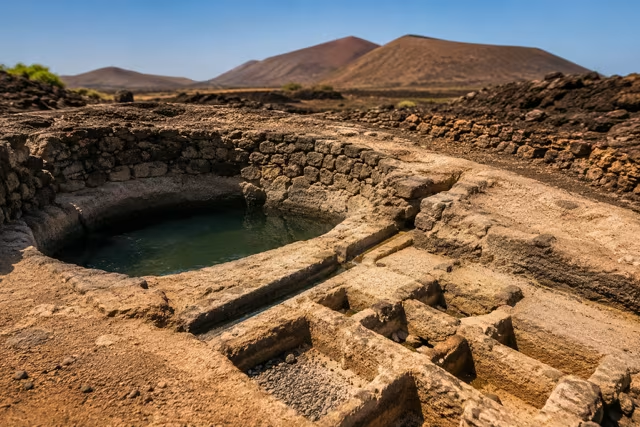
A possible ancient water cistern
One of the most exciting discoveries made during the more recent archaeological work was a structure that could be the oldest known cistern or water tank discovered in Lanzarote.
The circular structure measures approximately 1.5 metres across and has been dated to a period beginning around the 1st century BC.
Part of the structure appears to curve upwards, leading researchers to suggest that it may originally have had a vaulted roof. A stone area alongside it may also have helped collect rainwater.
Researchers believe its position and construction could indicate that it was intended for human drinking water rather than simply being a place where animals drank.
If that interpretation is confirmed, it would provide another fascinating insight into how Lanzarote’s indigenous population adapted to life on an island where reliable sources of fresh water were extremely limited.
Evidence of Roman contact in Lanzarote
Perhaps the most remarkable aspect of El Bebedero is the evidence of contact between the island’s indigenous population and people from the Roman cultural world.
Archaeologists have discovered Roman amphora fragments, metal objects and glass beads, alongside locally produced indigenous pottery and other artefacts.
The archaeological evidence and a series of scientific dating techniques place much of this interaction between approximately the 1st century BC and the 4th century AD.
This doesn’t necessarily mean that Lanzarote was occupied by the Romans.
Instead, researchers believe the evidence points towards contact and exchange with sailors and traders travelling through the waters around the Canary Islands.
What did the Romans want from Lanzarote?
The answer may have been something very basic: water and food.
For sailors travelling around the Atlantic, the Canary Islands could provide valuable supplies.
Researchers believe exchanges may have involved local products such as meat, cereals and animal skins, while visitors could have brought products including wine, oil and salted foods, transported in ceramic amphorae.
The discovery of Roman pottery at El Bebedero therefore provides a fascinating glimpse into a much wider network of maritime movement that existed more than 1,500 years ago.
A settlement that tells the story of everyday life
It’s not just the Roman objects that make El Bebedero important.
Archaeologists have recovered an enormous variety of evidence about everyday life on ancient Lanzarote.
Among the discoveries are:
- Indigenous handmade pottery
- Animal bones
- Fish and shellfish remains
- Land snail remains
- Goat and sheep remains
- Pig remains
- Dogs
- Stone tools
- Metal objects
- Glass beads
- Roman amphora fragments
- A carved basalt stone or stele
Together, these discoveries help researchers build a picture of how people lived, ate, worked and interacted with their environment hundreds and even thousands of years ago.
One of Lanzarote’s oldest archaeological sites
El Bebedero, together with the Buenavista archaeological site, is considered among the oldest known archaeological settlements in the Canary Islands.
Research has produced evidence covering a remarkably long period, with studies examining material dating from around the 1st century BC through to the 14th century AD.
That makes El Bebedero particularly important for understanding the early history of Lanzarote and the development of its indigenous population.
It also challenges the idea that the Canary Islands were isolated from the wider world before the arrival of Europeans in the 15th century.
Why El Bebedero matters today
For anyone visiting Lanzarote, it’s easy to think of the island’s history as beginning with the volcanic eruptions that created its extraordinary landscape or with the arrival of the Spanish.
But El Bebedero tells a much older story.
People were living on Lanzarote long before modern tourism, roads and resorts. They were adapting to the island’s harsh environment, raising animals, gathering food, making tools and pottery, and apparently interacting with sailors travelling across the Atlantic.
And perhaps most remarkably, the archaeological story is still being uncovered.
After around four decades of research, El Bebedero continues to produce discoveries that help archaeologists understand what life was like on Lanzarote more than 2,000 years ago.
If you’re interested in Lanzarote’s history…
The next time you drive through the rural interior of the island, remember that beneath the volcanic landscape are traces of a completely different Lanzarote — one inhabited long before the island became the holiday destination we know today.
An AI Generated Image has been used in this Article