

Heat in Canary Islands Schools: Why Classroom Temperatures Are Back in the Spotlight
The return to school in the Canary Islands has once again highlighted an issue that families, teachers and education authorities have been discussing for some time: how well are schools prepared for periods of unusually high temperatures?
What has happened this week?
A spell of very high temperatures in mid-September 2026 led to temporary changes to the school day in parts of the Canary Islands.
On Tuesday 15 September, face-to-face classes were suspended in Fuerteventura and in nine municipalities of Gran Canaria because of the heat. The affected Gran Canaria municipalities were Agüimes, Artenara, Ingenio, Mogán, San Bartolomé de Tirajana, La Aldea de San Nicolás, Santa Lucía de Tirajana, Telde and Valsequillo.
Face-to-face teaching returned across the affected areas on Wednesday 16 September as the weather situation improved. Education authorities also reported that some individual schools had requested earlier collection times because of the temperatures.
Lanzarote was not included in the list of areas moved to remote learning during that particular episode.
Why are schools struggling with heat?
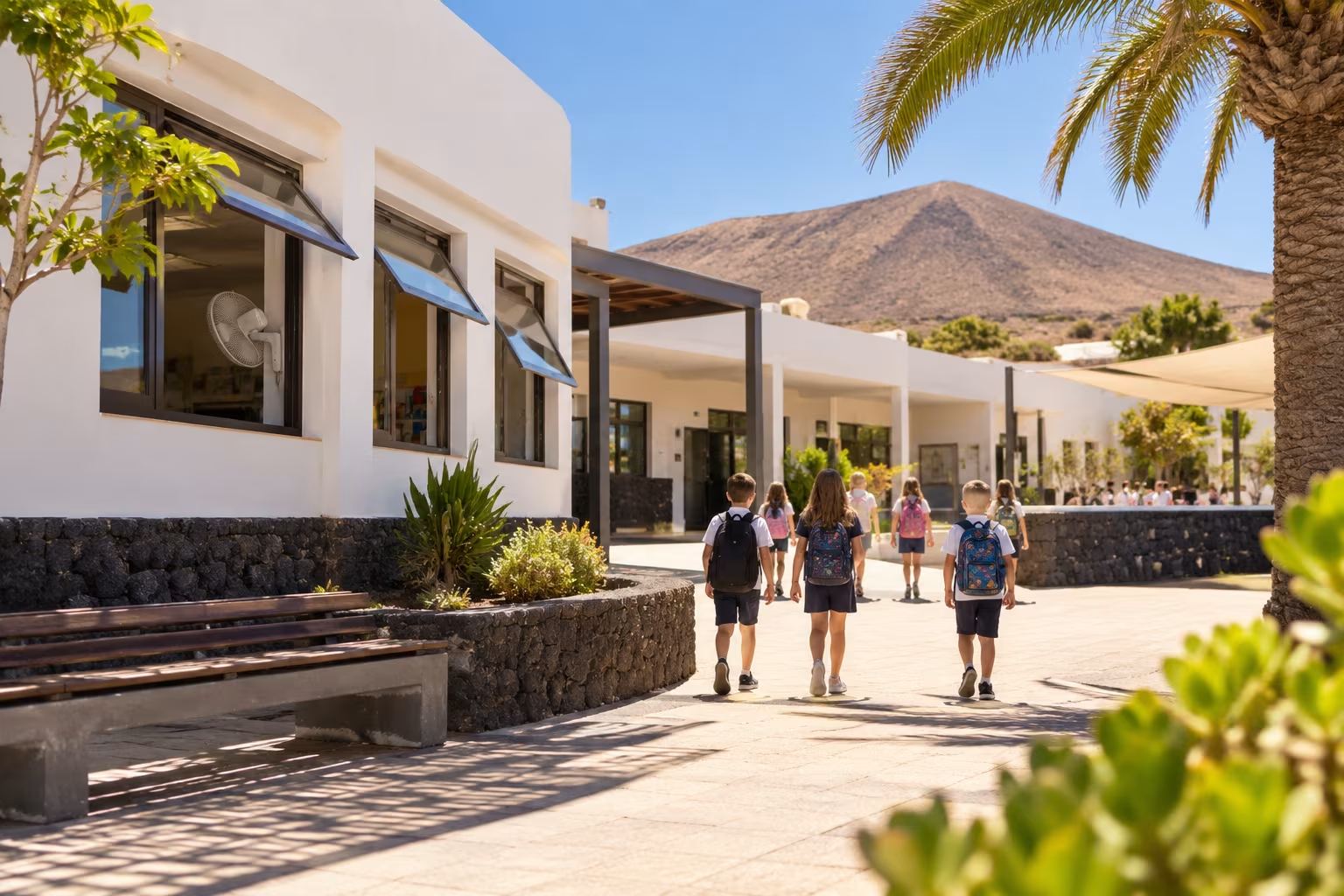
Canary Islands schools were designed for a climate where buildings could often rely on natural ventilation, shade and the trade winds. However, increasingly frequent episodes of very high temperatures are putting more pressure on buildings that were not necessarily designed with prolonged heat in mind.
The issue is not simply whether a school has air conditioning. Building orientation, direct sunlight, ventilation, shaded outdoor areas, classroom size and the age of the building can all influence how hot a classroom becomes.
Teachers and unions have raised concerns about classroom conditions, while the Canary Islands Government has acknowledged that many educational centres still need to adapt to hotter conditions.
Are schools being fitted with air conditioning?
This is one of the most important parts of the discussion, but the picture is more complicated than simply installing air conditioning in every classroom.
The Canary Islands Government has an adaptation plan covering measures such as shade, monitoring temperatures and improving the resilience of school buildings. A pilot project called Clima Escolar Canarias has already installed temperature sensors in 120 public schools, allowing authorities to collect real-time information about conditions inside centres.
The Government has also been developing a wider plan for adapting schools to high temperatures. According to reporting in September 2026, shade projects have already been introduced at hundreds of public education centres, while classroom cooling remains an area being tested and developed.
Solar power has also been suggested as part of the wider conversation about school buildings. Because the Canary Islands receive abundant sunshine, solar panels could potentially help reduce electricity costs over time and contribute to the energy needs of buildings. However, installing solar panels does not automatically solve the problem of classroom temperatures, and decisions about cooling systems depend on the individual building and wider infrastructure.
What happens when it gets too hot?
The Canary Islands has an official protocol for educational centres dealing with high temperatures. The current version was updated in May 2026.
Importantly, there is not a simple rule saying that every classroom must close as soon as it reaches a particular temperature.
Instead, the education protocol works alongside official heat-risk warnings. It has four levels, ranging from normal conditions through to high risk.
Depending on the level, schools can introduce measures such as keeping blinds closed when sunlight is hitting classrooms, improving ventilation, moving lessons to cooler or shaded areas, increasing opportunities for students to drink water and reducing strenuous outdoor activity.
In more serious situations, schools can request changes to the timetable or earlier collection of pupils. At the highest level, and when the relevant emergency alert is in place, teaching can move temporarily to a non-face-to-face format.
This means that school closures or changes to lessons are based on the wider heat-risk situation rather than simply on a thermometer reading inside one classroom.
What does this mean for families in Lanzarote?
For families living in Lanzarote, the recent episode is a reminder that September can still be extremely warm even though the summer holiday period has ended.
The island was not among the areas moved to remote teaching during the 15 September measures, but schools can still apply preventative measures when temperatures rise.
Parents should keep an eye on messages from their child's school and official Canary Islands education and emergency services, particularly during heat alerts. Children should have access to water, wear light and breathable clothing and avoid unnecessary strenuous activity during the hottest part of the day.
Why is this becoming a bigger issue?
The wider discussion is really about adapting buildings to the changing climate.
The Canary Islands Government says it is working on school adaptation, including monitoring conditions and creating more shaded areas. At the same time, teachers' representatives and other education groups continue to call attention to classrooms where ventilation and cooling are not sufficient during extreme heat.
The debate is therefore not just about air conditioning. It is about how Canary Islands schools can be designed and maintained so they remain comfortable and safe throughout the year.
For an island such as Lanzarote, where sunshine and warm weather are a major part of everyday life, making good use of shade, natural airflow, building design and renewable energy could all form part of that long-term solution.
