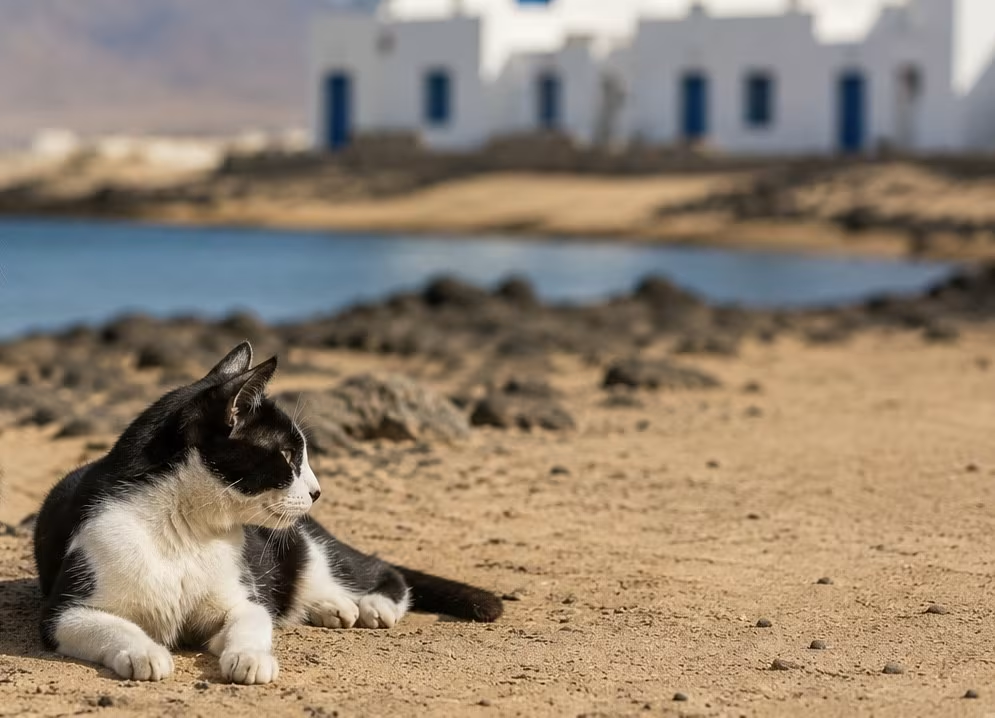

La Graciosa Residents Demand Action Over Growing Feral Cat Population
A new campaign is calling on Teguise Council to find a sustainable solution for La Graciosa’s growing feral cat population, while protecting the island’s unique wildlife.
A public demonstration is due to take place on La Graciosa on Thursday, September 3, as residents and animal supporters call for greater action over the management of cats living freely on the island.
The gathering has been organised alongside a petition calling on Teguise Council to introduce a long-term management plan for the island’s cat colonies. The campaign had collected 1,306 verified signatures by the beginning of September.
The issue is particularly sensitive on La Graciosa, where concerns about animal welfare are closely intertwined with the protection of a highly valuable natural environment.
Residents call for a solution that protects cats and wildlife
The campaign has been promoted by Asociación Felina Maulli2, which is calling for measures to manage the cat population without removing the animals from La Graciosa.
Among the proposals is a programme of sterilisation, intended to prevent the number of cats from continuing to increase. The group has also suggested the possibility of establishing a refuge on the island where cats could be cared for in a controlled environment.
The campaign argues that cats have been part of everyday life on La Graciosa for many years and that any solution should take their welfare into account while also addressing concerns raised by residents and conservationists.
The demonstration is scheduled for 9am on September 3 outside the municipal office on La Graciosa.
Why are feral cats such a concern on La Graciosa?
The debate is not simply about the presence of cats around Caleta del Sebo and other parts of the island.
La Graciosa forms part of the Chinijo Archipelago Natural Park and is surrounded by an exceptionally important marine and terrestrial environment. The island is home to protected and endemic species, while its position makes it an important location for seabirds.
Official information from Spain’s Ministry for the Ecological Transition highlights the island’s biological importance, including several endemic plant species and protected birds such as the Bulwer’s petrel, houbara bustard, stone-curlew and Kentish plover.
That creates a difficult conservation challenge because cats are natural hunters and can prey on birds and other wildlife.
There is documented evidence of this happening on La Graciosa.
In August 2014, environmental monitoring recorded a minimum of 75 seabirds believed to have been killed by cats, including 68 Bulwer’s petrels, six white-faced storm petrels and one European storm petrel. The official report noted that the figure was a conservative minimum based on identifiable remains.
More recently, government monitoring documented another predation incident involving a Bulwer’s petrel colony on La Graciosa in 2020. Following the discovery of dead birds, traps were moved into the area and the cat responsible was captured, demonstrating that targeted intervention can help protect vulnerable bird colonies.
A problem that has been discussed for years
The current campaign isn’t the first attempt to address feral cats on La Graciosa.
Environmental studies have previously examined the distribution of cats across the island, including areas close to important seabird colonies. Government-backed work has included night-time surveys and camera traps to establish where cats were present and identify areas where intervention might be required.
This is important because La Graciosa isn’t simply another residential area. Much of the island forms part of protected natural areas, meaning that managing domestic and feral animals has to take place alongside wider conservation objectives.
The island is part of the Archipiélago Chinijo Natural Park, while its surrounding waters are protected as part of the La Graciosa Marine Reserve and the waters north of Lanzarote.
There are strong feelings on both sides
The cat debate has previously divided opinion on Lanzarote.
Animal welfare campaigners argue that cats should be treated humanely and that sterilisation and responsible management can reduce population growth without unnecessarily removing animals from their familiar environment.
Conservation organisations, meanwhile, have raised concerns about allowing cats to remain in sensitive natural areas because of their potential impact on protected wildlife.
In 2024, environmental organisations publicly criticised a campaign involving the capture, sterilisation and release of cats on La Graciosa, arguing that returning cats to the natural environment could conflict with biodiversity protection requirements.
The controversy illustrates why finding a solution that satisfies everyone is unlikely to be straightforward.
What could happen next?
For residents, visitors and animal lovers, the latest campaign puts the spotlight firmly back on how La Graciosa manages its cat population.
The campaign isn’t calling for the cats simply to disappear. Instead, it is asking Teguise Council to establish a structured approach that deals with population growth, animal welfare, feeding and veterinary care while reducing the potential impact on wildlife.
For an island as environmentally sensitive as La Graciosa, that balance could prove crucial.
The challenge is finding a practical management system that recognises the affection many people have for the island’s cats without compromising the seabirds and other wildlife that make La Graciosa such a special part of the Canary Islands.