
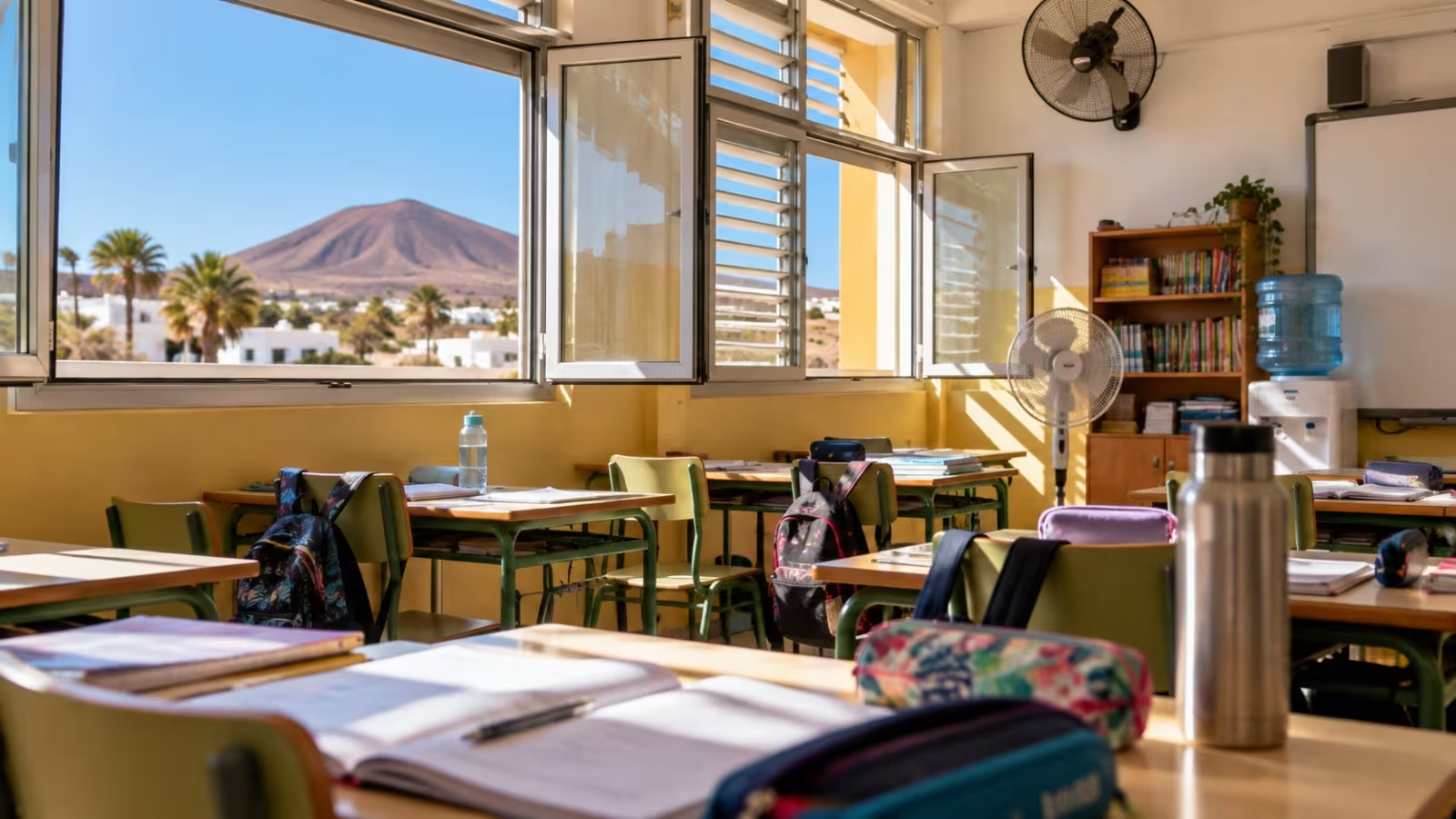

Lanzarote families question why they are fundraising to keep classrooms cool
The heat inside Canary Islands classrooms has become a growing talking point as families, education groups and politicians debate how schools should cope with increasingly difficult periods of high temperatures.
A recent political statement highlighted a particularly controversial issue: families being asked to raise money for measures intended to make classrooms more comfortable, including air-conditioning or cooling equipment. The criticism comes at a time when the Canary Islands Government has a dedicated programme for adapting schools to high temperatures.
The issue is particularly relevant in Lanzarote, where hot, sunny conditions are a normal part of island life for much of the year.
Why are Lanzarote schools facing the heat?
Schools across the Canary Islands have to deal with buildings designed for a climate in which extreme heat was historically less frequent. Modern heat episodes can put additional pressure on classrooms, particularly where there is limited shade, ventilation or mechanical cooling.
The regional education authorities already have a protocol for dealing with exceptionally high temperatures. Depending on the level of risk, schools can reduce physical activity, move pupils to cooler areas, alter activities and timetables, and, in more serious circumstances, introduce measures such as early departures or non-presential teaching.
Those measures are designed for periods of extreme heat, but they do not necessarily solve the longer-term question of how school buildings should be adapted.
Canary Islands school heat-adaptation programme
The Canary Islands Government says it has been investing in measures designed to make educational buildings more resilient to high temperatures.
The regional government's 2024 plan for adapting schools to high temperatures includes measures such as shaded areas, photovoltaic installations, greener schoolyards and refrigeration or cooling projects. A separate high-temperature protocol was updated in May 2026 and applies to publicly funded non-university education centres.
The government has also said that adapting the entire school network is a long-term process because different buildings have different needs.
That distinction is important. Cooling a classroom does not necessarily mean installing traditional air conditioning everywhere. In some buildings, better ventilation, external shading, insulation, reflective surfaces, trees or redesigned outdoor areas may provide part of the solution.
Why are families fundraising?
The latest controversy centres on the principle of parents having to contribute directly towards improvements to the learning environment.
Opposition representatives have questioned why families should have to organise collections or fundraising when education infrastructure is ultimately a public responsibility. The wider political debate also includes criticism over the amount of government money that has remained unspent during the current regional administration.
There is an important distinction here: the figure of more than €3.3 billion refers to funds described by opposition parties as having gone unexecuted across the Canary Islands Government's budgets during the legislature. It is not a €3.3 billion education fund that is simply sitting unused for school air conditioning.
For 2026, the Canary Islands education department has a budget running into billions of euros. The approved regional budget lists more than €2.6 billion under the education function, while the government presented its education department's 2026 budget as €2.315 billion when it was originally announced. Different budget classifications and accounting scopes mean these figures should not be treated as interchangeable.
What does this mean for families in Lanzarote?
For parents living on the island, the practical question is much simpler: are classrooms comfortable and safe when temperatures rise?
Lanzarote has a large school population. Around 21,500 pupils began the 2026-27 academic year across Lanzarote and La Graciosa, according to the island's education authorities.
The island also continues to see investment in school infrastructure, including new classrooms and improvements to existing facilities. However, some projects take time, and the need to adapt buildings to hotter conditions is becoming an increasingly visible part of the wider education debate.
The recent discussion also follows a period of unusually challenging heat across parts of the Canary Islands. In September 2026, exceptionally high temperatures led to temporary changes to teaching arrangements in Fuerteventura and several municipalities in Gran Canaria. Lanzarote also experienced the wider heat and calima episode affecting the archipelago.
What could cooler schools look like?
The answer may not be the same for every Lanzarote school.
A modern approach to climate adaptation could combine several measures: shaded playgrounds, better cross-ventilation, improved insulation, solar protection on windows, trees and planted areas, efficient fans, water facilities and, where necessary, mechanical cooling.
This is especially relevant to Lanzarote because reducing heat inside buildings is not simply a comfort issue. Cooler classrooms can help pupils and teachers concentrate and can make it easier for schools to maintain normal routines during periods of high temperatures.
For residents, the debate is therefore about more than air conditioning. It is about how public buildings on an island with a warming climate should be designed, maintained and upgraded.
For visitors to Lanzarote, it is also a reminder of how the island's hot climate affects everyday life beyond the beach and hotel pool.
The debate continues
The disagreement over classroom temperatures is now part of a much bigger conversation about education spending, public infrastructure and climate adaptation in the Canary Islands.
The regional government points to investment already under way, while opposition politicians and some family groups are calling for faster action and greater transparency over which schools still require improvements.
For families in Lanzarote, the priority is straightforward: ensuring children can learn in classrooms that remain suitable even when the temperature outside rises sharply.
As hot weather becomes an increasingly important consideration for schools, the question is likely to remain on the agenda well beyond the current heat episodes.
An AI Generated Image has been used in this Article for Illustration Purposes.
