
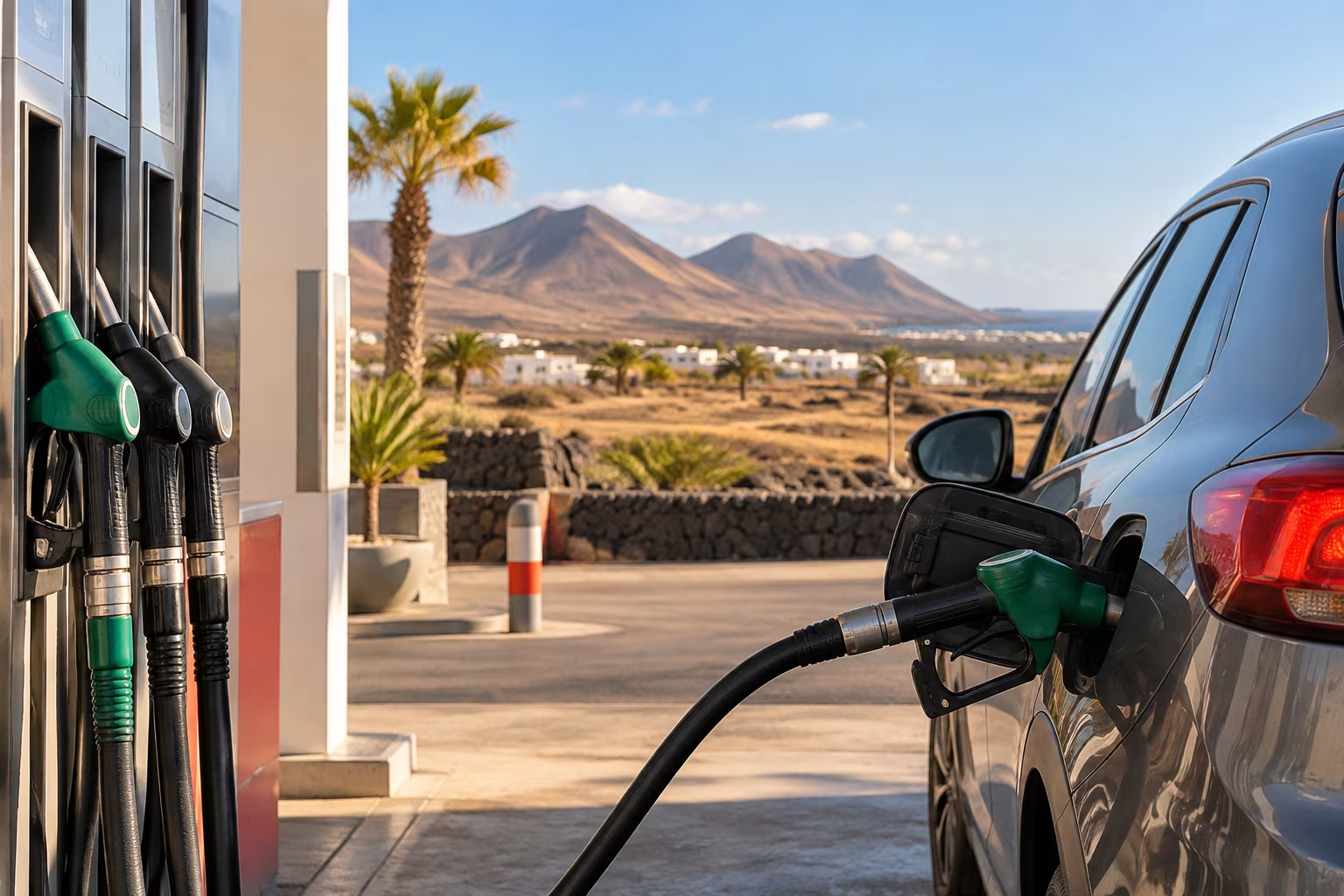

Lanzarote fuel prices rise sharply as Middle East conflict puts pressure on the pump
Motorists in Lanzarote are paying noticeably more to fill their cars this month, with petrol and diesel prices rising as disruption in international energy markets continues.
For residents, commuters and businesses that rely on vehicles, the increase is already being felt in everyday running costs. Visitors hiring a car in Lanzarote may also notice that filling up is more expensive than it was earlier in 2026.
What are fuel prices in Lanzarote right now?
The latest available fuel-price data for Friday 18 September 2026 puts the island-wide average at around €1.535 per litre for unleaded 95 petrol and €1.649 per litre for diesel.
Prices vary considerably between individual petrol stations, so the price displayed at one filling station can be quite different from another elsewhere on the island.
In Arrecife, for example, current official station data shows 95 petrol averaging around €1.53 per litre, while diesel is averaging around €1.63. The cheapest stations can be significantly below the most expensive, meaning it is worth checking prices before filling a large tank.
How much have Lanzarote fuel prices increased?
The change becomes clearer when today's prices are compared with the start of the year.
According to figures from the Centro de Datos de Lanzarote, the average price at the beginning of 2026 was about €1.187 per litre for petrol and €1.185 for diesel.
By August, the island average had risen to almost €1.50 for petrol and close to €1.60 for diesel. That represents an increase of roughly 30% for petrol and 38% for diesel compared with the same period a year earlier.
Diesel has therefore experienced the particularly sharp increase, something that matters not only to private motorists but also to taxis, delivery companies, tradespeople, agricultural operators and other businesses that depend heavily on diesel vehicles.
Why are fuel prices rising?
The main pressure is coming from the international oil and refined-fuel markets.
The conflict in the Middle East has disrupted important energy supply routes and created uncertainty around the movement of crude oil and refined products. The Strait of Hormuz is particularly important because it is a major route for oil and fuel shipments from the Gulf.
When international supply becomes more uncertain, crude oil and refined fuel prices can rise. Those higher costs can eventually feed through into wholesale prices and, in turn, the prices motorists see at petrol stations.
However, the price at the pump is not determined by the cost of crude oil alone. Refining costs, transport, distribution, taxes, currency movements and local competition between filling stations all play a part.
Canary Islands tax measures are currently helping
There is an important difference between Lanzarote and mainland Spain when it comes to fuel taxation.
The Canary Islands Government has kept IGIC at zero on petroleum and refined petroleum products during September 2026 as part of temporary measures introduced in response to the Middle East energy crisis.
The measure is due to run until 30 September 2026 under the current arrangements. The Canary Islands Government has said the continuation of the measure is linked to the significant increase in fuel prices.
This means that, despite the sharp rise in the underlying cost of fuel, motorists in Lanzarote are currently benefiting from a tax measure designed to soften some of the impact.
Where can you find cheaper fuel in Lanzarote?
Fuel prices can change frequently, and the cheapest station can vary from one day to the next.
Current data shows particularly competitive prices at some independent and lower-cost stations in Arrecife, while other stations elsewhere on the island can be considerably more expensive.
Currently Plenergy in Arrecife is listed as the cheapest at 1.417 per litre for 95 unleaded.
What does this mean for tourists visiting Lanzarote?
For most holidaymakers, the increase in fuel prices is unlikely to transform the cost of a holiday on its own, but it can add to the overall cost of a driving holiday.
Visitors planning to explore Timanfaya, Playa Blanca, Papagayo, Famara, Teguise, Haría and other parts of the island should factor fuel into their car-hire budget.
The good news is that Lanzarote remains a relatively compact island, so even with higher fuel prices, many popular attractions can be reached without exceptionally long journeys.
Higher fuel costs can also have a wider effect. Businesses that use vehicles may face increased transport and delivery costs, which can eventually influence the prices of goods and services.
Will Lanzarote fuel prices keep rising?
That is much harder to predict.
Fuel prices on Lanzarote ultimately depend heavily on international oil prices and the availability and cost of refined fuel. If the disruption in the Middle East eases and international supply routes return to normal, pressure on prices could reduce.
If disruption continues or becomes more severe, prices could remain under pressure.
For now, the most useful advice for motorists is simple: check current petrol station prices, compare nearby stations and remember that prices can change quickly.
For anyone living in Lanzarote or visiting the island by hire car, keeping an eye on fuel prices is likely to remain important over the coming weeks.
