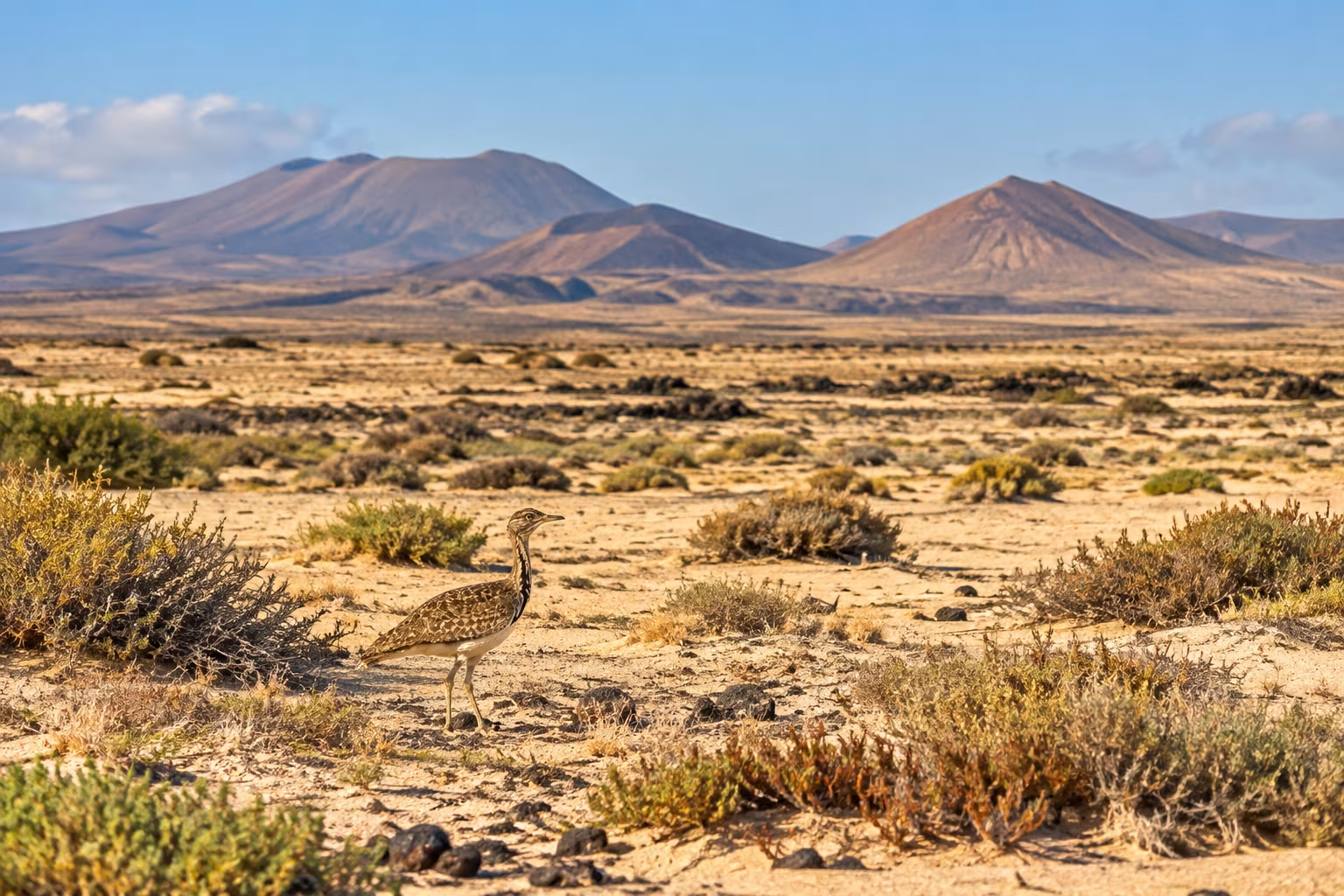

Lanzarote’s El Jable: Why Protecting Its Rare Steppe Birds Matters
Lanzarote is famous for its volcanoes, beaches and dramatic coastal scenery, but away from the main tourist resorts there are quieter landscapes that are just as important to the island’s identity. One of the most fascinating is El Jable, the sandy, semi-desert area stretching through central-northern Lanzarote.
Now, the future of the birds that depend on this unusual landscape is once again in the spotlight.
The Cabildo of Lanzarote and La Graciosa is bringing experts, farmers and other groups connected with El Jable together for a special conservation day on 19 October 2026. The event, taking place at Casa Cerdeña in San Bartolomé from 8:45am to 6:30pm, will look at how Lanzarote can protect its threatened steppe birds while allowing traditional activities to continue.
Why is El Jable so special?
El Jable is very different from the volcanic landscapes many visitors associate with Lanzarote. It is a vast area of wind-blown, marine-derived sand, creating a dry, open environment that supports specialist plants, wildlife and traditional agriculture.
The area is also important for birdlife. Tourism Lanzarote highlights species including the Canary Island houbara, the stone-curlew and the cream-coloured courser among the birds associated with this distinctive ecosystem. El Jable forms part of a protected bird area, meaning its environmental importance extends well beyond its scenic value.
For visitors who enjoy nature and birdwatching in Lanzarote, this makes El Jable a particularly interesting part of the island to discover responsibly.
The Canary Island houbara
One of the species at the centre of conservation efforts is the Canary Island houbara (Chlamydotis undulata fuertaventurae).
It is a striking ground-dwelling bird adapted to the dry, open landscapes of the eastern Canary Islands. Rather than spending most of its time perched in trees, the houbara is often seen walking or running across open ground, where its patterned plumage provides excellent camouflage.
Official Canary Islands documentation identifies the houbara as an endangered species and recognises the importance of areas around El Jable and Famara for its habitat.
This is one reason why changes to the landscape can have consequences far beyond the immediate area affected.
Balancing conservation with everyday life
The challenge facing El Jable is not simply about keeping people out.
For generations, the landscape has been used by farmers and other local communities. Traditional agriculture is part of the cultural character of Lanzarote, and the sandy soils of El Jable have helped make crops such as sweet potatoes possible in an otherwise dry island environment.
At the same time, conservationists need to consider how farming, hunting, recreation, vehicles, development and other activities interact with fragile habitats.
That is why the October meeting is being described as a participatory event rather than simply a conservation announcement. The programme will consider the condition of the steppe birds, the management of protected bird areas, traditional agriculture, land use and the effects of different activities.
There will also be discussion of the houbara’s population dynamics and its recovery plan, followed by a dialogue involving hunting, biodiversity and agricultural interests.
Why this matters to tourists
For most holidaymakers staying in Puerto del Carmen, Costa Teguise, Playa Blanca or other popular Lanzarote resorts, El Jable may not be on the standard sightseeing itinerary.
But it is part of what makes Lanzarote such an unusual destination.
The island is not simply a collection of beaches and volcanic attractions. Its natural environment includes dunes, lava fields, coastal habitats, agricultural landscapes and semi-desert areas supporting species that have adapted to life in the Canary Islands over thousands of years.
Nature lovers, walkers and birdwatchers can therefore find a completely different side of Lanzarote away from the busy resort areas.
However, visiting sensitive natural areas comes with responsibility. Staying on appropriate routes, avoiding disturbing wildlife, keeping dogs under control where permitted, and never chasing or approaching birds are simple ways visitors can help protect Lanzarote’s wildlife.
A landscape worth protecting
The wider importance of El Jable is recognised through environmental protection measures. Government of the Canary Islands information describes the sandy areas of El Jable as part of the wider protected landscape associated with the ZEPA (Special Protection Area for Birds) of the northern islets and Famara.
Government planning documents also identify the area as important habitat for the houbara and other steppe birds such as the stone-curlew and courser.
There are continuing pressures on parts of the landscape. Recent Canary Islands government documentation has also highlighted issues connected with sand extraction and habitat within areas considered important for houbara conservation.
That makes the search for practical solutions particularly important.
What happens next?
The 19 October meeting is intended to bring together scientific knowledge and the experience of people who work in or regularly use El Jable.
The aim is to build a shared understanding of the condition of the birds and their habitat, examine the pressures affecting them and identify realistic measures that can work on the ground.
For Lanzarote, this is about finding a balance: protecting one of the island’s most unusual natural environments while recognising the agricultural and traditional uses that have shaped the landscape.
For residents and visitors alike, El Jable is a reminder that some of Lanzarote’s most valuable attractions are not necessarily the ones with entrance signs or ticket booths.
Sometimes, they are the quiet open spaces where the landscape appears almost empty — but where rare wildlife is quietly surviving.