
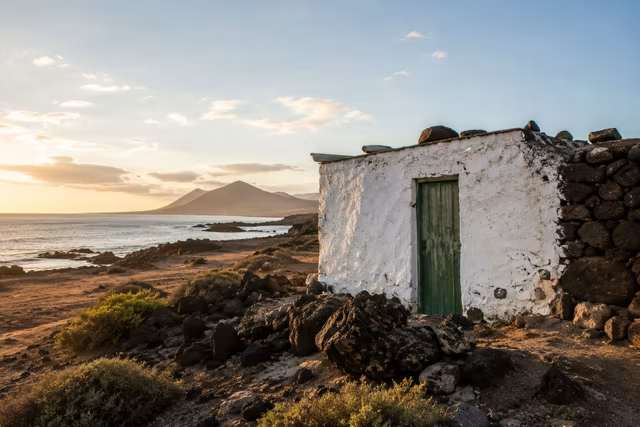

Lanzarote’s Traditional Coastal Huts Face the Bulldozers – While the Sandos Papagayo Still Stands
A fight over Lanzarote’s coastline is growing, with campaigners asking why small historic huts are being demolished while a controversial Playa Blanca hotel continues to operate
A row over some of Lanzarote’s traditional coastal huts has erupted this week, putting the island’s history, coastline and planning rules firmly back in the spotlight.
Two traditional coastal structures in the Haría area have already been demolished by Spain’s coastal authorities, while another historic hut has been temporarily spared following an appeal.
Now cultural organisation Pueblo Maho is challenging what it describes as an uneven approach to development along Lanzarote’s coastline.
And there is one question increasingly being asked:
Why are tiny traditional huts being removed while the much larger Sandos Papagayo hotel in Playa Blanca remains standing?
The huts that became part of Lanzarote’s story
These aren’t modern holiday homes or recently constructed buildings.
The traditional coastal huts around Mala, Seifío, Charco del Palo, Punta Mujeres and Órzola have been associated with generations of Lanzarote families and the traditional use of the island’s coastline.
For local campaigners, they represent a disappearing connection between island residents and the sea.
The structures were linked to activities including fishing and the use of marine and agricultural resources, and supporters argue that their value extends beyond the physical buildings themselves.
They are part of the story of how previous generations lived and worked in Lanzarote.
Two huts have already disappeared
The latest action by Costas, Spain’s coastal authority, has already resulted in the demolition of two huts in Haría.
One was located between Punta Mujeres and Órzola, while another stood close to the traditional hut belonging to Emiliano Ventura at Playa de Seifío, between Charco del Palo and Mala.
The demolitions have caused considerable anger among people campaigning to preserve Lanzarote’s cultural heritage.
But the story became even more dramatic last week.
50 people formed a human barrier to save one hut
On 28 August, around 50 people gathered at Playa de Seifío as machinery arrived to carry out the demolition of the famous “Choza de los Barcos”.
The hut belongs to local resident Emiliano Ventura and is described by supporters as having more than a century of history.
Rather than allowing the demolition to go ahead, the group formed a human barrier around the building.
The demolition was subsequently suspended after Ventura lodged an administrative appeal.
A petition has also been launched calling for the hut to be saved, with supporters arguing that removing it would mean losing a physical piece of Lanzarote’s history.
For now, at least, the hut remains.
Why is Pueblo Maho angry?
Cultural association Pueblo Maho says the traditional huts should not simply be viewed as illegal structures occupying valuable coastal land.
The organisation believes they form part of the heritage associated with Lanzarote’s traditional relationship with the sea.
It has criticised what it calls a “disimetría administrativa” — an administrative disparity — in the way different buildings on the island’s coastline are treated.
The argument has gained attention because of another building on Lanzarote’s coast.
And this one is considerably larger.
The Sandos Papagayo question
The Sandos Papagayo, formerly known as the Papagayo Arena, has a long and complicated planning history.
Located in Playa Blanca, the hotel has been operating since 2003.
Its previous licences were annulled by the courts, and its planning situation has remained the subject of a lengthy legal and administrative process.
In 2024, the Cabildo de Lanzarote began the process of granting the hotel provisional tourist authorisation and provisional classification as a five-star hotel.
However, there is an important detail here.
That did not simply mean the hotel had been completely legalised.
The provisional tourist authorisation was subject to obtaining the necessary urban planning licence from Yaiza Town Hall and authorisation from Costas.
That complicated distinction is important when discussing the current controversy.
A tiny hut versus a huge hotel
This is where the debate becomes particularly emotive.
Campaigners are not necessarily arguing that the same rules should automatically apply to a small traditional hut and a major hotel.
Instead, they are asking whether Lanzarote’s historic buildings should receive greater consideration for their cultural and ethnographic value before they are removed.
Environmental campaigners have suggested that some of the traditional structures could potentially be recognised as ethnographic heritage, while being given appropriate cultural or practical uses.
For supporters, saving these huts isn’t about stopping coastal protection.
It’s about asking whether there is room for Lanzarote’s history within the modern legal framework governing its coastline.
What happens to the remaining huts?
That is now the big question.
Some structures have already gone.
Others are facing demolition orders, while appeals are buying their owners additional time.
The future of the Choza de los Barcos at Seifío will depend on the outcome of the administrative process now underway.
Meanwhile, the campaign to save the hut has given the issue a much wider audience.
For some residents, it has become symbolic of a bigger concern:
What happens when the Lanzarote of today leaves no physical trace of the Lanzarote that came before it?
Why tourists should care too
For visitors, Lanzarote is often about the volcanoes, beaches, sunshine and spectacular coastline.
But the island’s appeal also comes from its history.
The traditional fishing villages, whitewashed buildings, volcanic stone walls and old coastal structures all contribute to the distinctive character that makes Lanzarote different from a conventional resort destination.
That is why the argument over a few small huts has attracted so much attention.
They may be tiny compared with a hotel.
But to some Lanzarote residents, they represent something much bigger.
A piece of the island’s memory.
The debate isn’t over
The authorities are enforcing coastal legislation.
Campaigners are demanding greater recognition of Lanzarote’s cultural heritage.
And the Sandos Papagayo remains at the centre of arguments about planning, tourism and the treatment of buildings along the island’s coast.
For now, the excavators have already claimed some of the huts.
Others are still standing.
And on Lanzarote, the question of what should remain on the coastline — and what should disappear — is far from settled.
