
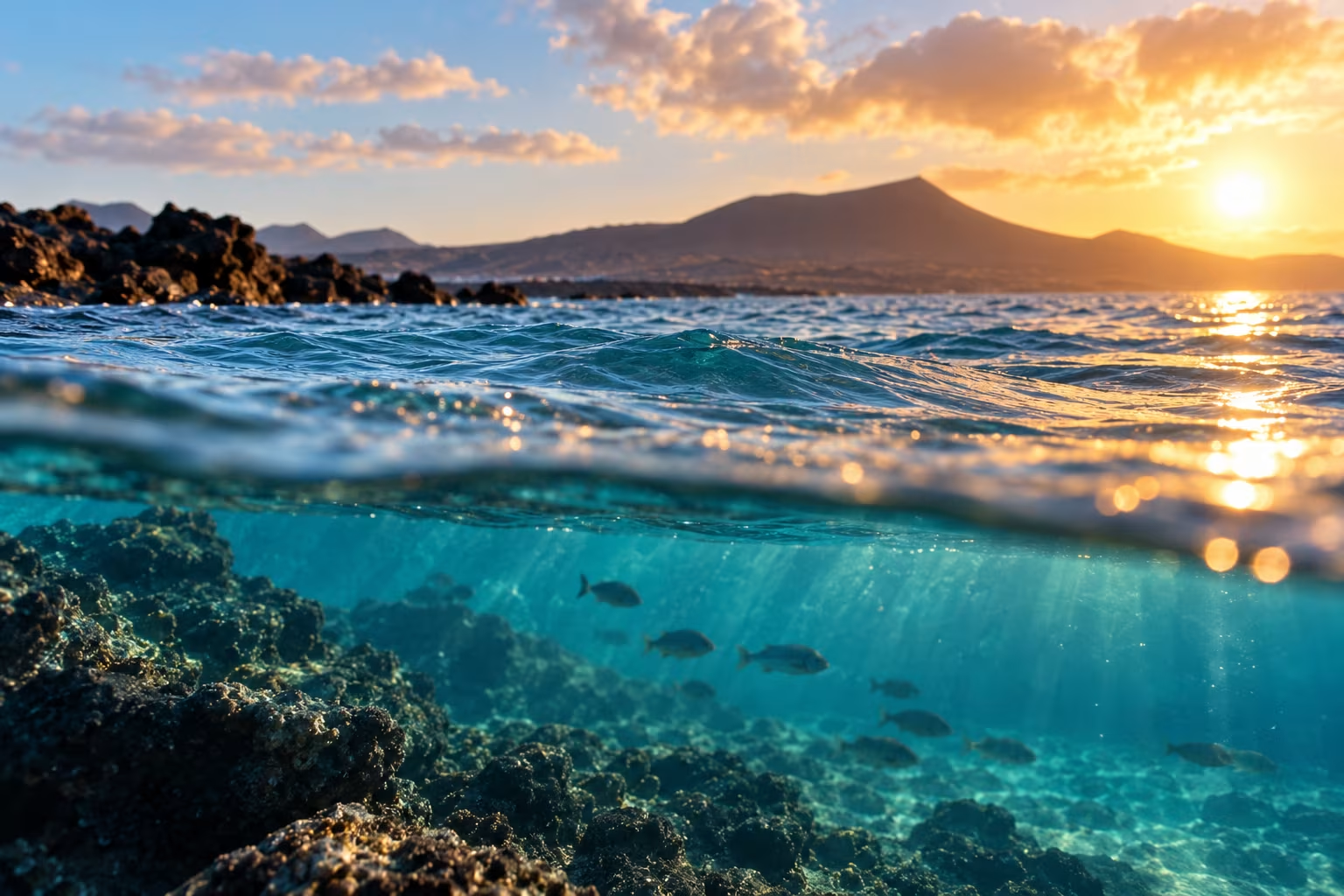

Lanzarote’s Warming Ocean: What Rising Sea Temperatures Could Mean for Marine Life
Lanzarote’s waters are famous for their clear blue colour, rich marine life and year-round appeal to swimmers, divers and water sports enthusiasts. But scientists are increasingly watching another side of the Atlantic: rising ocean temperatures and the effect they could have on the marine ecosystems surrounding the Canary Islands.
A new global sea-temperature record has put the spotlight back on the changing conditions beneath the surface — and while a worldwide record does not mean that Lanzarote has experienced the same temperature increase, the island is very much part of a changing Atlantic environment.
A NEW GLOBAL OCEAN TEMPERATURE RECORD
According to the Copernicus Climate Change Service, the average global sea-surface temperature reached 21.1°C on 22 August 2026, the highest daily value recorded in the dataset, which goes back to 1979.
What makes the latest figure particularly significant is the time of year. Global ocean temperatures are normally at their highest around March and April, yet this new record was reached in August.
Copernicus says the exceptionally warm conditions are occurring against a background of long-term human-driven ocean warming, with a developing strong El Niño event also adding additional heat to the climate system.
Earlier in the summer, global sea temperatures had already broken records for the time of year, highlighting how persistent the warmth has been in 2026.
SO, WHAT DOES THIS HAVE TO DO WITH LANZAROTE?
For anyone living in or visiting Lanzarote, it is important not to interpret the global figure as meaning that the sea around the island has suddenly reached 21.1°C.
In fact, Lanzarote's surrounding waters are generally warmer than the global average because of the island's location in the subtropical Atlantic.
Recent local observations show sea temperatures around the Canary Islands in the mid-20s Celsius, while AEMET's beach forecast for El Reducto in Arrecife was showing around 24–25°C in mid-September.
For swimmers and holidaymakers, that sounds like good news.
For marine ecosystems, however, the temperature of the water matters enormously.
Fish, algae, seagrasses, invertebrates and other marine organisms are adapted to particular environmental conditions. When those conditions change repeatedly or very quickly, the balance of an ecosystem can begin to shift.
LANZAROTE'S MARINE LIFE IS ALREADY RESPONDING TO WARMER WATERS
Research into fish communities around the Canary Islands has found evidence of changes associated with warming sea temperatures and marine heatwaves.
A five-year study involving monitoring sites in Lanzarote, Tenerife and El Hierro found that marine heatwave events could trigger significant changes in fish communities. Researchers say continued warming could contribute to temperate species moving away from areas that become too warm, while warmer-water and tropical species expand their range.
This process is sometimes referred to as the tropicalisation of marine ecosystems.
In simple terms, the species that we are accustomed to seeing around Lanzarote may gradually change as the water becomes more suitable for species normally associated with warmer regions.
That doesn't mean Lanzarote's familiar marine life will suddenly disappear. Ecosystems are complicated, and temperature is only one of many factors involved. But scientists are watching these changes closely.
WHY MARINE HEATWAVES MATTER
A gradual increase in average ocean temperature is one thing. Extended periods of unusually warm water can be even more disruptive.
These events are known as marine heatwaves.
They can put additional stress on marine organisms, alter feeding patterns and affect where different species are able to live. Globally, Copernicus reports that the number of marine heatwave days has increased dramatically since the early 1990s.
Research specifically examining the Canary Islands has also identified marine heatwaves as an important driver of changes in local fish communities.
The Canary Islands have one natural advantage, however: the Canary Current and coastal upwelling system can help moderate temperatures in parts of the region.
That natural influence doesn't eliminate the effects of climate change, but it is an important part of understanding why conditions around different Canary Islands can vary.
THE CANARY ISLANDS ARE ALREADY MONITORING THESE CHANGES
This isn't simply a theoretical concern.
The Government of the Canary Islands has established systems to collect and analyse information about the marine environment, including changes in temperature, sea level and ocean acidification.
The ECOMARCAN system is designed to improve understanding of Canary Islands marine ecosystems and support conservation and environmental management. The regional government notes that changes in ocean temperature are already influencing the distribution and abundance of marine species and contributing to the tropicalisation of marine ecosystems.
Lanzarote has also been the focus of marine monitoring projects. An oceanographic buoy was installed in the area of the Marine Reserve of Isla Graciosa and the northern islets of Lanzarote, measuring parameters including temperature, salinity, oxygen, pH and carbon dioxide.
That kind of long-term monitoring is increasingly important because one unusually warm summer doesn't tell scientists everything. They need to see how conditions develop over years and decades.
WHAT COULD WARMER SEAS MEAN FOR LANZAROTE?
For a volcanic island surrounded by the Atlantic, the health of the ocean is particularly important.
Lanzarote's marine environment supports everything from recreational diving and snorkelling to fishing and tourism. The island's beaches, coastal landscapes and waters are also a major part of its appeal to visitors.
Changes in marine ecosystems could therefore have consequences beyond the fish and other creatures living underwater.
Potential impacts include:
• Changes in the distribution of local fish species
• More warm-water and tropical species appearing around the Canary Islands
• Stress on species adapted to cooler conditions
• Changes to algae and seagrass communities
• Greater pressure during prolonged marine heatwaves
• Changes to marine food chains
• Potential impacts on fishing and other marine activities
The Canary Islands Government has previously identified rising sea temperatures, more frequent marine heatwaves, changes in marine vegetation and the expansion of tropical species among the potential consequences of a warming marine environment.
LANZAROTE'S OCEAN IS WORTH PROTECTING
The latest global sea-temperature record is certainly concerning, but it is important to put it into perspective.
One record doesn't tell us exactly what will happen to Lanzarote's waters, nor does it mean that the island's marine ecosystem is suddenly in crisis.
What it does provide is another piece of evidence in a much bigger picture: the world's oceans are warming, marine heatwaves are becoming an increasingly important issue, and marine ecosystems are responding.
For an island like Lanzarote, where life, tourism and culture are so closely connected to the sea, keeping a close eye on those changes is essential.
The ocean may look the same from the beach.
Underneath the surface, however, Lanzarote's marine world is changing — and understanding those changes now could help us protect it for the future.
