
Lanzarote Earthquake: Why Small Tremors Are Usually Nothing to Worry About
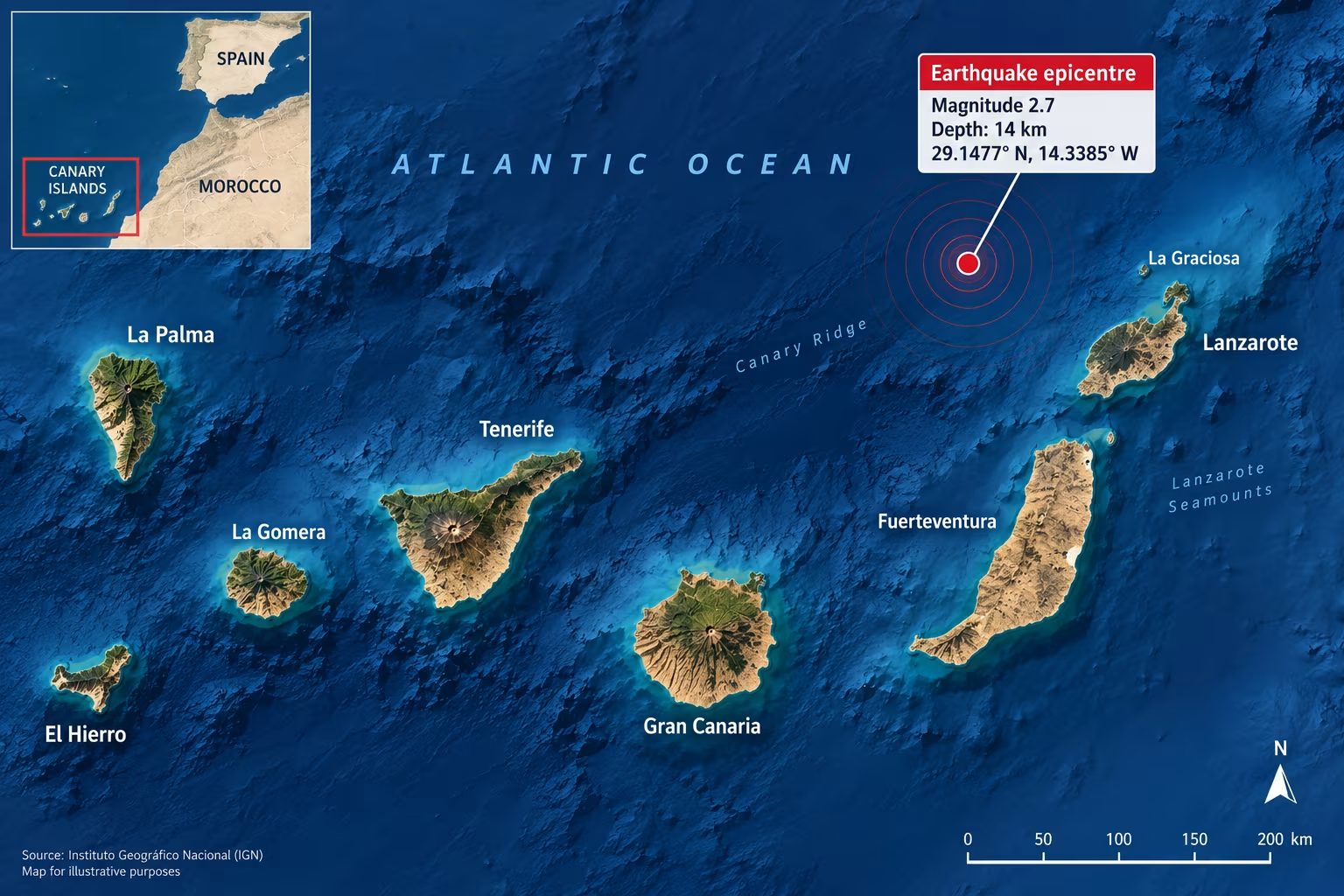
A small earthquake was recorded in the Atlantic to the west of Lanzarote on Thursday, 17 September 2026.
Spain’s National Geographic Institute (IGN) recorded the earthquake at 10:20 UTC, which was 11:20am local time in the Canary Islands. It had a magnitude of 2.7 and was measured at a depth of around 14 kilometres. The IGN located the event in the Atlantic-Canarias area, at 29.1477° north and 14.3385° west.
The earthquake was not reported as being felt by the public.
HOW OFTEN DO EARTHQUAKES HAPPEN AROUND THE CANARY ISLANDS?
Earthquakes are detected regularly across the Canary Islands and the surrounding Atlantic. The IGN's monitoring records show numerous small seismic events, most of which are never noticed by people on the islands.
For some perspective, the IGN reported that 135 earthquakes were located in the wider Canary Islands area during August 2026. That figure covers the whole archipelago and surrounding area, rather than Lanzarote alone, so it should not be interpreted as 135 earthquakes on Lanzarote.
Earthquakes are not unusual in the Canary Islands. Seismic activity is monitored across the archipelago, with areas around Tenerife, La Palma and El Hierro often recording more activity that Lanzarote.
WHY DON'T WE NORMALLY FEEL THEM?
Whether an earthquake is felt depends on several factors, including its magnitude, depth, distance from populated areas and the type of ground beneath a location.
A magnitude 2.7 earthquake is relatively small. When an event also occurs offshore and several kilometres beneath the seabed, the movement reaching the surface can be too weak for people on land to notice.
LANZAROTE IS A VOLCANIC ISLAND — DOES THIS MEAN A VOLCANO IS BECOMING ACTIVE?
Not from this earthquake alone.
Lanzarote's volcanic landscape is a reminder of its geological history, but a single small earthquake is not, by itself, evidence that an eruption is approaching.
The IGN operates a volcanic and seismic monitoring network across the Canary Islands, looking at earthquakes alongside other measurements such as ground deformation and other volcanic indicators. Its monitoring network includes seismic stations in Lanzarote, including stations in Yaiza, Tinajo and Haría.
WHAT DOES THIS MEAN FOR PEOPLE HOLIDAYING IN LANZAROTE?
For visitors enjoying a holiday in Lanzarote, there is no indication from this particular 2.7 magnitude earthquake that normal tourism activities are affected.
Many people living in Lanzarote for years will never knowingly feel one of these small offshore earthquakes. They may only hear about them afterwards when the IGN publishes its measurements.
THE BOTTOM LINE
The 2.7 magnitude earthquake recorded offshore from Lanzarote on 17 September was a small seismic event, approximately 14 kilometres deep, and there were no reports of it being felt by the public.
Small earthquakes are detected regularly in the wider Canary Islands region. Most are minor and many are never noticed at all.
So while the word “earthquake” can understandably catch people's attention, this particular event is much more a piece of interesting geological news than something that should change holiday plans.