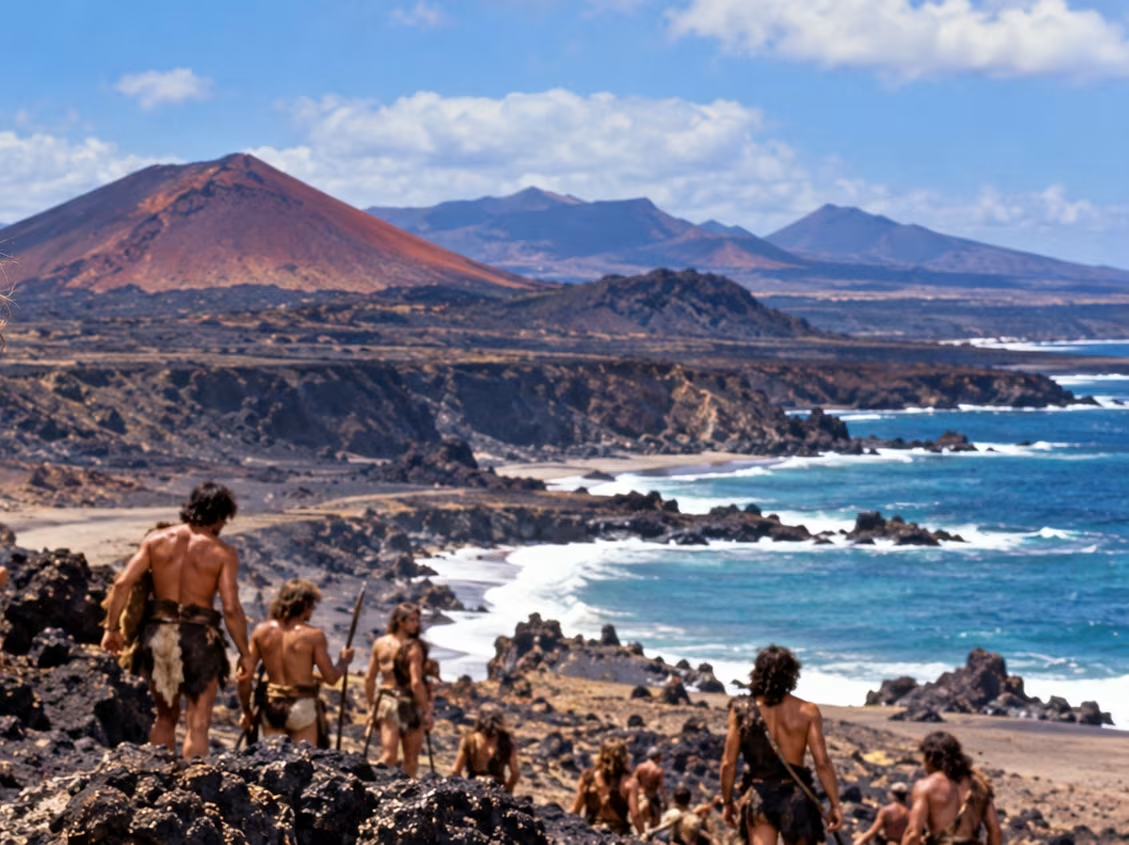

ONE MILLION YEARS B.C.: THE RAQUEL WELCH FILM THAT TURNED LANZAROTE INTO PREHISTORIC LAND
If you have ever looked across the volcanic landscape of Lanzarote and thought it would make the perfect film set, you would not be the first. More than 60 years ago, one of the island’s most dramatic landscapes became the setting for one of the most memorable fantasy films of the 1960s.
The film was One Million Years B.C., the 1966 Hammer Films adventure starring Raquel Welch and John Richardson. Although the story was supposed to take place in an imaginary prehistoric world, the filmmakers found much of what they needed in the Canary Islands — and Lanzarote played a particularly important part.
RAQUEL WELCH COMES TO LANZAROTE
Raquel Welch was still a young actress when she travelled to the Canary Islands for the production. She played Loana, a member of the peaceful Shell Tribe, alongside John Richardson as Tumak.
The film was directed by Don Chaffey and produced by Hammer Film Productions, with special effects created by the legendary Ray Harryhausen, one of the great pioneers of stop-motion effects.
The production is generally dated to 1965–1966. Production records give the filming period as 18 October 1965 to 7 January 1966, with extensive location work taking place in the Canary Islands during the winter.
That winter filming produced one of the film’s great curiosities: while the scenery looked hot, remote and prehistoric, the cast and crew were actually working in sometimes very cold conditions. Welch later recalled filming in the islands during winter and described the difficult conditions she experienced, including becoming seriously ill with tonsillitis.
WHERE WAS ONE MILLION YEARS B.C. FILMED IN LANZAROTE?
Lanzarote was one of the film’s most important locations. The island’s young volcanic landscape was almost tailor-made for the prehistoric world the filmmakers wanted to create.
Among the Lanzarote locations associated with the production were:
• Timanfaya — the spectacular volcanic landscape provided some of the film’s most convincing prehistoric scenery.
• Papagayo — the beaches were used for scenes involving Loana and the Shell Tribe.
• Famara — Lanzarote’s huge natural beach and surrounding cliffs were used for spectacular sequences.
• El Golfo and Lago Verde — the unusual volcanic landscape around the green lagoon also featured in the production.
• Cueva de los Verdes — historical film records also identify this volcanic cave system as one of the Canary Islands locations used by the production.
One of the cleverest aspects of the film is that viewers are rarely aware that different Canary Islands locations have been combined to represent one enormous prehistoric landscape. Lanzarote’s lava fields could be cut together with Tenerife’s high-altitude volcanic scenery, creating a fictional world that appeared to stretch for miles.
FAMARA AND THE FAMOUS BEACH SCENES
Famara is particularly interesting for film fans. Lanzarote Film Commission identifies the beach as one of the locations used in One Million Years B.C., and it is associated with spectacular scenes involving Raquel Welch and the prehistoric flying creatures.
Today, Famara is much better known for surfing, walking and its enormous natural beach, but its cinematic history goes back to the 1960s.
For visitors standing on Famara today, it can be difficult to imagine the beach as a prehistoric movie set. That contrast is part of what makes Lanzarote’s film history so fascinating.
THE FAMOUS RAQUEL WELCH IMAGE
There is no escaping the image that made One Million Years B.C. famous.
Welch’s costume — a fur-style prehistoric bikini — became one of the most recognisable promotional images in cinema history. The publicity campaign helped turn the young actress into an international star.
The film itself was an adventure fantasy about prehistoric tribes living alongside dinosaurs. Scientifically, of course, humans and dinosaurs did not live together, but scientific accuracy was never the point. The film was designed as spectacular escapist entertainment.
The combination of Lanzarote’s volcanic scenery, Harryhausen’s stop-motion dinosaurs and Welch’s striking screen presence proved enormously effective.
HOW SUCCESSFUL WAS THE FILM?
Very.
One Million Years B.C. became one of Hammer Film Productions’ biggest successes. Contemporary and historical box-office records show that the film made a substantial profit and became one of the most popular films at the British box office in 1967.
Sources record a production budget of approximately £422,816. Fox records cited in film histories indicate that the film generated about $4.425 million in rentals against a break-even figure of $2.25 million, while other sources put its international box-office take at more than $8–9 million.
The exact figure varies depending on whether a source is referring to gross box office, distributor rentals or a particular territory, but there is no real doubt about the overall verdict: One Million Years B.C. was a major commercial success.
It also became particularly famous because of its marketing. Raquel Welch’s promotional image became arguably even more famous than the film itself.
A FILM MADE BEFORE CGI
Modern audiences are used to computer-generated dinosaurs, but One Million Years B.C. was made decades before digital effects existed.
The dinosaurs were brought to life using stop-motion techniques associated with Ray Harryhausen. Models were animated frame by frame and combined with live-action footage.
This was painstaking work. The film’s dinosaurs, including the giant creatures attacking the human characters, were not computer generated. They were carefully designed and animated physical models.
The production even had to use miniature effects for volcanic activity. Because there was no convenient active volcano available for the required effect, a small artificial volcano was constructed for studio work.
RAQUEL WELCH AND THE CANARY ISLANDS
Welch’s trip to the Canary Islands became an important chapter in her career. One Million Years B.C. was a breakthrough role and transformed her into an international star.
Her later recollections of the production also give an insight into just how different film-making was in the 1960s. Location filming meant physically transporting cast, crew and equipment to remote volcanic landscapes rather than relying on digital backgrounds or modern studio technology.
The Canary Islands were ideal because they offered an extraordinary variety of landscapes within a relatively small area: black volcanic lava, barren mountains, beaches, cliffs and dramatic high-altitude terrain.
LANZAROTE'S UNEXPECTED FILM LEGACY
One Million Years B.C. is particularly significant in Lanzarote’s history because it was one of the earliest major international productions to use the island's landscapes so prominently.
The film helped demonstrate something that filmmakers would return to again and again: Lanzarote could stand in for places that did not exist anywhere else.
Its volcanic scenery could represent another planet, another era or another world entirely.
Over the decades, many other productions have followed, but One Million Years B.C. remains one of the most famous examples because of the combination of Raquel Welch, dinosaurs, Ray Harryhausen’s effects and Lanzarote’s extraordinary volcanic scenery.
CAN YOU STILL VISIT THE FILM LOCATIONS?
Yes — although you should remember that the island has changed considerably since the 1960s and some locations are now protected.
Timanfaya is now one of Lanzarote’s most important protected natural areas and a major tourist attraction. Visitors can experience the volcanic landscape, but should stick to authorised routes and viewing areas.
Famara remains one of the island’s most spectacular beaches, while Papagayo is famous for its clear water and dramatic volcanic surroundings. El Golfo and Lago Verde are also popular stops for visitors exploring Lanzarote’s western coastline.
In other words, you can visit many of the landscapes that helped create the imaginary prehistoric world of One Million Years B.C. — but thankfully, you are unlikely to encounter a dinosaur.
THE LANZAROTE CONNECTION THAT STILL CAPTURES THE IMAGINATION
More than half a century after the cameras arrived, One Million Years B.C. remains a fascinating piece of Lanzarote film history.
The movie may have been about dinosaurs and prehistoric tribes, but its real-life story is just as interesting: a young Raquel Welch travelling to the Canary Islands, a British film crew working through winter, stop-motion dinosaurs being combined with spectacular real landscapes, and Lanzarote providing scenery so extraordinary that it could convincingly pass for another world.
For anyone interested in Lanzarote history, famous films filmed in Lanzarote or the island’s volcanic landscapes, One Million Years B.C. is a fascinating reminder that Lanzarote has been a cinematic star for far longer than many visitors realise.