

WHY DOES LANZAROTE LOOK SO DIFFERENT FROM OTHER CANARY ISLANDS?
The Canary Islands are famous for sunshine, beaches and beautiful scenery, but each island has its own personality. Tenerife has Mount Teide and lush northern landscapes, while Gran Canaria ranges from green valleys to sweeping sand dunes. Lanzarote is different: black lava fields, rust-coloured mountains, whitewashed villages and wide-open volcanic scenery can make parts of the island feel almost otherworldly.
A LANDSCAPE SHAPED BY VOLCANOES
Like the other Canary Islands, Lanzarote was formed by volcanic activity. Its landscape was dramatically shaped by eruptions between 1730 and 1736 in the area now associated with Timanfaya National Park. Lava covered farmland and settlements and created extensive fields of solidified rock. Today, visitors can see jagged black lava, volcanic cones and mountains in shades of red, brown, ochre and charcoal. The contrast between dark rock, blue sky and the Atlantic is one of Lanzarote’s most recognisable features.
WHY IS LANZAROTE SO DRY?
Lanzarote generally receives relatively little rainfall, so its vegetation differs from the forests and lush greenery found on some other islands. Hardy shrubs, succulents and drought-resistant plants grow where conditions allow. The sparse vegetation also exposes the island’s geology. Lanzarote is not completely barren, though: around Haría and in parts of the north, visitors can find palm trees, agricultural land and greener valleys that look very different from the lava fields in the south.
THE FAMOUS WHITE HOUSES
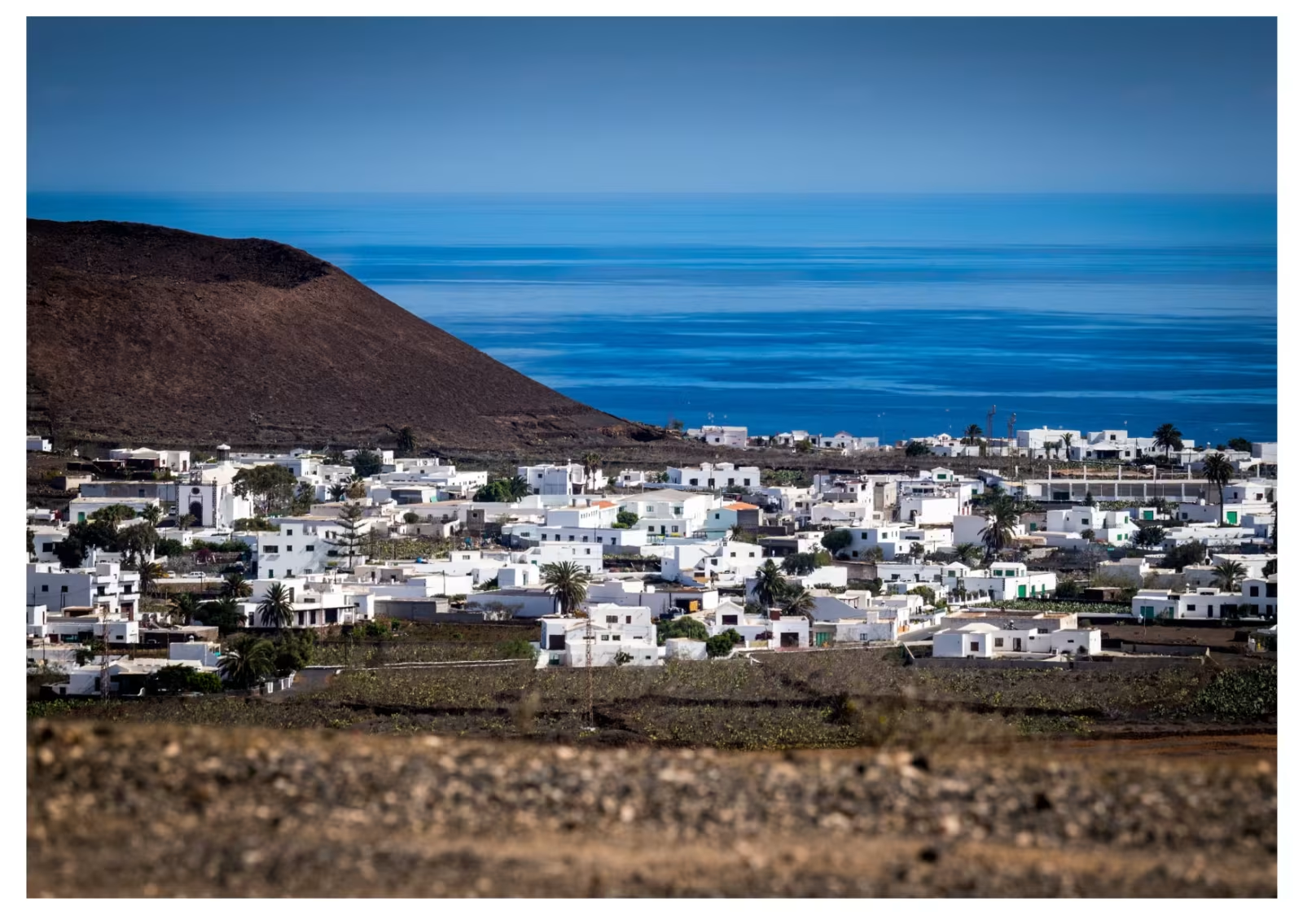
Traditional whitewashed houses stand out against the volcanic landscape. White exteriors reflect sunlight and help keep buildings cooler, while green or blue doors and shutters add colour. Many villages have retained a low-rise, traditional appearance, giving them a distinctive character. A cluster of white houses against a dark volcanic hillside can be as memorable as one of the island’s major attractions.
CÉSAR MANRIQUE’S INFLUENCE
Lanzarote-born artist, architect and environmental campaigner César Manrique believed that development should work with the island’s natural surroundings rather than overwhelm them. His influence can be seen at attractions including Jameos del Agua, Mirador del Río and the Monumento al Campesino. These places combine art, architecture and the natural environment. Manrique helped promote a vision of tourism that respected Lanzarote’s landscape and traditional character, and his legacy remains an important part of the island’s identity.
A DIFFERENT KIND OF NATURAL BEAUTY
Lanzarote’s appeal often lies in contrasts. At El Golfo, the green waters of Charco de los Clicos sit beside dark volcanic terrain. At Los Hervideros, waves crash against rugged lava formations, while the Famara coastline pairs enormous cliffs with a broad Atlantic beach. In La Geria, vines grow in volcanic ash inside curved stone hollows that shelter them from the wind. These vineyards show how local growers adapted to challenging conditions.
WORTH EXPLORING BEYOND THE RESORTS
Absolutely. Puerto del Carmen, Playa Blanca and Costa Teguise are popular for good reason, but the island offers traditional villages, volcanic landscapes, César Manrique attractions, local wines and changing coastal scenery. A hire car can make exploring easier, although organised excursions and public transport can also help visitors discover more of the island.
FINAL THOUGHTS
Lanzarote may be part of the Canary Islands, but its volcanic scenery, distinctive architecture and efforts to protect its character give it an identity all its own. For some visitors, the landscape is the first attraction; for others, it is the relaxed atmosphere, traditional villages or the chance to experience something different from a conventional beach holiday. Whatever brings you here, Lanzarote’s unusual beauty is difficult to mistake for anywhere else.
