
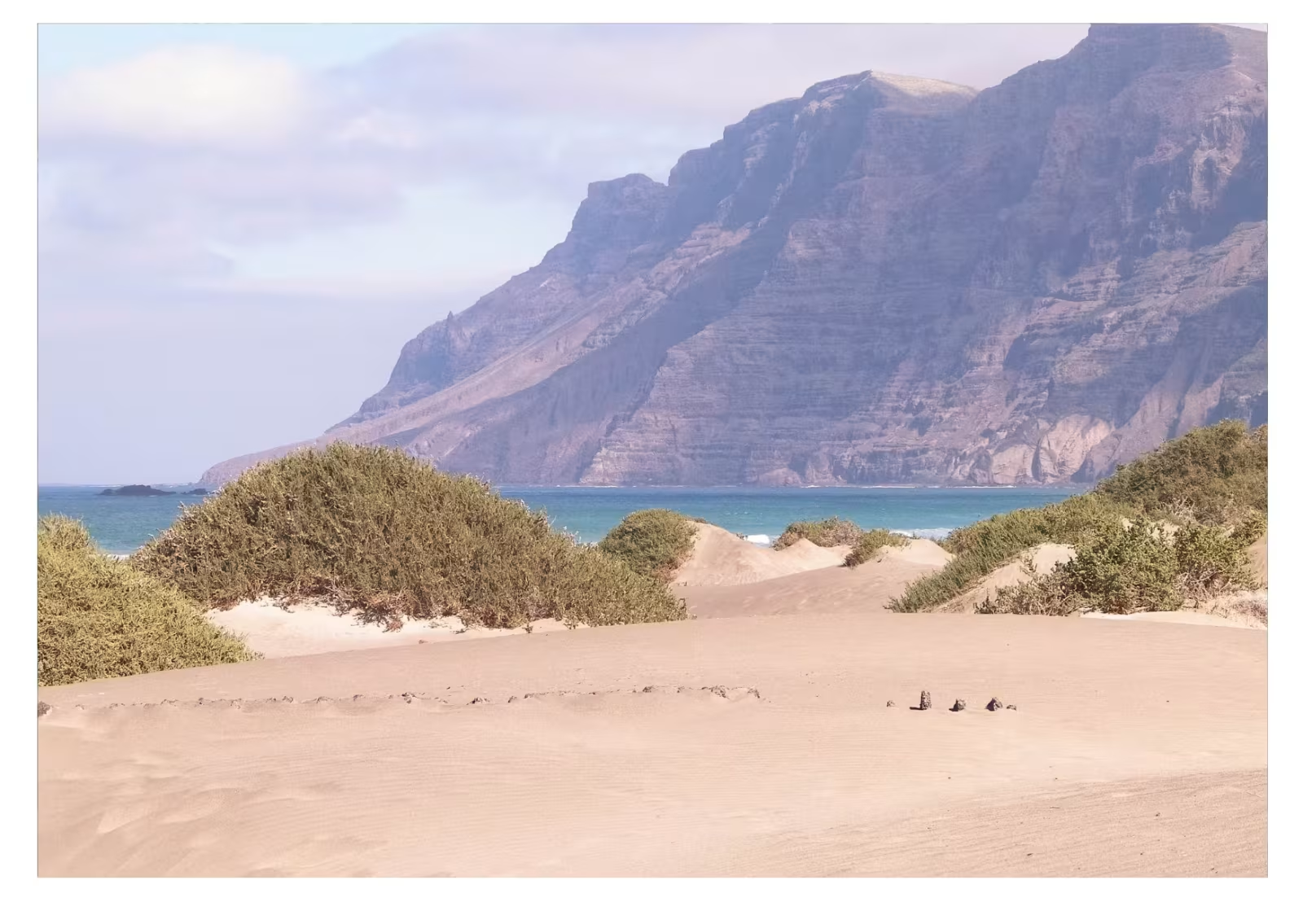

DID YOU KNOW? THE CLIFFS OF FAMARA ARE A BOTANICAL TREASURE TROVE
The towering cliffs of Famara are famous for their dramatic views across the north of Lanzarote towards La Graciosa. But there is another reason this rugged landscape is so special: the Famara massif is home to an extraordinary concentration of plant life found nowhere else in the world.
Despite Lanzarote's dry climate and volcanic appearance, the cliffs and ledges of Famara provide a refuge for rare and endemic plants. In fact, Turismo Lanzarote describes the massif as having the highest number of endemic botanical species per square kilometre in Europe.
WHAT MAKES FAMARA SO SPECIAL?
The north of Lanzarote has a different feel from the island's drier southern landscapes. The high cliffs interact with the trade winds and passing clouds, creating local conditions that can be cooler and more humid than the exposed lowlands.
The steep slopes, rocky ledges and variety of soils provide many small habitats. Some plants grow in cracks in the rock, while others survive on narrow terraces where a little soil and moisture collect. The difficult terrain has also helped protect some species from disturbance.
The Canary Islands Government's planning documents for the Chinijo Archipelago and Famara describe the cliffs as an area of exceptional botanical value. They record numerous endemic plants, including species restricted to Lanzarote or to very small parts of the island.
PLANTS WITH FAMARA IN THEIR NAME
Some of the best-known examples carry the name of the place where they grow. These include the Famara daisy, Argyranthemum maderense, and Famara tajinaste, Echium famarae.
There are also much rarer plants that most visitors will never notice unless they know where to look. The Guinate rockrose and Famara rockrose are two local endemics found in very restricted areas of the cliffs. The Canary Islands Government approved a recovery plan for these plants because their populations are limited and vulnerable.
The official plan explains that they grow on small, steep ledges with very little soil. Damage from trampling and grazing can remove the thin layer of ground they depend on. That makes the protection of their habitat especially important.
A LANDSCAPE WORTH MORE THAN A PHOTOGRAPH
For visitors, Famara is often associated with the long beach, surfing, walking trails and spectacular viewpoints. The cliffs are also an important part of the protected natural area of the Chinijo Archipelago and Famara.
If you visit, take time to look at the landscape beyond the famous views. The small plants clinging to the rock are part of what makes this corner of Lanzarote so remarkable. Please stay on marked paths, avoid picking flowers and do not climb onto fragile ledges in search of plants. Some of these species have extremely limited distributions, and a little care helps protect them.
So the next time you look up at the Risco de Famara, remember that this is not simply a dramatic wall of volcanic rock. It is also one of Europe's most important little pockets of botanical diversity.