
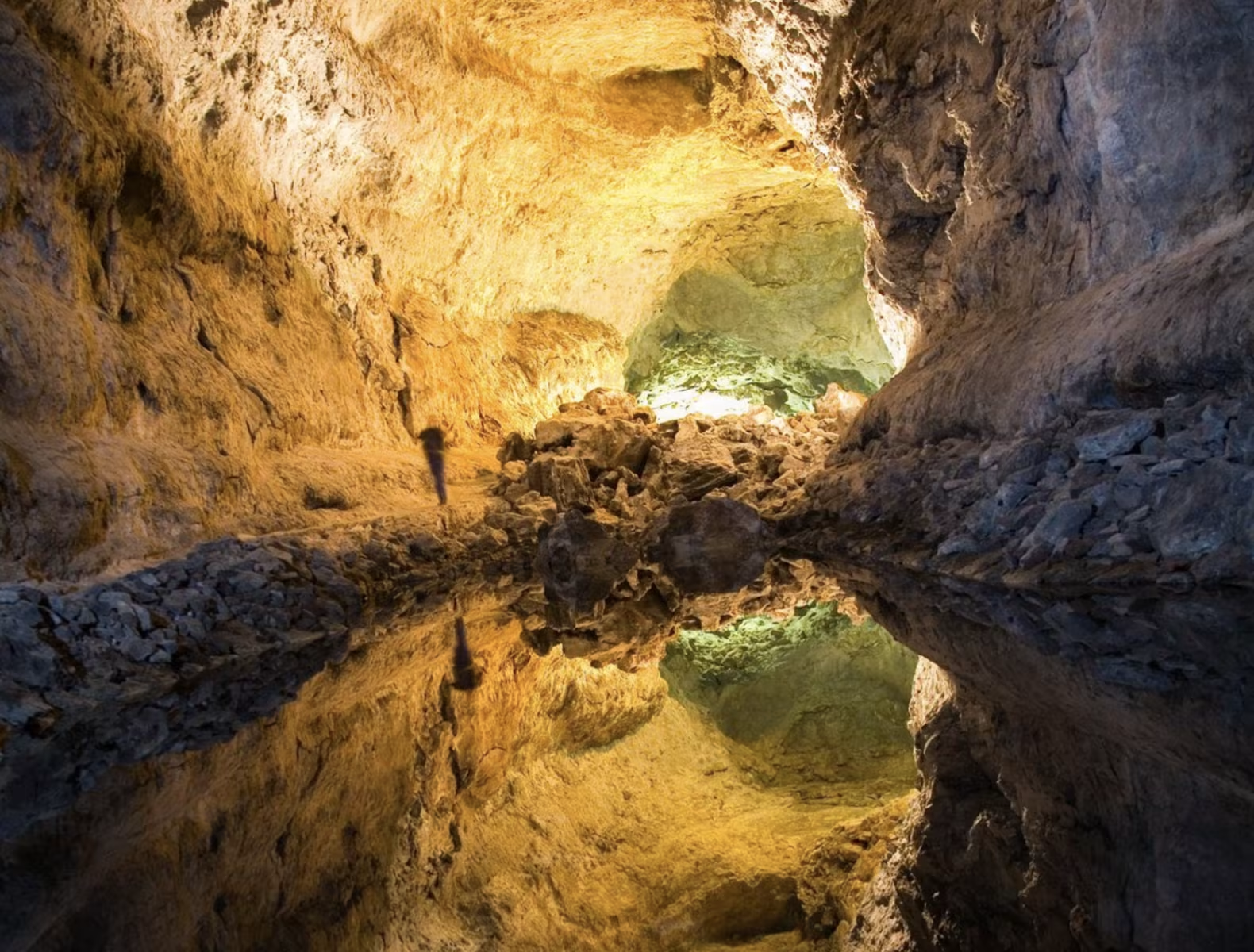

Did You Know? A Volcanic Tunnel Runs for Kilometres Beneath Lanzarote
Explore the remarkable La Corona lava tube, Cueva de los Verdes and the underwater Túnel de la Atlántida
Lanzarote’s volcanic history is easy to see above ground, from the dramatic cones of the north to the vast lava fields around Timanfaya. But one of the island’s most extraordinary volcanic features is hidden underground: a natural tunnel formed by flowing lava that stretches for several kilometres from the slopes of La Corona volcano towards the coast.
The tunnel system was created during the eruption of La Corona in the north of Lanzarote. As lava travelled downhill, the outer surface cooled and hardened. Molten rock continued to flow through the centre beneath this solid crust. When the eruption’s flow drained away, it left a hollow passage behind — rather like a natural underground pipeline. Over time, sections of the roof collapsed, creating openings and chambers along the route.
Part of this system can be explored at Cueva de los Verdes, one of Lanzarote’s best-known visitor attractions. The guided route takes visitors through around one kilometre of the volcanic tube. Inside, the lighting designed by artist Jesús Soto highlights the colours, textures and unusual shapes left by the lava. There are narrow passages, changes in level and impressive chambers, so visitors should check accessibility information before booking.
The same volcanic system is also home to Jameos del Agua, where artist and architect César Manrique transformed a section of the tunnel into a cultural and leisure space. The word ‘jameo’ refers to a collapsed section of a lava tube, where the roof has fallen in and created an opening. At Jameos del Agua, these natural openings and chambers have been incorporated into a distinctive setting that includes a lake, gardens and an auditorium.
Perhaps the most surprising part of the story is that the tunnel does not stop at the shoreline. A section continues beneath the Atlantic Ocean and is known as the Túnel de la Atlántida. Scientific descriptions of the La Corona system put the main tube at approximately 7.6 kilometres long, including a submerged section of around 1.6 kilometres; measurements that include branches and upper levels can be greater. The entire system is not open for visitors to walk through, and the underwater section is of particular scientific and geological interest.
The formation of the tunnel depended on a very specific combination of conditions: a sustained flow of lava, a crust that cooled quickly enough to contain the molten interior, and a route that allowed the lava to continue moving towards the sea. The result is a rare and fascinating record of how volcanic landscapes develop from the inside out.
If you want to visit, Cueva de los Verdes and Jameos del Agua are both in the north of Lanzarote and can be combined into a day exploring the island’s volcanic heritage. Check official opening information and book ahead where required. At Cueva de los Verdes, the visit is guided, and the natural route includes stairs and narrow sections.
DID YOU KNOW? Beneath the lava fields of northern Lanzarote lies a tunnel system that reaches under the Atlantic. The caves visitors can explore are only accessible sections of a much larger geological feature.
